
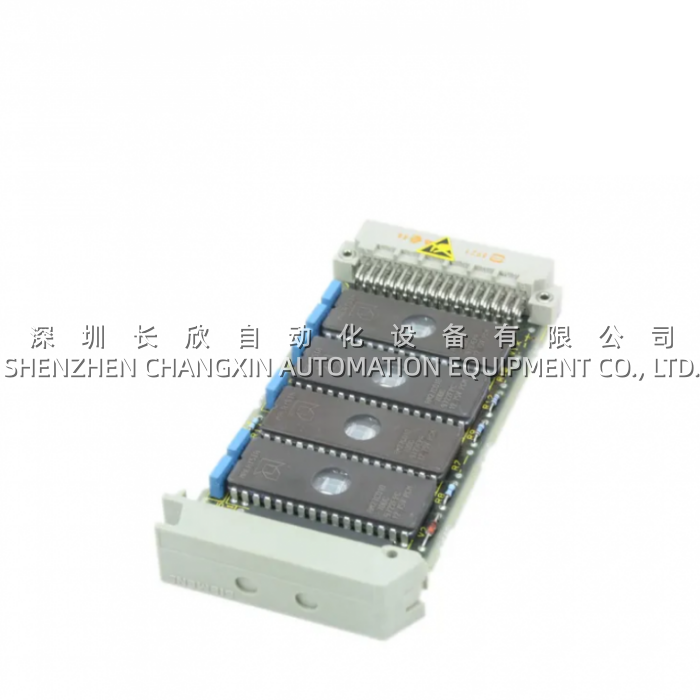
Description
The Siemens 6DD1610-0AG1 is the MS41 Memory Submodule within the SIMADYN D ecosystem—a compact plug-in memory carrier equipped with 512 KB of 16-bit EPROM for program storage and 2 KB of EEPROM for non-volatile data retention, designed to seat directly into the processor boards (PM4, PM5, PM6) of SIMADYN D racks as well as compatible slots on SIMOVERT P 6SE12 and SIMOREG K 6RA24 drive control boards. Unlike volatile RAM submodules, the 6DD1610-0AG1 holds its program image through power cycles without battery backup—making it the “set-and-forget” program-carrier for legacy SIMADYN D lines where the control logic rarely changes but the hardware must survive another decade. Siemens placed the MS41 into PM500 “Discontinued – Deleted Without Replacement” effective October 1, 2017, so verified NOS and tested-pulled units are the only path for the thousands of SIMADYN D / 6SE12 / 6RA24 racks still running worldwide.
Application Scenarios
In a German specialty-steel bar mill, the roughing-stand drive rack runs a SIMADYN D PM5 processor paired with a 6DD1610-0AG1 MS41 holding the 512 KB D7-SYS program (inter-stand tension PID, roll-speed synchronization, loopers). During a scheduled roll-change, a junior technician pulled the 6DD1610-0AG1 to read the EPROM type label and accidentally bent pin 14 on the submodule connector; the rack booted to “Memory Checksum Error” and the stand sat dead—costing ~€3,200/hour in lost bar throughput. The plant’s spare bank had one 6DD1610-0AG1 (sealed NOS from 2009, still good because EPROM doesn’t age like RAM). Swap took 4 minutes: power down PM5 → unclip the submodule → seat the replacement → power up → the PM5 auto-validated the checksum against the backup copy in its internal Flash (on PM5/PM6, there’s also onboard Flash as shadow—but the MS41 is the primary boot source on PM4). The stand was back in 7 minutes total. The plant’s takeaway: “EPROM doesn’t wear, but the pins do—stock one MS41 per PM4/PM5/PM6 processor in the rack.” They now keep three 6DD1610-0AG1 spares for six processors across two mills.
Parameter
| Main Parameters | Value / Description |
|---|---|
| Product Model | 6DD1610-0AG1 |
| Manufacturer | Siemens (SIMADYN D family) |
| Product Category | Memory Submodule (MS41 type) |
| Program Memory | 512 KB EPROM, 16-bit data bus |
| Data Memory | 2 KB EEPROM (non-volatile, limited write cycles) |
| Backup Battery | None (EPROM is non-volatile; EEPROM self-contained) |
| Host Compatibility | SIMADYN D PM4 / PM5 / PM6 processor boards; SIMOVERT P 6SE12; SIMOREG K 6RA24 |
| Mounting | Direct plug-in to processor board submodule socket (keyed) |
| Supply Voltage | 5 V DC (via processor board backplane) |
| Operating Temp. | –25 … +60 °C |
| Weight | ~0.092 kg |
| Dimensions (W × H × D) | 30 × 118 mm (submodule Euro-format) |
| Lifecycle | PM500 Discontinued (Oct 1, 2017, no replacement) |
Technical Principles and Innovative Values
- Innovation Point 1: EPROM + EEPROM Split Architecture. The 6DD1610-0AG1 uses EPROM (UV-erasable or OTP, depending on production batch) for the bulk 512 KB program store—meaning the D7-SYS / CFC project flashed once survives literally forever with power off, no battery drain, no super-cap to reform. The 2 KB EEPROM handles small runtime data (counters, hour-meters, last-fault pointers) that need to persist across cycles but don’t justify RAM + battery. For plants where “the program hasn’t changed since 2004 and shouldn’t change,” this is the ideal memory tier.
- Innovation Point 2: 16-Bit Bus Matching the PM4/PM5/PM6 Core. The 6DD1610-0AG1 runs a 16-bit data bus into the host processor, matching the PM4 (80386EX-based) and PM5/PM6 architecture. This avoids the bus-width translation penalty you’d get with narrower submodules, keeping boot-time EPROM shadow-copy into the processor’s RAM efficient—important when the PM5 is booting a 400 KB+ CFC project and needs to be online before the drive enables release.
- Innovation Point 3: Zero-Configuration Hardware Swap. Unlike battery-backed RAM submodules (MS42/MS43) that need a PG to restore contents after swap, the 6DD1610-0AG1 is “what you flashed is what you get.” Pull from a spare bin, plug into the PM4/PM5/PM6, power up—the processor validates the checksum and runs. This makes the the preferred spare for remote sites where a PG visit costs more than the part.
Application Cases and Industry Value
Case 1 – Wire-Rod Block Drives (Turkey, 2020). A 10-stand wire-rod finish block uses SIMOVERT P 6SE12 inverters, each with a 6DD1610-0AG1 carrying the stand-alone speed-loop + flying-shear sync logic. During a washdown, one inverter’s ventilation flap failed and the cabinet hit 58 °C—still within the 6DD1610-0AG1 –25…+60 range, but the EPROM window seal on that 2002-vintage unit finally gave; moisture creep caused a single bit flip at address 0x7A3C, manifesting as intermittent “speed feedback dropout” faults every 4–6 hours. The plant swapped the 6DD1610-0AG1 for a tested-pulled unit (pre-flashed with the same .bin via PG back at the shop), and the fault pattern vanished. The OEM’s note: “EPROM can fail, but only after 15+ years in humidity—still better than RAM + battery that dies in 7.”
Case 2 – Sectional Paper Drive (Canada, 2022). A 6-stand dryer-section retrofit kept the original SIMADYN D PM4 processors for cost reasons, each wearing a 6DD1610-0AG1 . When the mill upgraded from ProTool-era docs to a digitized spare-parts system, they discovered three of six submodules had date codes from 1999—23 years old. They bought three NOS 6DD1610-0AG1 units, read the EPROM contents from the live units via SIMADYN D PG (“Upload from Module”), burned the images to the new submodules using the Siemens EPROM writer path, and rotated the old ones to the “emergency-only” drawer. Zero downtime, zero project rebuild—the 6DD1610-0AG1 let them “clone and shelf” without touching the D7-SYS source.