
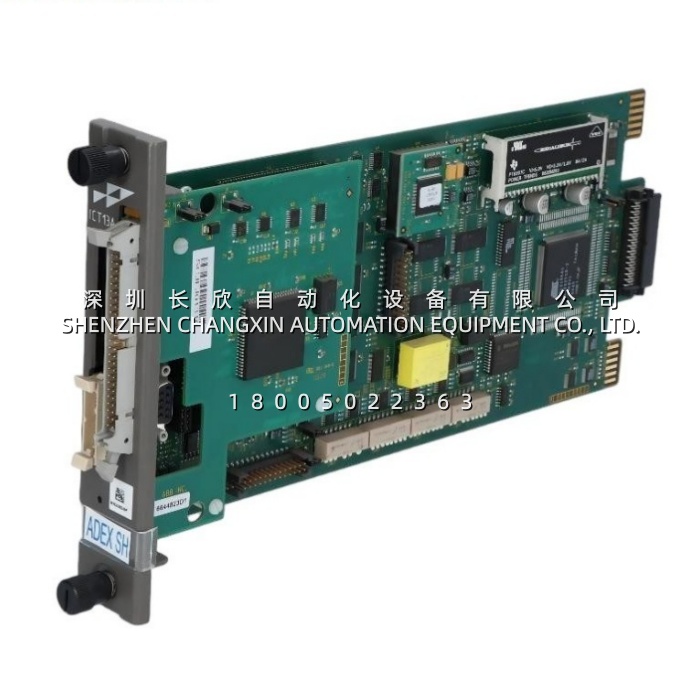
Application Scenarios
A 300 MW thermal power unit commissioned in the early 2000s relied on an INFI 90 DCS to manage boiler and turbine auxiliary systems. When the INICT13A in the central control cabinet began exhibiting communication timeouts, the operator station screens froze intermittently, and historical data logging halted—leaving operators without remote visibility into feedwater pump status and furnace draft pressure. Because the module sits between the INFI-NET coaxial backbone and the computer-side interface, its failure severed the entire plant’s supervisory link, not just a single control loop. The maintenance team sourced a tested replacement and restored data flow during a scheduled outage, avoiding the far costlier alternative of accelerating a full DCS migration. For plants still running Bailey legacy infrastructure, this module’s availability is a direct determinant of whether the control room remains functional.
Parameter
| Main Parameters | Value/Description |
|---|---|
| Product Model | INICT13A (also written ICT13A) |
| Manufacturer | ABB (originally Bailey Controls) |
| Product Category | Infi-Net to Computer Transfer Module (ICI card) |
| System Platform | Bailey INFI 90 / Network 90 / Symphony Harmony |
| Network-Side Interface | INFI-NET coaxial bus, 75 Ω standard, approximately 1 Mbps class |
| Computer-Side Interface | SCSI (primary) + RS-232-C via NTPM01 terminal unit |
| Power Supply | 12 V DC (some sources cite 5 V DC; verify against original cabinet label) |
| Power Consumption | Approximately 3–10 W |
| Operating Temperature | −20 °C to +60 °C (some batches rated −40 °C to +70 °C) |
| Installation | Standard MMU (Module Mounting Unit) slot, horizontal insertion with two panel locking screws |
| Status Indicators | Panel LEDs: power, network activity, fault |
| MTBF | > 50,000 hours (manufacturer sample specification) |
| Lifecycle Status | Discontinued; upgrade path: SPICT13A |
Technical Principles and Innovative Values
- Dual-Role Communication Bridge: The INICT13A does not merely pass data one way. It uploads process values, sequence-of-events records, and alarms from the INFI-NET to the computer side, while also carrying configuration downloads, setpoint changes, and engineering commands from the computer back to the control network. This bidirectional role makes it the single point through which all supervisory interaction flows.
- Hardware-Level Data Integrity: The module performs CRC verification, link self-checking, and automatic retransmission during bus fluctuations using its own onboard processing. This offloads communication overhead from the main controllers, preserving control loop determinism even when the operator station is polling heavily for trend data.
- Redundant INFI-NET Support: The INFI-NET side supports dual-link redundancy, meaning a single coaxial bus failure does not interrupt data exchange between the DCS and the supervisory computer. In plants where the INFI-NET backbone runs through electrically noisy cable trays, this redundancy is a practical safeguard rather than a theoretical feature.
- Legacy Compatibility Without Re-engineering: For existing INFI 90 installations, the INICT13A drops into the standard MMU slot and communicates with the plant’s existing operator stations without requiring changes to the DCS configuration or the computer-side driver stack. This “drop-in” characteristic is its primary value proposition in maintenance scenarios—it preserves a working architecture rather than forcing a migration timeline dictated by a single failed component.