
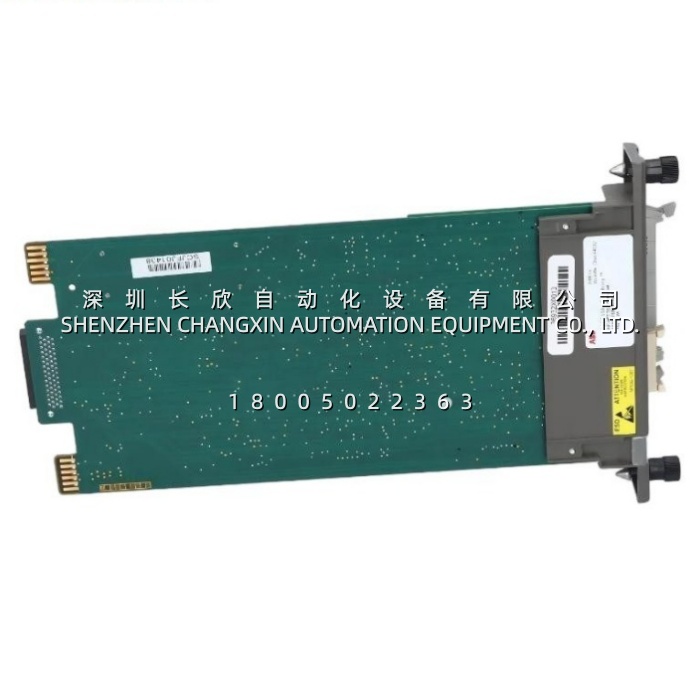
Application Scenarios
Picture a combined-cycle power plant commissioned in the late 1990s with a full ABB Bailey Infi 90 architecture — Bridge Control Units (BCUs) distributed across the boiler, turbine, and balance-of-plant areas, all communicating on the plant-wide INFI-NET loop. The original Operations Conductor operator stations have reached end-of-life, and the plant’s new long-term data historian runs on a modern UNIX-based server that has no native INFI-NET interface. The integrator slots an INICT13A into the host MMU chassis adjacent to the Network Processing Module (NPM), and the module immediately begins buffering incoming INFI-NET telegrams and re-packaging them into standard computer-side protocol frames over the SCSI / RS-232-C link. The pain point resolved is fundamental: the INICT13A lets the plant retain its entire proven Infi 90 control layer — thousands of loop files, group sequences, and BCU configurations that have been tuned over two decades — while opening a clean, buffered, deterministic channel to a modern historian and Enterprise Data Management (EDM) platform. No control-loop re-engineering, no BCU firmware changes, no PLC-DCS protocol gateway ladder to maintain — just one module bridging two eras of control technology.
Parameter
| Main Parameters | Value / Description |
|---|---|
| Product Model | INICT13A (alternate refs: ICT13A, INICT13AR, PINICT13A, YINICT13A) |
| Manufacturer | ABB / Bailey Controls (Elsag Bailey / ABB Bailey Infi 90) |
| Product Category | Infi-Net to Computer Transfer Module (DCS host-communication gateway) |
| System Compatibility | Bailey Infi 90, Network 90, Symphony, Symphony Plus, Harmony |
| Network Side | INFI-NET unidirectional high-speed serial data highway |
| Host-Side Interfaces | SCSI and RS-232-C serial; 32-bit buffered data path |
| Core Function | INFI-NET-to-computer protocol conversion with data buffering |
| Supply Voltage | +5 VDC |
| Current Draw | 2 A nominal |
| Mounting | Bailey MMU (Module Mounting Unit) — standard 19-inch rack chassis |
| Operating Temperature | 0 to 55 °C (32 to 131 °F), standard industrial range |
| Module Weight | 0.5 kg (1.1 lb) typical |
| Module Dimensions | Approx. 16 × 16 × 12 cm (6.3 × 6.3 × 4.7 in.) shipping envelope |
| Cooling | Natural convection through MMU chassis airflow |
| Backplane Communication | Direct insertion into Bailey MMU backplane bus |
| Country of Origin | Sweden / United States |
| Status | Discontinued by manufacturer; supplied as new-surplus or refurbished |
| Tariff / HS Code | 8517620050 |
| Typical Applications | Turbine control & monitoring, real-time information management, fly-ash carbon measurement, multi-fuel flame detection, enterprise MIS integration |
Key annotations: the +5 VDC / 2 A power draw is sourced directly from the Bailey MMU backplane rails — no local power wiring is required at the module face, simplifying replacement and hot-swap discipline; the SCSI and RS-232-C dual host ports of the INICT13A allow a single module to serve both a local engineering laptop (serial) and a plant historian server (SCSI) without an external protocol multiplexer; its role as the successor to the INICT01, INICT03A, and INICT12 makes the INICT13A the final-generation Bailey computer-transfer gateway for both Infi 90 and Harmony-era fleets.
Technical Principles and Innovative Values
- Innovation Point 1 — Deterministic INFI-NET buffering. The INICT13A maintains an onboard buffer that absorbs burst traffic on the INFI-NET unidirectional highway during heavy transaction periods, preventing backplane buffer overrun and ensuring that host-side data acquisition never introduces scan-cycle jitter into the underlying BCU control loops. This is what distinguishes a Bailey transfer module from a generic serial gateway — the buffering is engineered for DCS determinism, not just throughput.
- Innovation Point 2 — Transparent protocol-conversion bridge. The handles the translation between Bailey’s proprietary INFI-NET telegram structure and standard computer-side communications natively, eliminating the need for custom protocol conversion software on the host PC. Data tags, loop parameters, alarms, and diagnostic messages arrive at the host in a structured form that Supervisory Information Software and Enterprise Data Management systems consume directly.
- Innovation Point 3 — Non-intrusive host integration. Because the reads the INFI-NET highway as a passive traffic participant and publishes to the host on an independent physical channel, adding or removing a host computer has zero impact on the BCU control-layer performance. This architectural separation is the core reason Infi 90 plants have historically been able to refresh their operator and historian layers repeatedly without touching the control layer.
- Innovation Point 4 — MMU-native hot-swap discipline. The is designed for the Bailey MMU chassis with guided insertion, backplane-keyed connectors, and retention hardware. Field technicians can follow ABB’s established hot-swap procedure — take the host driver offline, unseat, insert, re-enable — and the module re-establishes communication with the INFI-NET loop without powering down the MMU, a capability that dramatically shortens planned-maintenance windows on continuously running units.
- Innovation Point 5 — Backward compatibility with the Bailey ecosystem. As the successor to the INICT01, INICT03A (Cnet-to-Computer), and INICT12, the preserves the Bailey engineering file structure and point-database conventions across the Net 90 → Infi 90 → Symphony → Harmony evolution. Plants that upgraded from Network 90 to Infi 90 to Symphony Plus could retain the same transfer-module configuration approach throughout, minimizing retraining and engineering rework.
- Innovation Point 6 — Industrial-grade thermal and mechanical envelope. Rated for the 0–55 °C industrial range and packaged for the standard 19-inch Bailey MMU rack, the deploys in turbine-hall and switchgear-room environments without forced air conditioning — a contrast with general-purpose industrial PCs that demand stricter environmental control in the same locations.