
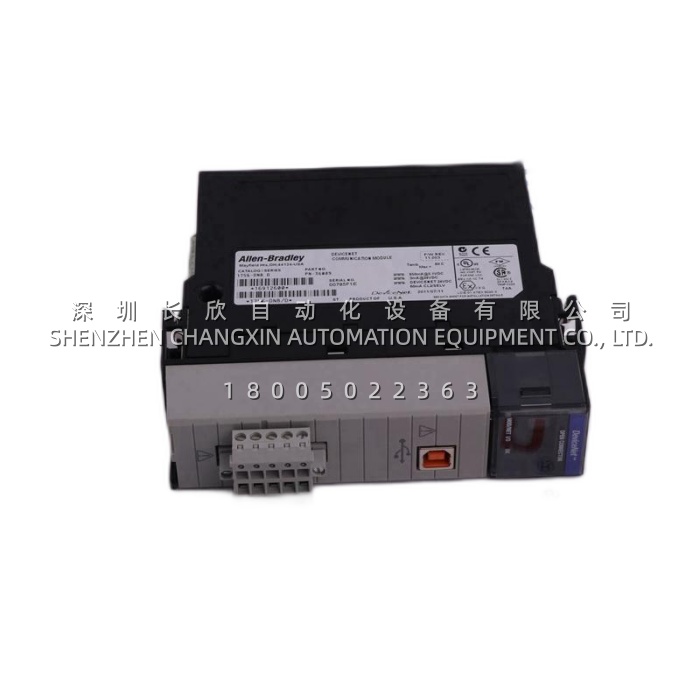
Technical Specifications
| Parameter | Value |
|---|---|
| Product Model | 1756-N2 |
| Manufacturer | Allen-Bradley / Rockwell Automation |
| Product Type | ControlLogix Empty Slot Filler / Blank Dummy Module |
| Function | Mechanical slot closure; no electrical function, no backplane load |
| Compatibility | All 1756 chassis: 1756-A4, A7, A10, A13, A17 (and 1756-A4XT / A8XT) |
| Module Width | 1 slot (standard 1756 single-width form factor, 25.4 mm / 1.0 in. face) |
| Mounting | Snap-in to 1756 chassis guide rails, captive latch, no tools required |
| Construction | High-temperature thermoplastic, color-matched to 1756 module face |
| Electronics / Logic | None — passive device, no PCB, no firmware, no configuration |
| Backplane Current Draw | 0 A at 5.1 V and 24 V rails |
| Environmental Rating | IP20 / UL open-type enclosure front; 0 to 60 °C operating, -40 to 85 °C storage |
| Flammability / Compliance | UL 94 V-0 housing material; RoHS-compliant |
| Dimensions (H×W×D) | 142 × 25.4 × approx. 35 mm (5.59 × 1.00 × 1.38 in.) |
| Weight | Approx. 40 g (0.09 lb) |
| Programming / Software | Not applicable — invisible to RSLogix 5000 and Studio 5000 |
| Approvals | UL, CSA, CE as part of 1756 system environmental rating |
| Lifecycle Status | Active, in-catalog consumable spare |
Main Features and Advantages
It closes the ingress path that every open slot leaves behind
A bare ControlLogix backplane connector is a 5.1 V and 24 V exposed edge, sitting behind a slot that is often inches from a VFD heatsink, a contactor arc chute, or a washdown nozzle. The Allen-Bradley 1756-N2 is shaped to seat flush against the chassis front and ride the same guide rails as a live module, so the dust that settles on the rack stays on the outside of the filler, not on the card-edge fingers. In powder, grain, metal-cutting, and packaging environments, that simple barrier prevents the class of “intermittent backplane communication fault” that disappears the moment someone opens the panel.
One part fits the whole 1756 family
There is no such thing as an N2 that is “for analog only” or “for the L7x chassis.” The 1756-N2 is dimensionally identical to a single-slot 1756 module and locks into every 1756 rack ever shipped. That means one bin label, one part number, and one procurement line for every panel in the plant. When a 1756-IF16 is pulled for calibration or a 1756-EN2T is swapped under warranty, the Allen-Bradley 1756-N2 drops in immediately and the rack stays sealed until the replacement returns from the bench.
Zero configuration, zero surprise
Unlike a real I/O module, the 1756-N2 cannot fault the controller, cannot mismatch an electronic key, and cannot be loaded with the wrong firmware. It does not appear in the I/O tree, does not consume a connection, and does not change the slot count seen by the 1756-Lx processor. A technician with no Logix training can fit one correctly on the first try. For contract electricians and night-shift maintenance, that predictability is unusual enough to be worth calling out.
It makes the panel readable at a glance
A partially loaded rack with open slots looks, to the next person on the call-out, like a work-in-progress or a missing device. Filling those slots with the 1756-N2 turns the rack into a finished drawing: populated slots are clearly live, blanks are clearly intentional. Add a label under each filler with the planned future module type — “slot 6: 1756-OB16E, spare” — and the Allen-Bradley 1756-N2 becomes a static planning tool that survives crew changes and shift handovers.
Cheap insurance with no failure mode
There is nothing to test, no battery to replace, and no calibration to drift. The worst that happens to a 1756-N2 is a cracked latch or a lost unit, both of which are visible and both of which are fixed in seconds. Stocking a box of them is the closest thing in industrial automation to a free win: the cost is trivial, the downside of not having one is a contaminated backplane, and the installation is tool-free.