
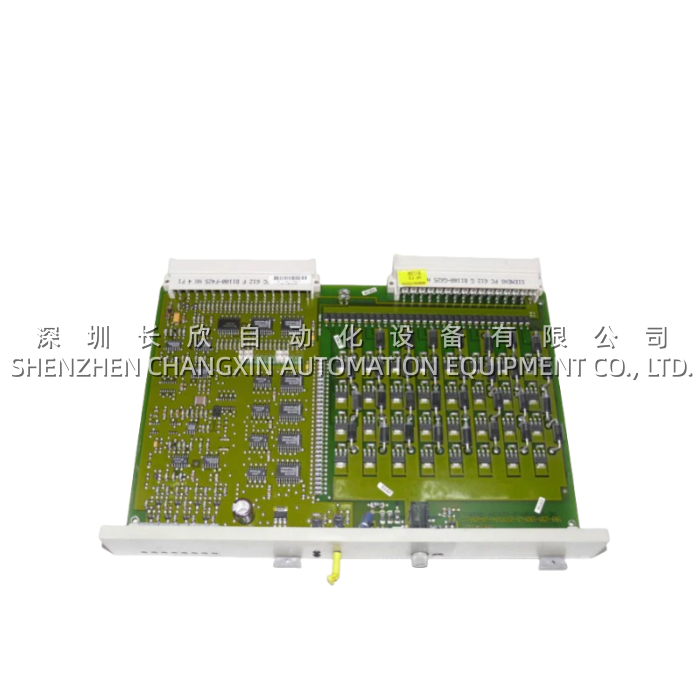
Product Overview
The Siemens 6DS1603-8RR is a Teleperm M series analog input module — specifically an 8-channel thermocouple and resistance-thermometer (RTD) input card — designed to plug into the process I/O subrack of a Teleperm M AS 220 or AS 260 automation station. Teleperm M, for context, is Siemens’ dedicated power-plant DCS platform (1980s–2000s era, predecessor path: Teleperm M → SPPA-T2000 → PCS 7 Power Control Library), deployed across fossil-boiler, combined-cycle, hydro, and large-process-industrial sites where the automation station needed galvanically clean analog acquisition for slow-to-medium temperature loops. The 6DS1603-8RR sits on the Teleperm M SG system bus inside the AS 220/260 rack, exchanging converted binary values (12-bit + sign per channel) with the AS CPU, which runs the cyclic/event task programs (CFC/FB libraries for combustion, turbine aux, balance-of-plant).
Per-channel, the Siemens 6DS1603-8RR accepts a wide sensor menu: Pt100, Ni100, Cu10 resistance thermometers, and Fe-CuNi (type J), NiCr-Ni (type K) thermocouples — measurement spans from –200 °C to +850 °C depending on sensor type. Each channel is independently galvanically isolated (2.5 kV test voltage, channel-to-channel and channel-to-ground), a design choice driven by power-plant reality: ground-potential differences between a boiler wall thermowell, a bearing pedestal RTD, and a flue-gas TC junction can be tens of volts on an ungrounded loop, and shared-return AI cards would rail. The 6DS1603-8RR integrates its own A/D per channel (not a multiplexed single ADC), signal-conditioning op-amps, and automatic cold-junction compensation (CJC) referenced to the card’s own ambient sensor — critical because TC readings are difference between hot-junction and cold-junction (terminal block), and the 6DS1603-8RR lands the TC wires directly on its front terminal (CJC sensor is on-card near the terminals). Linearization for each TC/RTD curve is done in the card’s local logic before handing the binary value to the AS CPU, offloading the AS scan.
Conversion time is configurable per channel in the ~10 ms to ~50 ms range (slower = more averaging, better rejection of 50 Hz hum from nearby CT/VT cables in the MCC). Open-wire (break) detection is built in — if a TC lead fractures or an RTD 3-wire leg loosens, the Siemens 6DS1603-8RR flags the channel and the AS CPU can force the associated PID to manual / alarm the burner-management system. The card draws 24 V DC from the Teleperm M subrack backplane (fed by the rack’s PS), weighs ~0.4 kg, form-factor ~100 × 65 × 35 mm (plug-in card, not a S7/DIN单体), and mounts by edge-connector into the AS 220/260 I/O subrack slots (mixed with other 6DS1 cards: 6DS1601 AI voltage, 6DS1602 AO, 6DS1611 DI, 6DS1612 DO, 6DS1613 AI high-speed, etc.).
Lifecycle: Teleperm M as a platform is PM500 / long-discontinued (Siemens steered power-plant new builds to SPPA-T2000 then PCS 7), so the 6DS1603-8RR is spare-demand only. Thousands of AS 220/260 stations are still live in coal/gas/CHP plants globally — the 6DS1603-8RR is procured as “run-spare” because a single failed TC channel on a boiler-wall temp loop can force a BMS trip if the redundancy isn’t there.
Technical Specifications
| Parameter Name | Parameter Value |
|---|---|
| Product Model | 6DS1603-8RR |
| Manufacturer | Siemens |
| Product Type | Analog Input Module (Thermocouple / RTD) |
| Series / Platform | Teleperm M (AS 220 / AS 260 automation station) |
| Number of Channels | 8 (independent, isolated) |
| Input Signal Types | Pt100, Ni100, Cu10 (RTD, 2-/3-/4-wire); Fe-CuNi (J), NiCr-Ni (K) thermocouple |
| Measurement Range | –200 … +850 °C (dependent on sensor type) |
| Resolution | 12 bit + sign |
| Conversion Time | ~10 ms … ~50 ms per channel (configurable) |
| Galvanic Isolation | Channel-to-channel & channel-to-ground, 2.5 kV test |
| Cold-Junction Compensation | Built-in (on-card CJC sensor at terminal block) |
| Linearization | Built-in per TC/RTD curve (card-level, offloads AS CPU) |
| Open-Wire Detection | Yes (per channel, break monitoring) |
| Supply Voltage | 24 V DC (from Teleperm M subrack backplane) |
| Communication Bus | Teleperm M SG system bus (to AS 220/260 CPU) |
| Mounting | Plug-in card, Teleperm M I/O subrack (AS 220/260) |
| Dimensions (L × W × D) | ~100 × 65 × 35 mm |
| Weight | ~0.4 kg |
| Operating Temperature | 0 … +60 °C |
| Storage Temperature | –25 … +70 °C |
| Lifecycle Status | PM500 – Discontinued (Teleperm M platform) |
Main Features and Advantages
Channel-to-channel isolation for power-plant ground-loop immunity
The headline spec of the Siemens 6DS1603-8RR is the fully independent galvanic isolation per channel (2.5 kV test, channel↔channel and channel↔ground). In a 500 MW coal unit, TC/RTD fields on the same AS 220 rack might include: boiler water-wall TCs (grounded at the thermowell to the pressure-part), HP/IP bearing RTDs (grounded to the turbine pedestal, which sits on insulating pads but leaks ~5 V to plant earth), and flue-gas duct TCs (grounded to the duct, which ties to structural steel). A non-isolated multiplexed AI card would see those 5–10 V ground-potential differences as common-mode on the ADC mux and either rail or read drift. The 6DS1603-8RR isolates each channel’s front-end op-amp and A/D behind its own DC/DC + digital isolator, so the boiler-wall TC at –20 mV (J-type, 400 °C) and the bearing RTD at 110 Ω (Pt100, 25 °C) sit on different local grounds and the card doesn’t care. This is why the 6DS1603-8RR was the default TC/RTD card on Teleperm M AS 220/260 instead of the cheaper 6DS1601 (voltage/current AI, typically less isolation, more shared-return).
On-card CJC + linearization = AS CPU offload
A thermocouple reading is T_hot − T_cold, where T_cold is the terminal-block temperature. The Siemens 6DS1603-8RR carries its own CJC sensor (usually a small bead thermistor or diode) mounted on the PCB near the front terminal block, so the card knows T_cold locally and adds it back before handing the binary value to the AS CPU. No “CJC compensation in the AS FB” needed — the 6DS1603-8RR delivers engineering-unit °C (or raw mV if the AS config asks for it) already linearized per J/K/NiCr-Ni curve in the card’s lookup ROM. The AS CPU’s cyclic task (typically 100 ms–500 ms on Teleperm M AS 220) therefore doesn’t burn scan time on polynomial TC linearization for 8 channels — it just reads the prepared binary. For plants that added the 6DS1603-8RR late in a Teleperm M lifecycle (say a 2005 boiler retrofit on a 1996 AS 220), the offload mattered because the AS CPU was already loaded on combustion-FB + BMS-FB + turbine-aux-FB.