
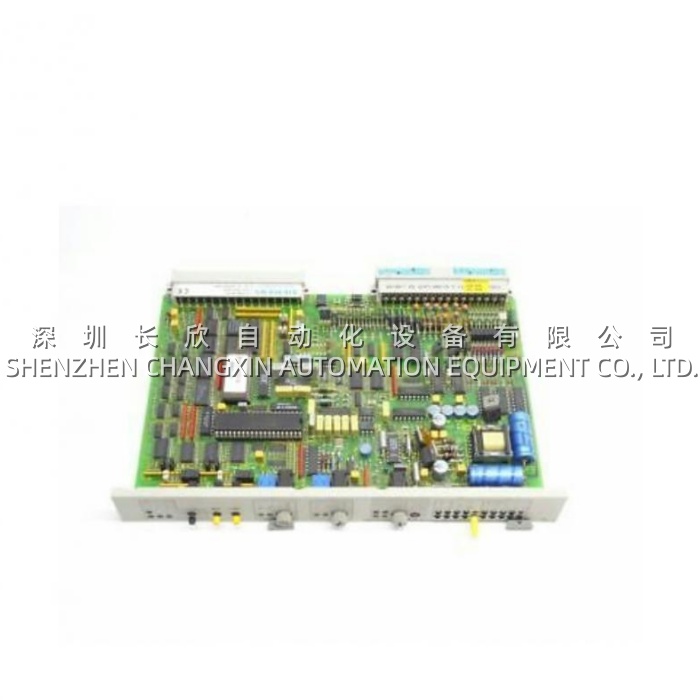
Product Overview
The 6DS1603-8RR is a Siemens Teleperm M digital input (DI) module belonging to the DS1603 I/O family, engineered specifically for the Teleperm M distributed control system (DCS) that dominated power-generation and heavy-process automation from the 1980s through the early 2000s. While Teleperm XP (covered earlier) succeeded Teleperm M in many retrofits, the 6DS1603-8RR remains actively maintained in legacy cabinets—particularly in turbine-protection, boiler-interlock, and generator-auxiliary loops where recertifying a migrated safety loop is prohibitively expensive. The module provides 16 galvanically isolated 24 V DC digital input channels, each capable of sensing dry-contact or NAMUR proximity-sensor signals with a 3 ms input filter to suppress contact bounce and electrical noise typical of power-plant environments. Its “8RR” suffix denotes the reverse-polarity-protected variant with enhanced channel isolation, making it the preferred choice for safety-critical loops where wiring errors or transient back-EMF from solenoid valves could otherwise damage the module or trigger false trips.
In a Teleperm M rack (typically AS220 or AS230 automation stations), the 6DS1603-8RR interfaces directly with the system bus via a 50-pin ribbon-cable connector, relaying discrete status data—valve limit switches, motor-run confirmations, pressure-switch contacts, turbine-bearing vibration trips—to the central automation processor. Unlike later S7 or PCS 7 I/O, Teleperm M modules like the 6DS1603-8RR are deeply integrated with the system’s proprietary bus protocol, requiring no GSD files or Profibus configuration; the module’s identity and channel mapping are hardcoded into the Teleperm M engineering database. This tight coupling ensures deterministic scan times (<10 ms for typical DI updates) critical for turbine overspeed protection or boiler-furnace safeguard sequences. Siemens has long since transitioned Teleperm M users to SPPA-T3000, but for plants operating under “run-to-failure” or phased-migration strategies, the 6DS1603-8RR is the definitive spare-part solution for maintaining uninterrupted protection coverage.
Technical Specifications
| Parameter Name | Parameter Value |
|---|---|
| Product Model | 6DS1603-8RR |
| Manufacturer | Siemens |
| Product Type | Teleperm M Digital Input Module (DS1603 Series) |
| Channels | 16 isolated digital inputs (24 V DC) |
| Input Voltage Range | 18–30 V DC (nominal 24 V DC) |
| Input Current | Typ. 7 mA per channel @ 24 V DC |
| Signal Types | Dry contact, NAMUR proximity sensors (EN 60947-5-6) |
| Input Filter | 3 ms (fixed, suppresses contact bounce) |
| Isolation | Galvanic isolation between channels and system bus (500 V AC test) |
| Connection | 50-pin ribbon cable connector (Teleperm M standard) |
| Power Dissipation | Max. 4.5 W (full load) |
| Operating Temp. | -25 °C to +70 °C (wide-range industrial) |
| Storage Temp. | -40 °C to +85 °C |
| Dimensions (W×H×D) | 40 × 220 × 180 mm (single-width Teleperm M module) |
| Weight | ~0.35 kg |
| Certifications | CE, suitable for safety-related loops (per Teleperm M SIL guidelines) |
Main Features and Advantages
The 6DS1603-8RR delivers three core advantages that sustain its relevance in legacy Teleperm M installations. First, the reverse-polarity protection on all 16 channels eliminates a common failure mode in field-wired DI loops—accidental 24 V DC reversal during maintenance or solenoid-valve wiring errors. In turbine-generator auxiliaries where dozens of limit switches and proximity sensors share a common 24 V DC supply, a single reversed wire can cascade damage across unprotected DI modules; the 6DS1603-8RR absorbs such faults without sacrificing channel integrity, a feature explicitly called out in Siemens Teleperm M maintenance manuals for safety-critical loops.
Second, channel-to-channel galvanic isolation (500 V AC tested) prevents “ground loop” interference between disparate field devices—e.g., a grounded pressure switch on Channel 1 won’t induce noise on a floating vibration-trip contact on Channel 2. This isolation is vital in power-plant environments where electromagnetic interference (EMI) from motor starters, arc furnaces, or lightning strikes can corrupt digital signals. The 6DS1603-8RR maintains signal fidelity even when field cables run parallel to high-voltage trays, a common scenario in older turbine decks.
Third, the 3 ms input filter strikes an optimal balance between noise immunity and responsiveness. Shorter filters (<1 ms) might miss contact bounce from mechanical limit switches but admit EMI spikes; longer filters (>10 ms) could delay critical trips (e.g., turbine overspeed detection). The 6DS1603-8RR’s 3 ms filter rejects transient noise while ensuring trip signals propagate to the automation processor within one Teleperm M scan cycle (~10 ms), meeting the timing requirements for boiler safety interlocks (NFPA 85) and turbine protection (API 612). Additionally, each channel features a front-panel LED for real-time status indication—green for “input active,” off for “inactive/fault”—enabling rapid troubleshooting without a laptop or engineering station.
The 6DS1603-8RR also supports NAMUR proximity sensors (EN 60947-5-6), a standard in European process plants for non-contact position detection (e.g., valve stem position, turbine blade clearance). This compatibility eliminates the need for external sensor interface relays, reducing cabinet footprint and wiring complexity. For plants with mixed dry-contact and NAMUR loops, the 6DS1603-8RR consolidates both signal types on a single module, simplifying spare inventory compared to dedicated dry-contact-only or NAMUR-only DI modules.