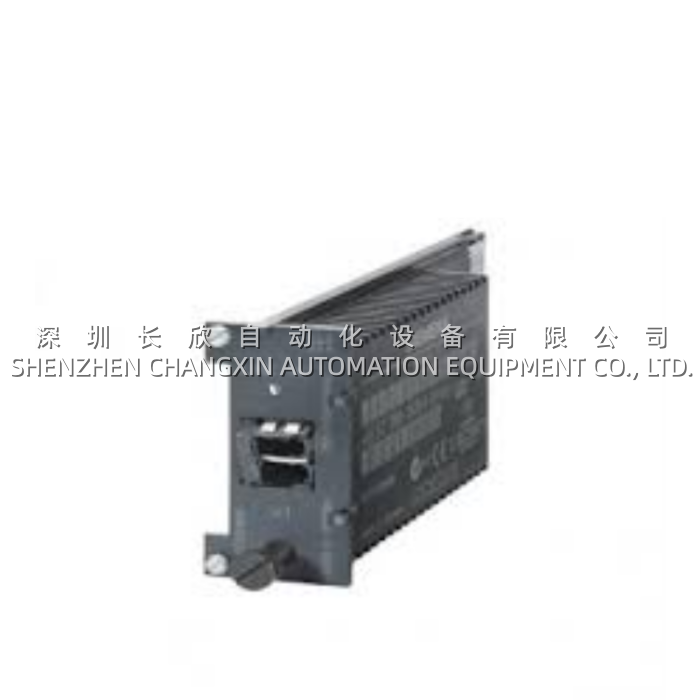
Product Overview
The 6DD2920-3AW2 is Siemens’ TAS21E thyristor electronics submodule within the SIMADYN D / SIMOVERT D&S power-electronic architecture — the “trigger brain” that sits in the SIMADYN D power rack and drives the pulse-distribution to the high-voltage SCR stacks in mega-watt-class DC drive rectifiers and inverter sections. “3AW2” in the 6DD2920 pattern denotes the voltage class: 5.00 KV primary / 3.90 KV secondary, configured for water-cooled SIMOVERT D and SIMOVERT S cabinets — the “FOR WATER” suffix distinguishing it from the air-cooled 3AW1 and the lower-KV 3AW0 variants. The 6DD2920-3AW2 is explicitly marked “WITHOUT ELEC. THYR. PROTECTION” in Siemens’ own parts listing, meaning the submodule focuses on precision pulse generation and distribution while the cabinet-level protection (snubber, fuses, supervision) resides elsewhere in the SIMOVERT D/S design — a deliberate partitioning Siemens used across the TAS21x family.
In the SIMADYN D system hierarchy, the 6DD2920-3AW2 lives downstream of the processor layer (PM5/PM6 CPU boards such as 6DD160x series) and the communication/interface layer, receiving firing-angle commands via the 4 µs/16-bit parallel backplane and converting them into isolated, timing-accurate gate pulses for the water-cooled thyristor arms. The 5.00 / 3.90 KV rating places the 6DD2920-3AW2 in the mid-high voltage tier of the 3AWx family — below the 3AW3 (6.80/5.60 KV) and 3AW4 (7.30/6.00 KV) flagships, above the 3AW1 (4.00/2.80 KV) and 3AW0 (baseline). Siemens cancelled the entire 6DD2920-3AWx row effective 2008-04-01 without substitution — meaning no active-production replacement exists in the current Siemens catalogue. Today the 6DD2920-3AW2 trades almost exclusively as tested-refurb or NOS spare for plants running SIMOVERT D/S rectifier cabinets that still power rolling-mill main drives, aluminum-smelter potlines, mine-winder DC drives, and marine propulsion converters — cells where ripping out a 15-year-old SIMADYN D rack for a SINAMICS retro-fit is capex the plant isn’t approving yet.
Technical Specifications
| Parameter Name | Parameter Value |
|---|---|
| Product Model | 6DD2920-3AW2 |
| Manufacturer | Siemens |
| Product Type | Thyristor Electronics Submodule (TAS21E) |
| Series / Platform | SIMADYN D / SIMOVERT D & SIMOVERT S |
| Voltage Rating | 5.00 KV (primary) / 3.90 KV (secondary) |
| Cooling Context | For water-cooled SIMOVERT D / SIMOVERT S cabinets |
| Electronic Thyr. Protection | None (“WITHOUT ELEC. THYR. PROTECTION” per Siemens listing) |
| Control Supply | 24 V DC (from SIMADYN D power rack backplane) |
| Mounting | SIMADYN D power rack module slot (6/12/24-slot chassis) |
| Pulse Output | Multi-channel isolated gate-trigger distribution to SCR stacks |
| Backplane Bus | SIMADYN D parallel fast bus (4 µs / 16-bit) |
| Operating Temp | 0 … +55 °C (standard SIMADYN D rack ambient; cabinet water-loop manages thyristor-side temp) |
| Status | Cancelled 2008-04-01, PM410, no substitution (EOL spare market only) |
Main Features and Advantages
TAS21E trigger submodule for water-cooled mega-watt rectifiers. The 6DD2920-3AW2 is not a standalone drive; it is a subsystem component whose value is entirely architectural. In a SIMOVERT D 6-pulse or 12-pulse water-cooled rectifier feeding a 5–10 MW DC main motor (rolling mill roughing stand, aluminum smelter potline converter, marine propulsion thyristor bridge), the PM5/PM6 CPU calculates the firing angle 100 µs loop time, pushes it across the SIMADYN D 4 µs backplane, and the 6DD2920-3AW2 converts that into hardware-timed, isolated gate pulses for each thyristor position in the water-cooled stack. The 5.00 / 3.90 KV rating tells the cabinet designer which SCR voltage class the submodule expects — matching the snubber and pulse-transformer secondary on the power deck. Getting this wrong (e.g., dropping a 3AW4 7.3 KV unit where 5 KV is spec’d, or vice-versa) risks pulse-transformer saturation or under-driving the gate; the 6DD2920-3AW2 is the mid-tier sweet spot for many 4–6 KV DC-link designs.
“Without elec. thyr. protection” — intentional partitioning. Siemens’ own parts listing for the 6DD2920-3AW2 calls out “WITHOUT ELEC. THYR. PROTECTION” — this is not a defect but a design choice carried across the TAS21E family. The submodule focuses on generating the trigger, not supervising the thyristor health (no desaturation detection, no di/dt monitoring onboard). Those functions live in the SIMOVERT D/S cabinet-level design — fuse coordination, snubber, water-flow interlock, and the PM5/PM6 software-layer alarm logic. For retrofit engineers, this means sparing a 6DD2920-3AW2 is a like-for-like hardware swap; the protection logic stays in the CPU firmware and cabinet wiring, untouched. This is also why the 3AW0/3AW1/3AW2/3AW3/3AW4 share the same “no elec. protection” tag — they differ only in KV class and cooling (air vs water), not in protection architecture.
Water-cooled SIMOVERT D/S specialization. The 6DD2920-3AW2 is tagged “FOR WATER” — meaning it expects the thyristor deck and pulse-transformer secondary environment of a water-cooled SIMOVERT D or SIMOVERT S cabinet (as opposed to the 3AW1 which is same KV tier but air-cooled, or the 3AW0 which is baseline water-cooled). In aluminum smelters and hot-mill main drives where the rectifier runs at 5–7 KV DC link and the thyristor junctions need de-ionized water loops at <40 °C, the 6DD2920-3AW2 is the trigger submodule Siemens specified. The submodule itself lives in the dry SIMADYN D rack (24 V DC backplane, IP20 internal), but its pulse-transformer secondary side ties into the water-deck’s HV isolation — the “5.00 / 3.90 KV” rating is the isolation boundary the submodule is qualified to.
SIMADYN D ecosystem compatibility. The 6DD2920-3AW2 drops into any SIMADYN D power rack (6/12/24-slot) alongside PM5/PM6 CPUs (6DD160x), communication processors (6DD167x), I/O (6DD168x), and the other 6DD2920 burden/load/current-meas modules. The 4 µs/16-bit parallel backplane means trigger latency from CPU decision to submodule output is deterministic — essential for 12-pulse rectifier synchronization where phase error of even 100 µs shows up as circulating current or torque ripple on a 5 MW mill motor. For plants with mixed 3AWx population (maybe a 3AW1 on the excitation converter, a 3AW2 on the main armature rectifier, a 3AW3 on the higher-KV standby), keeping a cross-spare strategy across the 3AWx row is common — the 6DD2920-3AW2 is the volume mover in the middle of the KV ladder.
EOL 2008 “no substitution” reality = sustained spare demand. Siemens cancelled the 6DD2920-3AW2 2008-04-01 with ohne Ersatz (without replacement) — there is no active-production Siemens SKU that drops in. The spiritual successor is SINAMICS DCM + CU320 + TM41/TM15 boards for new designs, but that is a full cabinet retro-fit (different rack, different backplane, different firmware, TIA/STARTER instead of D7-ES). For a plant running a SIMOVERT D 12-pulse water-cooled rectifier that still meets spec, ripping to SINAMICS is a €200 K+ capex the maintenance manager cannot get approved — so they buy tested-refurb 6DD2920-3AW2 units to keep the cell alive another 5–8 years. That is the entire buyer profile for this part.