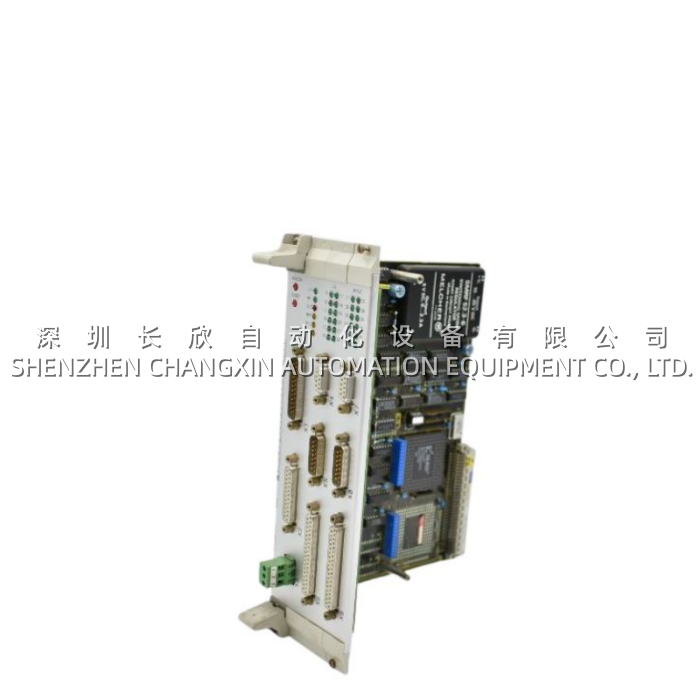
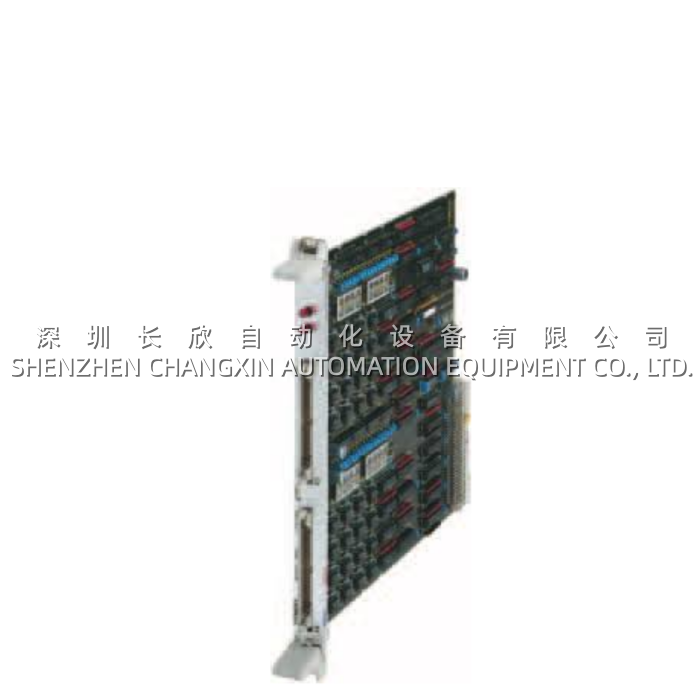
Description
The 6DD1607-0AA2 is a Siemens SIMATIC FM458-1 DP Application Module, designed to sit alongside the FM458-1 DP CPU module in a SIMATIC S7-400 rack and extend its high-speed closed-loop / motion-control capability with additional I/O, interfaces, and battery-backed SRAM. Built around a 64-bit RISC processor, the 6DD1607-0AA2 is programmed through D7-SYS (CFC + SFC, with user blocks in C), making it the workhorse behind demanding drive tasks — rolling-mill stands, multi-motor winders, high-dynamic test rigs — where a standard S7-400 CPU alone cannot sustain sub-millisecond loop timing.
Application Scenarios
In a specialty steel cold-rolling mill in Northern Italy, the main drive cabinet still runs an FM458-1 DP + 6DD1607-0AA2 pair commissioned in 2004, controlling a 6-stand tandem mill with gap-position and tension-looper loops closing at 400 µs. When the original Application Module began throwing sporadic SRAM parity alerts after a cabinet ventilation failure, the plant engineer’s first instinct was “we need a retrofit quote.” But the mill’s D7-SYS project had accumulated ~15 years of C-language user blocks tuned to the specific roll-gap friction model — rebuilding that logic on a modern SINAMICS/SIMOTION stack would have meant weeks of downtime and a six-figure engineering bill. Instead, the team sourced a tested 6DD1607-0AA2, swapped it into Slot 2 of the UR2 rack (the FM458-1 DP CPU occupies Slot 1), restored the battery-backed SRAM image from the spare MMC workflow, and was back on air within the same shift. For asset managers on FM458 iron, the 6DD1607-0AA2 is not a generic “spare module” — it is the exact expansion companion the FM458 CPU expects, and without it the closed-loop architecture literally cannot assemble.
Parameter
| Main Parameters | Value/Description |
|---|---|
| Product Model | 6DD1607-0AA2 |
| Manufacturer | Siemens (SIMATIC / S7-400 ecosystem) |
| Product Category | Application Module (companion to -1 DP CPU) |
| Processor | 64-bit RISC |
| Supply Voltage | 5 V DC (4.8–5.25 V) + 24 V DC dual-rail from S7-400 backplane |
| Current Consumption | Typ. 1.5 A / Max. 3 A @ 5 V |
| SRAM / Backup | 256 KB SRAM, battery-backed (max. backup current 15 µA) |
| Digital Inputs | 8 × fast DI, 24 V DC, Connector X2, 5 µs 0→1 delay |
| Serial Interface | RS-232 (for startup & diagnostics) |
| Fieldbus | PROFIBUS DP, equidistant mode, slave-to-slave direct data exchange |
| Real-Time Clock | Hardware RTC, 500 ms resolution |
| Expansion Support | EXM 438, EXM 438-1, EXM 448 expansion modules |
| Required Slots | 1 (adjacent to -1 DP CPU in S7-400 rack) |
| Weight | Approx. 1.0 kg |
Technical Principles and Innovative Values
Innovation Point 1: RISC-Offloaded Application Layer. The 6DD1607-0AA2 is not a passive I/O carrier — its 64-bit RISC processor runs the D7-SYS application tasks in parallel wie DP CPU, freeing the CPU for the tightest current/position loops while the Application Module handles slower supervisory logic, alarm edge-detection on its 8 fast DI, and PROFIBUS DP master/slave telegrams. This split is why an + 6DD1607-0AA2 combo can sustain 200–400 µs closed-loop on multi-axis drives where an S7-400 CPU alone would choke.
Innovation Point 2: C-Language User Blocks via D7-SYS. Through the “User Block Generator,” engineers write function blocks in ANSI C, compile them into the D7-SYS CFC project, and deploy to the 6DD1607-0AA2. This is the family’s killer advantage over standard S7-400 programming — you can embed a custom roll-gap friction model, a winder taper formula, or a test-rig hysteresis compensator in C and still stay inside the Siemens toolchain.
Innovation Point 3: EXM Expansion + RS-232 Diagnostics. The 6DD1607-0AA2 accepts EXM 438 / EXM 438-1 (encoder / incremental interface expansions) and EXM 448 (communication expansion), meaning the same Application Module base can scale from a 2-axis winder to a 6-stand mill just by populating the EXM sub-modules. The onboard RS-232 port (Connector X1 typically) gives service engineers a direct serial window for bootstrap and tracing without occupying the PROFIBUS port.
Application Cases and Industry Value
A German automotive transmission-test rig OEM standardize DP + 6DD1607-0AA2 pair across 12 end-of-line dyno cells. Each cell runs a 4-quadrant load motor and a spindle drive, with the CPU closing torque/speed loops at 250 µs and the 6DD1607-0AA2 handling the 8 DI touchdown sensors, PROFIBUS DP link to the cell’s S7-416 supervisor, and a C-block that calculates cumulative fatigue damage in real time. After 16 years, three Application Modules have needed replacement across the fleet. Each swap took one evening: slide the 6DD1607-0AA2 into the UR2 rack next to the CPU, reconnect X2 (8 DI) and the RS-232/X1, and the SRAM restore from the engineering station took < 5 minutes. The OEM estimates that staying on + 6DD1607-0AA2 instead of migrating to SIMOTION saved ~€120 K per cell in rewrite engineering alone — and the test rigs still meet the same 0.1% torque-repeatability spec they were certified to in 2008.
Related Product Combination Solutions
These models commonly appear in the same / S7-400 drive cabinet as the 6DD1607-0AA2:
- 6DD1606-0AD0 / 6DD1606-0AD1– DP CPU module itself (the 6DD1607-0AA2 is its mandatory Application Module companion in most closed-loop BOMs).
- 6DD1601-0AE0 – PM6 Processor Module (SIMATIC TDC side, sometimes co-spec’d when the plant mixes TDC + architectures).
- 6DD1681-0EB0 – EXM 438-1 expansion module, encoder interface that plugs into the 6DD1607-0AA2 for incremental/SSI encoder tasks.
- 6DD1681-0EG0 – EXM 448 communication expansion, for adding serial/Ethernet channels alongside the 6DD1607-0AA2‘s native PROFIBUS DP.
- 6ES7 400-1TA01-0AA0 – S7-400 UR2 rack (central rack where + 6DD1607-0AA2 sit; the Application Module occupies 1 slot adjacent to the CPU).
- 6ES7 951-0AG00-0AA0 – SIMATIC MMC (used by the host S7-400 CPU; the 6DD1607-0AA2 SRAM is battery-backed separately, but the MMC carries the CFC project that includes the + App Module logic).
- 6ES7 460-1BA01-0AB0 – IM460-1 (for linking the cabinet to distributed ET 200 I/O if the test rig spans multiple racks).