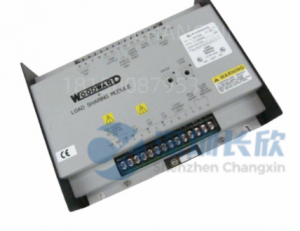
Application Scenarios
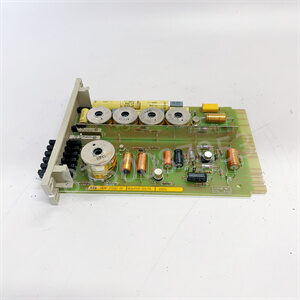
At a combined-cycle power plant in Texas, repeated nuisance trips during startup were traced to intermittent failures in legacy solid-state output modules controlling fuel shutoff valves. The root cause? Electrical noise from nearby VFDs coupling into unshielded driver circuits. The plant replaced all suspect units with genuine WOODWARD 8901-457 relay modules. Thanks to their opto-isolated inputs and electromechanical relay outputs, the new modules completely rejected EMI—and zero valve-related trips occurred over the next 24 months. “It wasn’t just a spare part swap—it was restoring system integrity,” said the controls lead. In applications where a single missed signal can trigger a $500k/hour outage, the WOODWARD 8901-457 proves that sometimes, the simplest technology (a relay) is the smartest choice.
Technical Principles and Innovative Values
Innovation Point 1: True Electromechanical Relays for Maximum Compatibility
Unlike solid-state outputs that struggle with inductive loads like solenoids, the WOODWARD 8901-457 uses gold-flashed mechanical relays that handle high inrush currents and provide near-zero leakage—ensuring valves fully de-energize during shutdowns.
Innovation Point 2: Full Optical Isolation Prevents Ground Loops
Each input is opto-isolated from the field side, breaking ground loops that commonly cause erratic behavior in generator control panels. This makes the WOODWARD 8901-457 ideal for retrofits in older plants with poor grounding.
Innovation Point 3: Direct Integration with WOODWARD Ecosystem
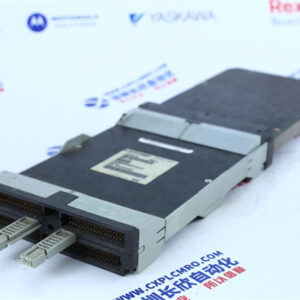
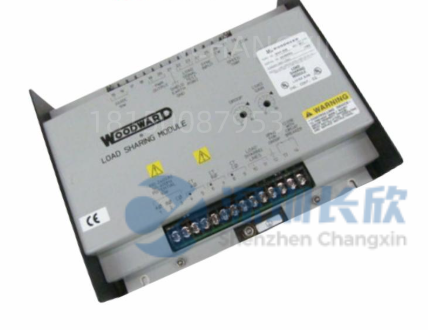
The module plugs directly into WOODWARD’s standard I/O backplanes (e.g., in 505E cabinets) with no configuration needed. Status LEDs match WOODWARD’s color-coding standards, simplifying troubleshooting for field technicians.
Innovation Point 4: Surge and Transient Protection Built-In
Each output includes RC snubbers and TVS diodes to suppress voltage spikes from inductive kickback—extending both the module’s life and the connected solenoid’s coil.
Application Cases and Industry Value
On a LNG carrier powered by dual WOODWARD-controlled gas turbines, the 8901-457 modules manage emergency blowdown valves and lube oil dump solenoids. During a recent sea trial, a lightning strike induced a 4 kV transient on the ship’s DC bus. While other electronics rebooted, the WOODWARD 8901-457 units maintained valve control—thanks to their robust isolation and surge protection. The chief engineer later stated: “These little boxes kept us from a black start at sea.”
In another case, a refinery upgraded its steam turbine ESD system using WOODWARD 8901-457 modules to replace aging PLC outputs. The result? A 70% reduction in false trips and full compliance with API 670 safety requirements—all without rewiring the field devices.
Related Product Combination Solutions
505E: WOODWARD’s flagship electronic governor—uses 8901-457 for trip, alarm, and auxiliary outputs
MicroNet Plus: Distributed control system that integrates 8901-457 via I/O racks for large turbine arrays
8901-456: 4-channel version of the same relay module for smaller applications
8901-458: Analog output module (4–20 mA) often used alongside 8901-457 in hybrid control panels
205/305: Legacy speed controllers that support 8901-457 via expansion I/O chassis
5437-115: WOODWARD terminal block adapter for quick field wiring to 8901-457
9907-162: DIN rail mounting kit with strain relief for harsh marine/vibration environments
Installation, Maintenance, and Full-Cycle Support
Installing the WOODWARD 8901-457 is straightforward: mount it on a standard 35 mm DIN rail inside a NEMA 4X or IP54-rated enclosure, connect the 24 VDC logic supply from your WOODWARD controller backplane, and wire field devices to the screw terminals. Always use shielded cable for solenoid leads, with shields grounded at one end only to avoid ground loops. The green LEDs provide instant visual confirmation of output state—critical during loop checks or emergency diagnostics.
For maintenance, periodically inspect relay contacts for pitting (especially if driving high-current solenoids). While the WOODWARD 8901-457 is rated for 100.000+ operations, in high-cycle applications (e.g., test benches), consider preventive replacement every 5–7 years. No calibration is required—just verify continuity during scheduled outages.
We rigorously test every WOODWARD 8901-457 for contact resistance, isolation integrity, and LED functionality before shipment. Our technical team includes former WOODWARD field service engineers who can assist with integration into 505. MicroNet, or custom control architectures—ensuring your system performs as intended, from commissioning to decommissioning.