Technical Specifications
| Parameter Name | Parameter Value |
|---|---|
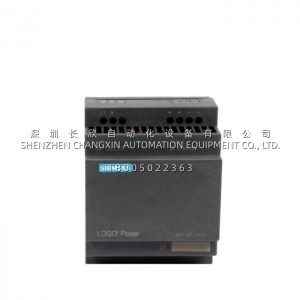
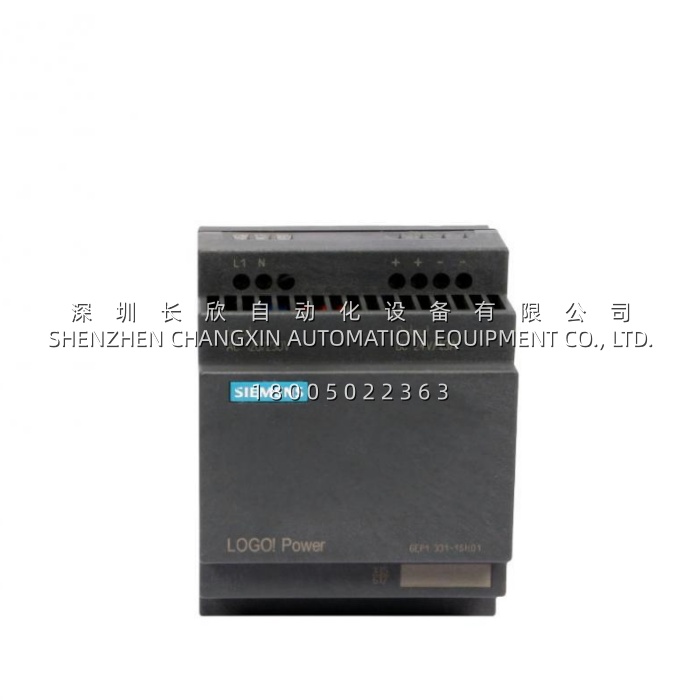
| Product Model | 6EP1331-1SH01 |
| Manufacturer | Siemens |
| Product Type | Stabilized Switch-Mode Power Supply |
| Series / Platform | Siemens SITOP (early-gen, PSU100S-class) |
| Input Voltage Range | AC 85 – 264 V, 47 – 63 Hz / DC 110 – 300 V |
| Rated Output Voltage | 24 V DC |
| Output Adjustment Range | 22 – 28 V DC (via front potentiometer) |
| Rated Output Current | 5 A |
| Rated Output Power | 120 W |
| Peak / Short-Term Overload | 120 % – 150 % rated (depending on duration & ambient, 5 s/min extra-power profile typical of PSU100S class) |
| Mains Buffering | approx. 20 ms (at 230 V AC input) |
| Efficiency | > 85 % (typical at rated conditions) |
| Short-Circuit Protection | Yes, constant-current limiting |
| No-Load Protection | Yes (output potential-isolated) |
| Diagnostic Indicator | Green LED “Output OK”; fault indication per batch (off/red) |
| Operating Temperature | –25 °C to +70 °C (derating applies above +50 °C, ~0.75 %/K for the 5 A PSU100S-class) |
| Storage Temperature | –40 °C to +85 °C |
| Relative Humidity | 10 % – 95 % (non-condensing) |
| Mounting | 35 mm standard DIN rail |
| Dimensions (W × H × D) | approx. 45 × 125 × 120 mm |
| Weight | approx. 0.5 kg |
| Terminals | Screw spring terminals or screw terminals (version-dependent) |
| Degree of Protection | IP20 (EN 60529) |
| Certifications | CE, cULus, CB (typical SITOP PSU100S-class portfolio); refer to nameplate for exact listing on shipped unit |
Main Features and Advantages
The Siemens 6EP1331-1SH01 earns its place in decades of S7-300 panels through a handful of well-chosen design decisions rather than raw spec-sheet bravado. The standout is unquestionably the wide-input envelope: AC 85–264 V auto-ranging plus DC 110–300 V coverage means one spare part number covers export machinery headed to North America (120 V), Europe (230 V), and even DC-backup substations where the plant floats the control-bus off a 220 V DC battery string. For OEMs building machinery sold into uncertain destination markets, specifying the Siemens 6EP1331-1SH01 eliminates the “which transformer/tap?” question entirely—the module sorts it out on power-up.
Output quality matters more than vendors often admit. The Siemens 6EP1331-1SH01 regulates to ±3 % tolerance (class-typical for PSU100S lineage) with low ripple, which keeps analog input modules, encoder supplies, and sensitive sensors from chasing noise that a cheap switched-mode supply would inject straight into the 24 V rail. The front potentiometer trimming 22–28 V is a small but heavily used feature: panel builders routinely dial the Siemens 6EP1331-1SH01 up to 26–27 V to recover the 1–1.5 V lost across long feeder runs to remote I/O clamshells, then let the S7-300 SM331/SM332 modules see a clean 24 V at the load end. No external booster, no second supply—just a screwdriver turn during FAT.
Overload behavior follows the PSU100S family philosophy: 120 % continuous to +45 °C (for the 5 A class) and a 150 % “extra-power” burst for 5 seconds per minute, which is what lets the Siemens 6EP1331-1SH01 start inductive loads—solenoid banks, contactor coils, motor-starter aux—without tripping on inrush. The 20 ms mains buffer at 230 V won’t hold through a generator transfer, but it does carry the PLC through the utility’s “blink” events that would otherwise reset a non-buffered rack and dump a running process into an unwanted startup sequence.
Mechanical fit is the quiet selling point for MRO buyers. The 45 mm width and S7-300-compatible DIN footprint mean the Siemens 6EP1331-1SH01 slides into the top-left corner of a classic S7-300 rack assembly—CPU on the right, I/O below, PS at the crown—without re-cutting DIN rail or re-terminating ferrules. Spring/screw terminal options (version-dependent) accept the same ferrule sizes the rest of the panel uses. And because the Siemens 6EP1331-1SH01 is potential-isolated output with no-load and short-circuit protection, commissioning technicians can probe the 24 V rail with a screwdriver slip and trip the PSU instead of letting the short propagate—the supply self-recovers when the fault clears, no fuse to hunt down in a darkened cabinet.