Application Scenarios:
A municipal water utility running a four-pump booster station found its oldest set running at fixed speed across a duty/standby arrangement, with discharge pressure held by throttling a butterfly valve. Pressure swings of ±1.5 bar were routine at night, seal failures were occurring roughly every 14 months, and the operator had no visibility into motor load or run hours. During a phased retrofit, the lead pump was converted to variable speed with the 690-432300C0-B00P00-A400, using its built-in process PID macro and the 4–20 mA transducer feedback from the discharge header. No external PLC was added — the drive’s function block engine handled the duty/assist changeover logic, the sleep/wake function at low demand, and the pipe-fill ramp that had been causing water hammer.
The result was stable pressure within ±0.2 bar, an immediate drop in specific energy consumption, and the disappearance of the throttling losses that had been burning power across the valve. Because the 690-432300C0-B00P00-A400 shares its parameter structure, menu hierarchy and PC tool workflow with the Parker DC590+ DC drive, the maintenance team — already trained on the DC drives in the same building — commissioned the unit without external support.
The same model appears with equal frequency on induced-draft and cooling-tower fans, conveyor and elevator drives, mixers, compressors, and machine-tool spindles, where the pain points are the same: uncontrolled inrush current, mechanical shock at start, poor low-speed torque, and no diagnostic data to support predictive maintenance.
Parameter:
| Main Parameters | Value/Description |
|---|---|
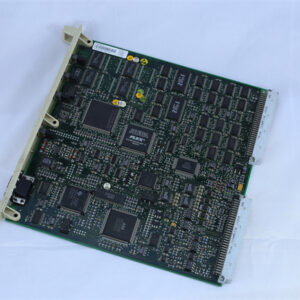
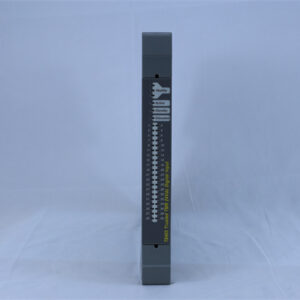
| Product Model | 690-432300C0-B00P00-A400 (legacy code 690PC/0150/400/0011/UK/0/0/0/0/B0/0/0) |
| Manufacturer | Parker Hannifin — Parker SSD Drives / Eurotherm Drives (AC690+ Integrator Series) |
| Product Category | AC Variable Frequency Drive / Inverter, Frame C, panel-mount chassis |
| Rated Power & Current | 15 kW / 20 HP at 31 A constant torque; 18.5 kW / 25 HP at 38 A variable torque — the second figure applies to fans and pumps, where load torque rises with speed squared |
| Input Supply | 3 × 380–460 V AC ±10%, 50/60 Hz ±5%; input current 37 A (44 A fan/pump); recommended input fuse 40 A / 50 A |
| Output Frequency | 0–120 Hz default, field-selectable 0–240 Hz or 0–480 Hz; PWM switching 3 or 6 kHz (Frame C), both audibly silent |
| Control Modes | Open-loop V/f, Sensorless Vector via MRAS, Closed-Loop Flux Vector with optional encoder technology box (100% standstill torque, up to 45 Hz speed-loop bandwidth) |
| Overload Capability | 150% for 60 s and 180% for 0.5 s (constant torque); 115% for 10 s (variable torque) — defines how hard the drive can be pushed during starting and transient peaks |
| I/O Configuration | 4 analog inputs / 3 analog outputs (0–10 V, ±10 V, 0/4–20 mA, 10-bit, 13-bit with system board); 8 configurable digital inputs at 24 V DC; 3 relay outputs 3 A @ 230 V AC; 1 motor thermistor input; +10 V / −10 V / +24 V reference supplies |
| Communication | RS232/RS485 (Modbus RTU) as standard; plug-in technology box for Profibus-DP, DeviceNet, CANopen, ControlNet, Ethernet TCP/IP, Modbus+ or LonWorks |
| Braking, Protection & Compliance | Internal brake chopper with external resistor (min. 50 Ω, 100% for 20 s or 25% continuous); IP20 panel mount with IP40/NEMA 1, IP54 and through-panel options; CE to EN50178 and EN61800-3 Category C3, UL508C, cUL C22.2 #14 |
| Mechanical & Environmental | 201 mm W × 348 mm H × 208 mm D, approx. 9.3 kg; M6 fixings on 150 × 335 mm centres; 0–45 °C (0–40 °C with IP40 cover), derating to 50 °C max; up to 1000 m ASL (derate 1% per 100 m above); 70 mm clearance above/below, 15 mm at sides |
Note on I/O count: Parker’s standard catalogue lists 7 configurable digital inputs, while Frame C units in distribution are commonly documented with 8 — verify against the rating label on your specific unit before finalising panel drawings.
Technical Principles and Innovative Values:
Innovation Point 1 — MRAS sensorless vector control without a shaft encoder:
The 690-432300C0-B00P00-A400 runs a Model Reference Adaptive System that continuously re-estimates rotor flux and rotor speed from the motor’s own voltage and current. This gives high starting torque and tight speed regulation with no feedback wiring at all. Plants get closed-loop-grade control on conveyors, mixers and positive-displacement pumps while eliminating the encoder, its coupling, its cable and its bearing-mounted failure points — typically the first components to fail in a dirty or washdown environment.
Innovation Point 2 — Embedded function block programming replaces a small PLC:
Every 690-432300C0-B00P00-A400 carries a full function block engine with timers, counters, comparators, math blocks, Boolean logic and a process PID. Pre-built application macros cover simple speed control, forward/reverse, raise/lower, process PID, preset speeds and winder control. Machine builders routinely absorb pump changeover interlocks, duty/standby rotation and two-pump alternation into the drive itself, removing a PLC, its power supply and roughly a third of the panel’s terminal rail.
Innovation Point 3 — Identical programming model to the Parker DC590+ DC drive:
The 690-432300C0-B00P00-A400 uses the same parameter structure, menu hierarchy and HMI navigation as the DC590+ series, and the same DSE Lite / ConfigEd Lite PC tool. For sites midway through a DC-to-AC migration, a technician qualified on one platform can commission the other with barely any retraining. This is the single biggest hidden cost saving on mixed-technology retrofit projects.
Innovation Point 4 — Integrated brake chopper and energy-optimised fan/pump mode:
Frame C ships with the brake switch fitted as standard, so the accepts an external 50 Ω resistor directly for overhauling loads such as unwinders, declines and centrifuges. In variable-torque service, the quadratic V/f curve, sleep/wake function and energy-save mode cut motor losses at part load — where a fan or pump spends most of its life. For four-quadrant duty, the range also offers an Active Front End that returns regenerative energy to the grid at unity power factor instead of dissipating it as heat.