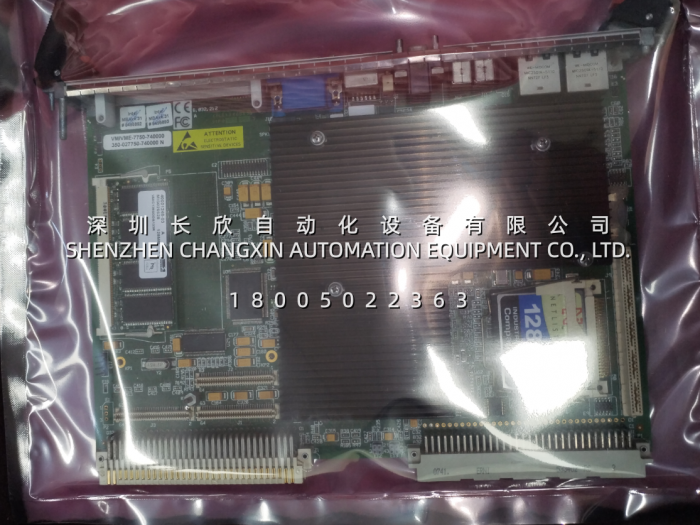
Application Scenarios
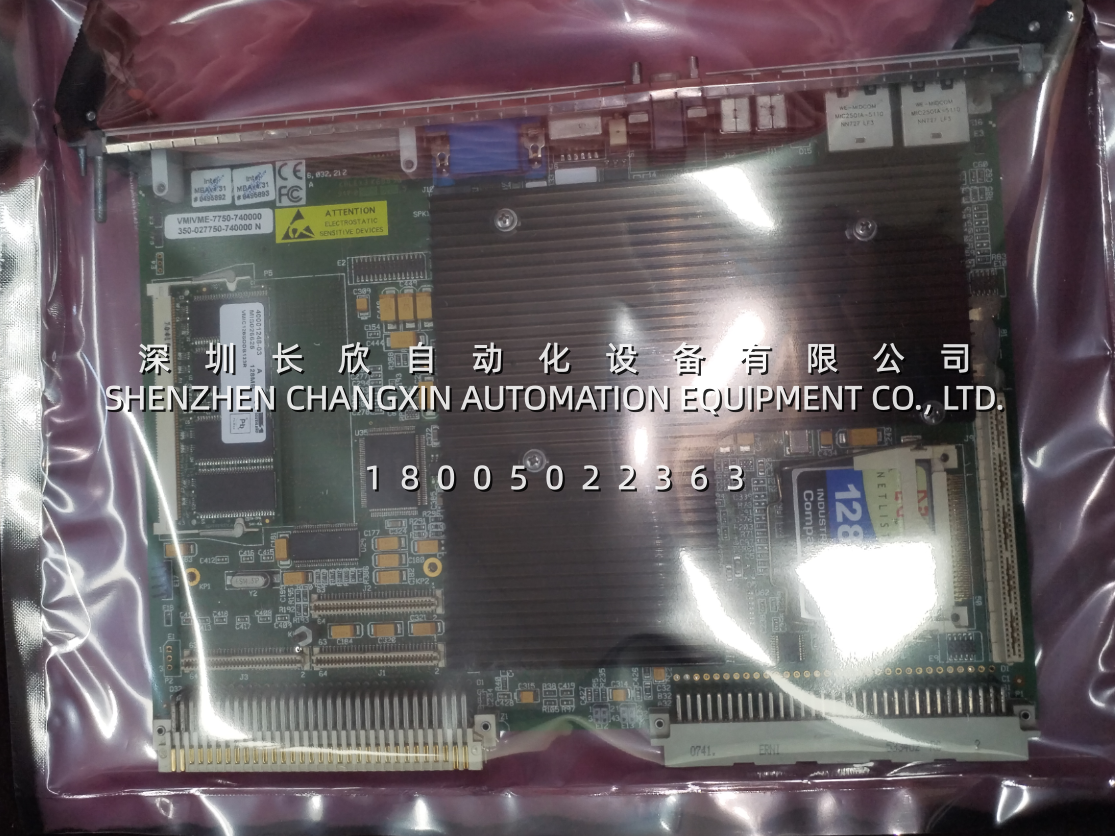
In a large power generation facility, engineers faced a critical challenge: their aging VME-based turbine control system was running on obsolete processors that could no longer support modern diagnostic software or communicate with the plant’s upgraded SCADA network. Replacing the entire system would have required months of downtime and millions in capital expenditure. By deploying the GE VMIVME-7750 as a direct CPU replacement, the facility upgraded its computing capability to Pentium III level within a single maintenance window. The GE VMIVME-7750’s dual Ethernet ports enabled seamless integration with the plant’s industrial network, while its ability to run VxWorks preserved the existing application software investment.
The real-world value of the GE VMIVME-7750 becomes clear in redundant control configurations. In a military radar tracking system, the VMIVME-7750 serves as the primary computation engine, processing thousands of data points per second while maintaining deterministic response times. Its wide operating temperature range (-40°C to +85°C for ruggedized versions) ensures reliable performance in unheated shelters and mobile command vehicles. The on-board watchdog timer and hardware monitoring features provide critical fault detection, enabling the GE VMIVME-7750 to initiate automatic recovery before a system failure can compromise mission objectives.
Parameters
| Main Parameters | Value / Description |
|---|---|
| Product Model | GE VMIVME-7750 |
| Manufacturer | GE Fanuc / GE Intelligent Platforms (VMIC Series) |
| Product Category | 6U VMEbus Single-Board Computer (SBC) |
| Processor | Intel Pentium III, up to 1.26 GHz with 512 KB L2 Cache |
| Chipset | Intel 815E with 133 MHz Front-Side Bus |
| System Memory | Up to 512 MB PC133 SDRAM (144-pin SODIMM) |
| Storage | CompactFlash Type II (up to 1 GB bootable), IDE interface |
| Graphics | Integrated AGP SVGA, 4 MB dedicated video memory |
| Ethernet | Dual 10/100Base-TX controllers (Intel 82559) |
| Serial Ports | 2x RS-232 (16550 UART compatible) |
| Expansion | 1x PMC slot (IEEE P1386, 5V PCI mezzanine card) |
| Bus Interface | VME64x (VMEbus Rev. C.1), A32/A24/D32/D16, BLT32/BLT64 |
| Operating Temp | Standard: 0°C to +55°C / Wide-temp: -40°C to +85°C |
| Dimensions | 6U Eurocard: 233.4 mm × 160 mm × 20.3 mm (single slot) |
| Power Requirements | +5 VDC (6A typical), +12 VDC, -12 VDC |
Technical Principles and Innovative Values
Innovation Point 1: Transparent PCI-to-VME Bridge Architecture
The integrates the Tundra Universe IIB PCI-to-VMEbus bridge, providing seamless, transparent communication between the Pentium III’s PCI local bus and the legacy VME64x backplane. This innovative design allows the to operate either as the system controller or as a peripheral CPU in multi-processor VME configurations. The bridge supports advanced block transfer modes (MBLT64 up to 40 MB/s), enabling high-throughput data exchange with other VME modules without CPU intervention.
Innovation Point 2: Superior Environmental Resilience
Unlike commercial-grade computers, the features industrial-grade construction with conformal coating on the PCB to resist humidity, dust, and corrosive gases. The board is qualified to withstand 5g vibration and 50g shock, making the suitable for deployment in high-vibration environments such as locomotive control, shipboard systems, and gas turbine monitoring. Its passive cooling design—using a heatsink without a fan—eliminates a common point of failure, significantly improving mean time between failures (MTBF) compared to actively cooled alternatives.
Innovation Point 3: Comprehensive Real-Time OS Ecosystem
The stands out for its extensive operating system support, including VxWorks, QNX, LynxOS, Solaris (Intel edition), and Linux, in addition to Windows XP/2000. Board support packages (BSPs) are available for each RTOS, providing pre-configured drivers for all on-board peripherals including Ethernet, serial ports, VMEbus access, and DMA engines. For VxWorks applications, the BSP includes byte-swapping features to handle communication between big-endian and little-endian devices on the same VMEbus—a critical feature in mixed-vendor systems.