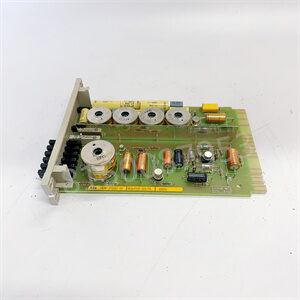
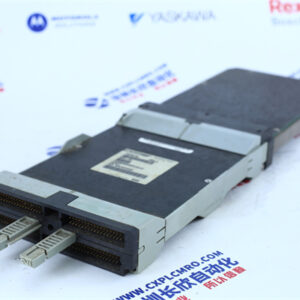
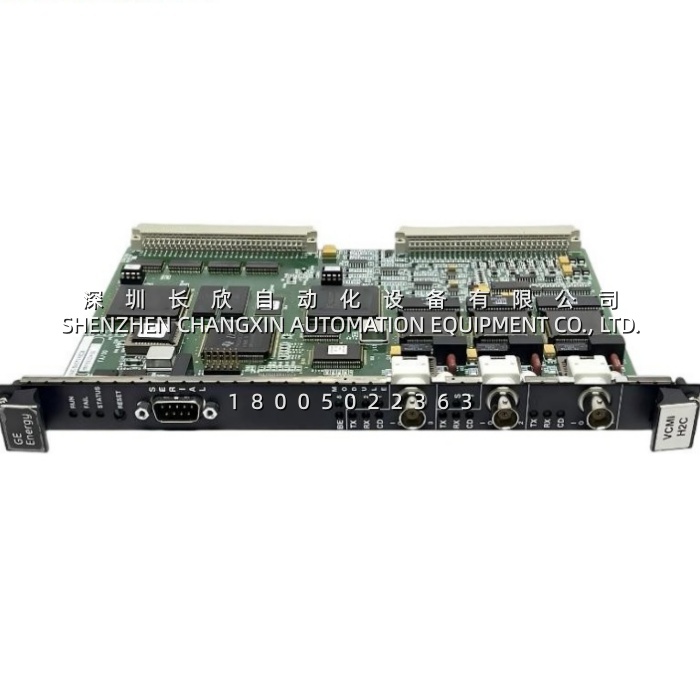
Application Scenarios
: At a 400 MW combined-cycle power plant in the Middle East, three GE 7FA.03 gas turbines run under Mark VIe control with full TMR architecture. During a scheduled outage, the maintenance team discovered that the VCMI board in Control Module B exhibited intermittent COMM FAULT conditions logged by the PAMS diagnostic system. Because the IS215VCMIH2CB sits in Slot 1 of each control module — the only slot that arbitrates VME bus ownership for all downstream I/O boards — a degraded link meant that fuel valve commands and flame detector data were arriving at the processor with microsecond-level skew. Left unresolved, the TMR voter would have forced an unplanned trip during the next load ramp.
The replacement of a single IS215VCMIH2CB restored full communication symmetry across all three redundant modules within four hours, avoiding an estimated 48-hour outage that would have cost the plant over USD 320,000 in lost generation. This scenario is far from isolated: among plants operating aging Mark VI fleets (commissioned 2000–2012), VCMI board degradation is the second most common cause of forced turbine trips after servo valve issues. The IS215VCMIH2CB addresses the pain point of communication integrity in environments where electromagnetic noise from large motors, frequency drives, and arc furnaces routinely corrupts serial and network links.
Parameters
| Main Parameters | Value / Description |
|---|
| Main Parameters | Value / Description |
|---|---|
| Product Model | IS215VCMIH2CB |
| Manufacturer | GE Energy (General Electric) |
| Product Category | VME Bus Master Controller / Communication Interface Board |
| Series / Platform | Speedtronic Mark VI / Mark VIe Turbine Control System |
| Processor | TI TMS320C32 32-bit Floating-Point DSP |
| Memory | 32 KB Dual-Port RAM; 256K×32 SRAM; 512K×8 Flash |
| Communication Ports | 3× IONet 10Base2 Ethernet (BNC) + 1× RS-232C Serial (D-sub) |
| Communication Speed | 10 Mbps per IONet channel |
| Board Form Factor | 6U VME, 0.787 in (20 mm) width |
| Operating Voltage | DC 9–36 V (backplane supplied, via J301 connector) |
| Operating Temperature | −20 °C to +60 °C (−40 °C to +70 °C extended) |
| Weight | Approximately 0.45 kg (1 lb) |
| Redundancy Support | TMR (Triple Modular Redundancy) voting compatible |
| Technical Manual | GEH-6421 |
Technical Principles and Innovative Values
: • Innovation Point 1 — Hardware-Managed Bus Arbitration. Unlike generic VME interface cards that rely on software polling, the IS215VCMIH2CB implements a dedicated arbitration state machine within the TMS320C32 firmware. When any I/O board asserts a bus request, the IS215VCMIH2CB grants access within one bus cycle (< 1 μs), ensuring deterministic response times essential for turbine governor loops with ≤ 20 ms total loop latency.
: • Innovation Point 2 — Triple IONet with Independent Link Diagnostics. The H2 hardware revision expanded from single-port (VCMIH1) to three independent IONet BNC channels. Each port carries its own TX/RX/CD LED group and error counter, allowing maintenance personnel to pinpoint a degraded cable segment without removing the board. By comparison, competing VME bridges in the same era required external protocol analyzers for equivalent fault isolation.
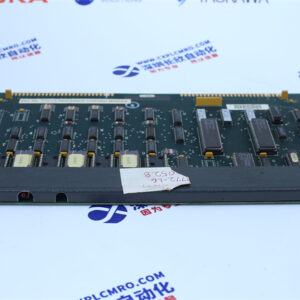
: • Innovation Point 3 — Ferrite-Beaded EMI Hardening. Over 25 ferrite inductors and three isolation transformers on the PCB suppress conducted noise above 1 MHz. Field tests in GE’s Schenectady lab demonstrated a 14 dB improvement in common-mode rejection versus the predecessor VCMIH1, directly translating to fewer communication error counters when installed in cabinets sharing bus duct with 6.6 kV feeders.
: • Innovation Point 4 — Firmware Compatibility Group “CB.” The suffix CB designates a firmware interoperability set validated against Mark VIe CIS (Control Interface Software) versions R3.07 and later. This guarantees that the can coexist with upgraded UCSA/UCSB processor cards without requiring a full system re-commission — a significant cost saver during mid-life control upgrades.
: • Innovation Point 5 — Self-Healing Reset with State Preservation. The front-panel push-button triggers a soft reset that preserves the dual-port RAM mailbox contents. In TMR operation, the surviving modules detect the brief communication gap and re-synchronize the reset module within 500 ms without tripping the turbine — a behavior absent in simple watchdog-reset designs.