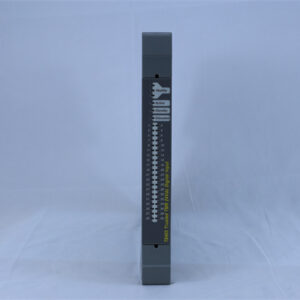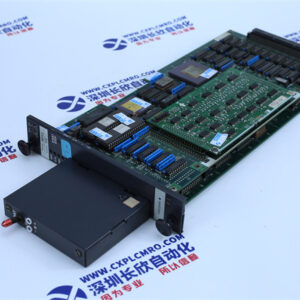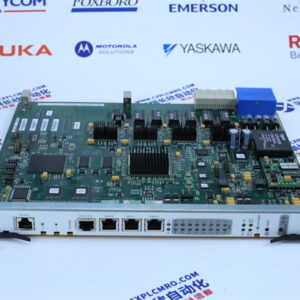
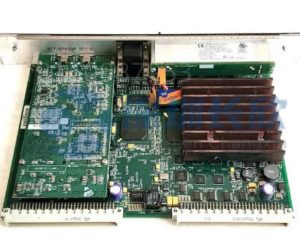
 Engineered for Speed, Scale, and Determinism
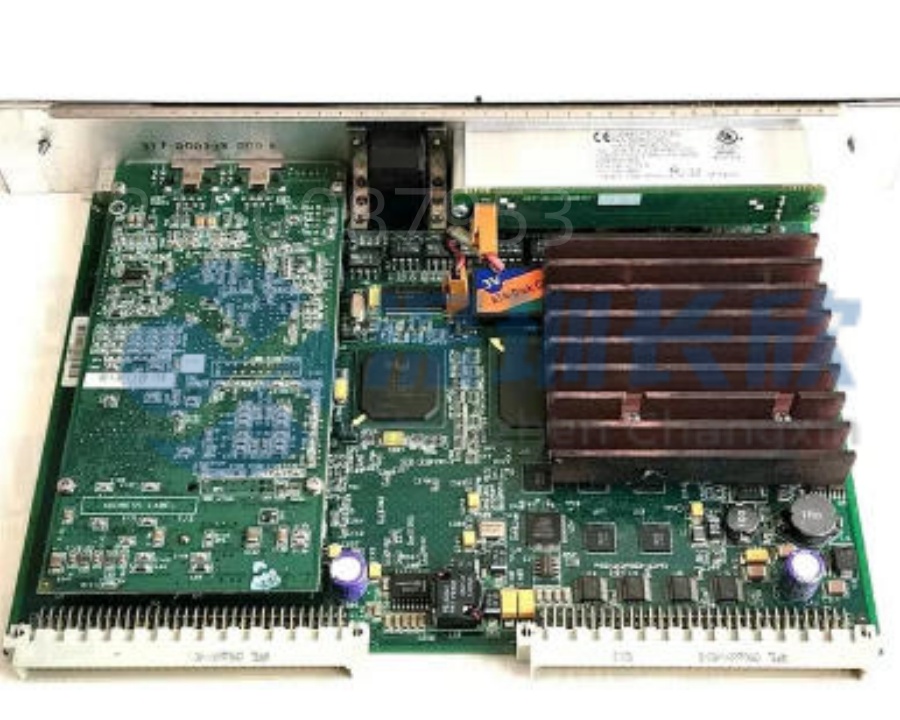
The IC698CPE010-JU stands apart from conventional PLC CPUs through its dual-core PowerPC architecture, delivering 1 GHz of processing power dedicated to both user logic and system tasks. Unlike single-core predecessors that juggle communication, I/O updates, and program execution on one thread—risking jitter under load—the CPE010-JU assigns separate cores to real-time control and background services. This ensures sub-millisecond scan times even with thousands of I/O points and complex algorithms such as thermal modeling or PID cascade loops.
A key differentiator is its deterministic I/O update mechanism. In power plants, for instance, synchronizing breaker status across a substation requires precise timing. The IC698CPE010-JU supports time-stamped I/O and event-driven data acquisition, enabling sequence-of-events (SOE) resolution down to 1 millisecond—critical for post-fault analysis and grid compliance (e.g., NERC standards). This level of temporal precision is why utilities rely on it for generator protection, bus transfer schemes, and black-start sequencing.
Moreover, the module integrates seamlessly into the PACSystems RX7i backplane, supporting up to 20 high-density I/O modules per rack and scalable to multi-rack configurations via Genius or Ethernet Global Data (EGD). With 512 MB of user memory and 1 GB of non-volatile storage, it accommodates large programs, historical trend buffers, and embedded HMI logic—all without external SD cards or USB drives that introduce failure points.
Real-World Resilience: Deployments Where Reliability Is Non-Negotiable
Hydroelectric Power Station – Pacific Northwest
A century-old dam modernized its turbine governor and excitation control using redundant IC698CPE010-JU systems. Legacy electromechanical relays were slow to respond to load rejection events, risking overspeed damage. The new PACSystems platform, powered by the CPE010-JU, executed closed-loop speed control at 4 ms intervals, coordinating guide vane position, field current, and circuit breaker status in real time. During a grid separation event, the system stabilized frequency within 2 seconds—preventing a full plant trip. “It didn’t just replace relays—it gave us dynamic grid support capability,” said the station engineer.
Steel Mill Continuous Caster – Eastern Europe
In a harsh environment with ambient temperatures exceeding 50°C and EMI from arc furnaces, previous controllers suffered memory corruption and communication dropouts. After installing IC698CPE010-JU units in ventilated, shielded enclosures, the caster’s mold-level control and emergency stop logic ran uninterrupted for over three years. The CPU’s conformal-coated PCBs and wide operating voltage range (85–264 VAC) proved essential. “We’ve had zero CPU-related failures since commissioning,” reported the automation manager. “Even during summer heatwaves, it just keeps running.”
Built-In Redundancy and Diagnostics for Zero-Downtime Operations
For applications requiring continuous availability, the IC698CPE010-JU supports hot-standby redundancy via the IC698RMX016 redundancy module. Two CPUs synchronize program state, I/O images, and communication sessions over a dedicated fiber-optic link. Failover occurs in less than 20 milliseconds—transparent to field devices and operators. This architecture is widely used in combined-cycle plants where a control hiccup could trigger a $500.000/hour outage.
Equally important is its self-diagnostics capability. The module continuously monitors:
Core temperature and voltage rails
Memory integrity via ECC (Error-Correcting Code)
Backplane communication health
Task execution overrun
All diagnostics feed into the Proficy Machine Edition engineering suite and can trigger SNMP traps or email alerts. Field technicians also benefit from front-panel LEDs indicating RUN, STOP, I/O FAULT, and REDUNDANCY STATUS—enabling rapid visual assessment during emergencies.
Expert Recommendations for Optimal Deployment
“Don’t max out the CPU load. Keep sustained utilization below 60% if you’re running motion or high-speed counting. The CPE010-JU has headroom—but only if you respect it.”
— Senior Controls Engineer, Global Energy EPC
Veteran GE PACSystems integrators advise:
Use shielded, grounded racks in high-EMI environments; bond all chassis to a single-point ground.
Enable watchdog timers in critical routines to force fail-safe states if logic stalls.
Leverage EGD for peer-to-peer data sharing between RX7i and RX3i systems—avoid OPC for hard real-time needs.
Perform firmware alignment across all redundant pairs and spares to prevent version mismatch during swaps.
A Legacy of Industrial Trust in a Changing Landscape
Though newer platforms like VersaMax and RXi2 have emerged, the IC698CPE010-JU remains in active service—and specification—for greenfield projects due to its proven track record, extensive certification base (including IEEE, UL, and CE), and long-term support from Emerson (which acquired GE Automation). Its architecture anticipated today’s demands for edge intelligence: large memory, fast processing, and embedded diagnostics—without relying on cloud dependencies.
In an era of digital transformation, the GE IC698CPE010-JU reminds us that innovation isn’t always about novelty—it’s about delivering unwavering performance where it matters most. For engineers safeguarding the world’s power grids, refineries, and heavy industrial assets, this CPU isn’t just hardware. It’s peace of mind, coded in silicon and hardened by decades of real-world duty.