Application Scenarios
In a thermal power plant’s boiler feedwater system, the desuperheating spray valve operates at the edge of a dangerous trade-off. If a power or signal loss forces the valve fully open, steam temperature collapses and the turbine risks water induction. If it slams shut, superheater tubes can overheat and rupture within minutes. The plant‘s instrumentation engineer had lived with this dilemma for years, accepting that any positioner failure meant choosing which failure mode was less catastrophic. The solution came not from redesigning the valve but from changing how it fails. By specifying the V18345-2010521001, the team gained a positioner that does neither: on loss of electrical power, air supply, or control signal, it freezes the actuator pressure and holds the valve exactly where it was. The desuperheating valve simply stays put until operators intervene. For any loop where “stop moving” is safer than “go to a predetermined position,” the Fail-Freeze logic of the V18345-2010521001 turns a binary failure choice into a controlled pause.
Parameter
| Main Parameters | Value/Description |
|---|---|
| Product Model | V18345-2010521001 |
| Manufacturer | ABB (TZIDC / TZID-C series) |
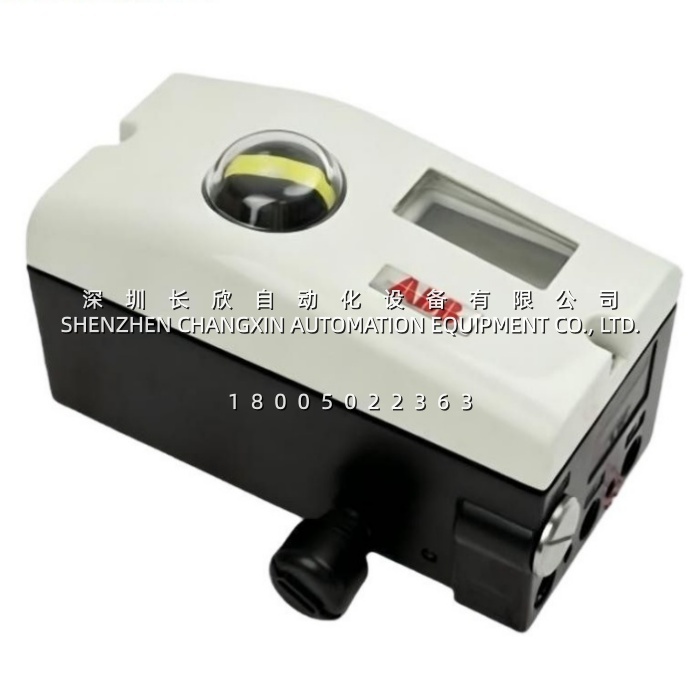
| Product Category | Intelligent Electro-Pneumatic Valve Positioner |
| Input Signal | 4–20 mA DC, two-wire |
| Safe Position Logic | Fail-Freeze (holds current position on power/air/signal loss) |
| Actuator Compatibility | Double-acting pneumatic actuators |
| Housing | Aluminum, painted, with mechanical position indicator |
| Analog Feedback | Built-in 4–20 mA position feedback module, two-wire |
| Explosion Protection | None (non-hazardous area use only) |
| Pneumatic Connections | 1/4-18 NPT |
| Electrical Connection | 1/2-14 NPT |
| Stroke Range | Linear: 20–150 mm; Rotary: up to 125° |
| Operating Temperature | −40°C to +85°C |
| Protection Class | IP65 / NEMA 4X |
| Weight | Approximately 1.7 kg |
The model code itself tells the configuration story. The “20” designates aluminum housing with mechanical indication. The “1” after that specifies the 4–20 mA two-wire input without HART module. The “0” confirms no explosion protection. The “5” is the critical digit: double-acting with Fail-Freeze output. The “2” sets NPT thread connections, and the final “1” indicates the plug-in analog feedback module is included . This is a positioner built for standard industrial areas where valve position must survive a utility interruption without moving.
Technical Principles and Innovative Values
Innovation Point 1: Fail-Freeze as a deliberate safety philosophy. Conventional positioners default to fail-safe or fail-open on utility loss. The V18345-2010521001 rejects both options for applications where any movement is hazardous. When power, air, or signal is interrupted, the pneumatic output ports are sealed, trapping actuator pressure on both sides of the piston. The valve stem does not travel. This behavior is particularly valuable in temperature control loops, level control on surge vessels, and any process where the “safe” position is simply the one the valve was already in .
Innovation Point 2: Piezoelectric pilot stage with no wearing parts. The TZIDC platform uses a piezoelectric ceramic disc to modulate air flow rather than a conventional spool valve with sliding seals. There is no spool to stick, no O-ring to swell, and no notched orifice to clog. The result is a positioner that tolerates contaminated instrument air far better than spool-type designs and maintains consistent response over millions of cycles . For plants with aging air systems where compressor oil carryover is a fact of life, this distinction translates directly into reduced maintenance calls.
Innovation Point 3: Single-button commissioning that respects field reality. The Autoadjust function learns the valve’s end stops, measures friction, and selects control parameters with one front-panel button press. No laptop, no HART communicator, no parameter list required for basic setup. The two-line LCD and four-button interface show setpoint, temperature, and control deviation during operation, while the mechanical position indicator provides a visual check even if the display is unreadable in bright sunlight . Commissioning a replacement positioner becomes a task measured in minutes rather than hours.
Innovation Point 4: Built-in diagnostics that count what matters. The V18345-2010521001 tracks valve movements and total travel, storing these values for retrieval via HART or the local interface. Maintenance planners can set thresholds and receive alarms when a valve is cycling faster than expected or has accumulated travel beyond its design envelope. This data turns a positioner from a passive actuator into a monitoring point, providing early warning of packing wear, seat erosion, or process instability before those conditions demand emergency attention .