Application Scenarios
A food and beverage plant operates a pasteurization line where product temperature must follow a defined ramp and hold profile while flow rate, valve position, and utility conditions change. A basic on/off controller can hold a simple temperature setpoint, but it may not manage long process dead time, changing product loads, or interaction between heating and cooling actuators. If the controller overshoots during a transition, the product may be overheated; if response is too slow, the process may not remain within the required holding temperature.
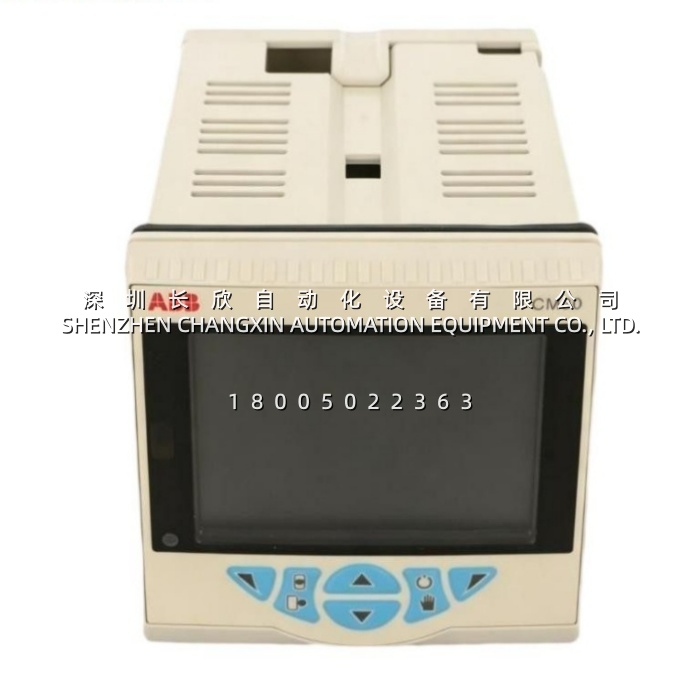
The ABB CM30 addresses these issues through configurable control structures and adaptive tuning. Its universal input can accept a direct thermocouple or RTD signal, while the controller processes the measurement using PID, gain scheduling, or predictive PI where supported by the installed functionality. A color operator screen shows process value, setpoint, output, and alarms without requiring the operator to scroll through multiple abbreviated displays. In this application, the controller can help maintain a stable temperature profile, reduce overshoot during transitions, and provide immediate visibility into abnormal sensor or control conditions.
In a boiler or thermal-fluid system, the ABB CM30 may be applied to temperature control, valve sequencing, or a dual-loop arrangement involving temperature and a secondary variable. The advanced autotune function calculates tuning values for the process, while configurable alarms and diagnostic messages help operators distinguish between a process deviation, sensor failure, and output problem. This reduces the need to interpret generic fault codes and helps maintenance personnel take faster, more accurate corrective action.
Parameter
| Main Parameters | Value/Description |
|---|---|
| Product Model | ABB CM30 |
| Manufacturer | ABB Measurement & Analytics |
| Product Category | Universal process controller |
| Product Family | ABB ControlMaster |
| Panel Size | 1/4 DIN |
| Faceplate Dimensions | 97 × 97 mm |
| Panel Cutout | 92 × 92 mm |
| Typical Mounted Depth | Approximately 121–141 mm depending on option boards and cabling |
| Display | 3.5 in. color TFT LCD |
| Analog Inputs | Up to 2 universal inputs; one standard and one optional |
| Input Types | Thermocouple, Pt100, mV, V, mA, resistance, frequency, pulse, and digital signals |
| Supported Thermocouples | B, E, J, K, L, N, R, S, T |
| Analog Outputs | Up to 2; one standard and one optional |
| Analog Output Signal | 0/4–20 mA typical; maximum load 750 Ω |
| Relay Outputs | Up to 4; one standard and three optional |
| Relay Rating | 5 A at 240 VAC typical |
| Digital I/O | Up to 6; 2 standard and 4 optional, configurable as inputs or outputs |
| Power Supply | 100–240 VAC ±10%, 50/60 Hz standard; 10–36 VDC optional |
| Maximum Power Consumption | 10 W |
| Process Alarms | 8 configurable alarms |
| Trend Capability | Two-channel on-screen trend; 272 displayed samples |
| Communication | Modbus RTU over RS-485 and/or Ethernet Modbus TCP, depending on build |
| Control Functions | PID, time proportioning, current proportioning, split output, motorized valve, autotune, gain scheduling |
| Advanced Templates | Feed-forward, cascade, ratio, and dual-loop strategies |
| Update Rate | 125 ms |
| Front Panel Protection | IP66 / NEMA 4X |
| Rear Protection | IP20 |
| Operating Temperature | 0 to +55°C |
| Storage Temperature | -20 to +70°C |
| Approximate Weight | 0.5 kg excluding accessories |
| Certifications and Compliance | CE; cULus where ordered; designed to relevant IEC/EN 61010 and IEC/EN 61326 requirements per configuration |