Application Scenarios
In a plastics extrusion plant, barrel zone temperature stability directly determines product dimensional consistency. An operator at the control panel notices that Zone 4 is oscillating ±8°C around setpoint, producing visible surface defects on the extrudate. The legacy controller offers only a red LED error code. With the ABB CM30 3 installed, the full-color TFT screen displays a trend graph of the zone temperature alongside the alarm log, showing that the oscillation began precisely when a downstream cooling fan kicked on—a classic control loop interaction issue invisible on a basic indicator. The technician adjusts the PID gain scheduling profile from the front panel, and the zone stabilizes within minutes. The value of the CM30 3 here is not just control—it is the diagnostic visibility that turns a blind troubleshooting exercise into a targeted correction, reducing scrap generation during changeovers.
Parameter
| Parameter | Value / Description |
|---|---|
| Product Model | ABB CM30 3 (family designation; specific variant depends on full code) |
| Manufacturer | ABB (ControlMaster Series) |
| Product Category | Universal Process Controller / PID Panel Instrument |
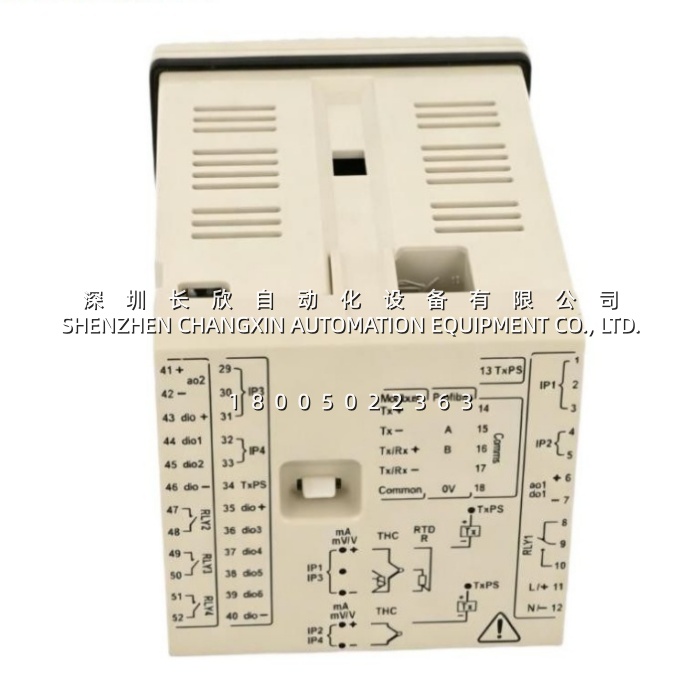
| Form Factor | 1/4 DIN, 97 mm × 97 mm front face, 121 mm panel depth |
| Display | Full-color TFT LCD, multi-line, green/red/yellow status colors |
| Output Configuration (3-output variant) | Analog and relay outputs; max 5A relay rating |
| Input Types | Universal: RTD, thermocouple (V-type), resistance, digital input, mA/mV |
| Digital Communications | RS485/Modbus, Ethernet, IrDA (configuration dependent) |
| Supply Voltage | 90–264 V AC (standard) or 24 V auxiliary options |
| Operating Temperature | 0°C to +55°C |
| Protection Rating | IP66 front panel, NEMA 4X |
| Mounting | Panel mount with integrated clamps |
| Key Standards | cULus, EN 61010-1, IEC 61326, NEMA 4X |
Technical Principles and Innovative Values
- Gain Scheduling for Nonlinear Processes: The CM30 3 stores up to three independent PID parameter sets and automatically switches between them based on process conditions. In a heat-treat furnace where the heating rate curve changes dramatically above 600°C, the controller can apply aggressive tuning during ramp and conservative tuning near soak temperature—eliminating the overshoot that a single PID set would produce.
- Split Output for Heat/Cool Control: A single CM30 3 can drive both a heating element and a cooling valve on the same process, with independent PID parameters for each direction. This eliminates the need for two separate controllers on extruders, injection molding machines, and environmental chambers where bidirectional control is required.
- On-Screen Math and Logic Blocks: Beyond PID, the controller executes arithmetic functions (averaging, min/max hold, square root) and eight logic blocks for interlock functionality. A flow measurement that requires temperature compensation can be calculated directly in the CM30 3, reducing the computation load on the supervisory PLC and eliminating a separate signal conditioning module.
- Front-Panel Configuration Without Software: Autotune, alarm setpoints, input type selection, and communication parameters are all accessible through the front-panel menu structure. For a maintenance technician replacing a failed unit at 2 a.m. without access to the engineering laptop, the can be brought online using only the faceplate buttons and the nameplate data from the failed original—a practical resilience feature that formal configuration software cannot match.
Application Cases and Industry Value
Case: Chemical Reactor Jacket Pressure Control
A specialty chemicals producer operated a batch reactor with jacket steam pressure control handled by a 15-year-old analog controller. The controller’s drift required manual correction every shift, and operators had no visibility into the pressure trend between control room rounds. A variant with relay outputs and Ethernet communication was installed as a drop-in panel replacement. The controller’s autotune routine established PID values within the first production batch, and the trend display on the TFT screen revealed a previously unnoticed pressure spike at the start of each steam injection cycle. By enabling the controller’s math block to apply a feedforward offset during the injection phase, the spike amplitude dropped by 60%, reducing mechanical stress on the jacket and extending gasket life. The plant reported that the paid for itself in reduced gasket replacement labor within eight months.
Related Product Combination Solutions
- The single-output base variant of the ; suited for simple temperature loops where three outputs are unnecessary, sharing the same panel cutout and display.
- ABB CM50 Series: The next-generation ControlMaster controller with enhanced connectivity; not a direct drop-in replacement for the due to terminal layout differences, but the natural migration path for new installations.
- ABB S800 I/O Remote Stations: For applications where the controls a local loop but process data must be integrated into a larger DCS, S800 I/O provides the distributed signal interface.
- RS485/Modbus Repeaters: Essential when multiple controllers are daisy-chained to a supervisory system over distances exceeding standard RS485 limits.
- Isolated 24 V DC Power Supply: Required for the auxiliary supply input when the is configured with communication modules that draw additional current.
- Panel-Mount Signal Isolators: Where the shares sensor signals with a PLC or recorder, isolators prevent ground-loop interference between the controller’s universal input and the external system.
- Replacement Gasket and Mounting Clamp Kit: The IP66 seal depends on the panel gasket integrity; keeping spare gaskets on hand maintains the environmental rating when the is removed for service.