Application Scenarios
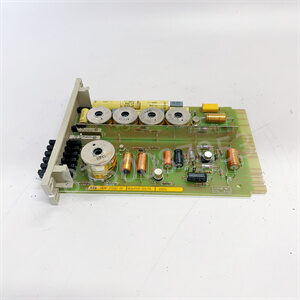
At a 320 MW coal-fired unit in Eastern Europe, the electrical team had been living with a nagging problem for months: after each large load rejection, the generator terminal voltage would overshoot by 4–6% before the AVR recovered, occasionally tripping the unit on overvoltage and costing the plant roughly €18 k per unplanned stop. Root-cause analysis pointed to a drifting reference DAC on the original ABB 3BHE014967R0001 (UNS2880B-P) that had been in service since the 2009 commissioning. Because the UNITROL 5000 rack supported redundant control boards, the team kept the failing unit online while staging a replacement. During the next scheduled outage, they slid a fresh ABB 3BHE014967R0001 into the standby slot, pushed the configuration from the active board via CAN-backed redundancy sync, and then rotated the faulty one out—zero excitation downtime. Post-retrofit load-rejection tests showed terminal voltage recovery within ±1.2% in under 1.5 seconds, and the “AVR sluggish” alarms that had been a weekly nuisance vanished. For a plant where excitation stability directly gates whether the turbine stays synchronized, the ABB 3BHE014967R0001 isn’t just a spare card—it’s the difference between a quiet night shift and a pager at 3 a.m.
Parameter
| Main Parameters | Value/Description |
|---|---|
| Product Model | 3BHE014967R0001 (UNS2880B-P / UNS2880B-P V1) |
| Manufacturer | ABB |
| Product Category | Excitation Control & Firing Pulse Board |
| Applicable System | ABB UNITROL 5000 / UNITROL 6000 static excitation |
| Backplane Supply | +5 V DC, ±12 V DC (analog), +24 V DC (digital, internally regulated) |
| Power Consumption | ~8 W (typical) |
| Control Loop Update | 10 kHz (DSP-driven AVR & limiters) |
| Trigger Pulse Output | Max 6 pulses/cycle (3-phase full bridge), optocoupler-isolated to pulse amp |
| Analog Input | ±10 V DC (16-bit ADC, PT/CT feedback conditioning) |
| Electrical Isolation | ≥2.5 kV AC (field/trigger side ↔ logic side) |
| Communication | CAN bus + backplane parallel bus (redundant board / HMI link) |
| Protection Functions | OEL, UEL, V/Hz limiter, Loss-of-Field (LOM), PT fuse alarm |
| Operating Temp | 0 °C to +60 °C (IEC 60255); storage –25 °C to +70 °C |
| Mounting | DSR/RFO rack slot (UNITROL cabinet backplane) |
| Dimensions (approx.) | 240 × 200 × 30 mm (variant-dependent) |
| Certifications | CE, IEC 60255, IEC 61000-6-2 / 6-4 |
Technical Principles and Innovative Values
- Innovation Point 1 — DSP-Level 10 kHz AVR Loop: Unlike older analog excitation cards that struggle with sub-cycle transient response, the ABB 3BHE014967R0001 runs a digital signal processor refreshing the entire AVR + limiter chain at 10 kHz. This gives the UNITROL system the headroom to ride through load rejections and grid disturbances without spilling into overexcitation taps.
- Innovation Point 2 — Native Redundancy via CAN + Backplane: Two ABB 3BHE014967R0001 boards can be paired in a hot-standby arrangement inside the same rack. If the active controller fails a watchdog or self-diagnostic check, the standby takes over bumplessly—critical for units running in grids with tight VAR dispatch windows.
- Innovation Point 3 — Integrated Protection Suite on the Same Silicon: OEL, UEL, V/Hz limiting, and loss-of-field detection are executed on the same DSP that drives AVR, meaning protection reaction times are sub-millisecond rather than relay-coil delays. The ABB 3BHE014967R0001 therefore collapses what used to be three separate cards (AVR + limiter + LOM) into one slot.
- Innovation Point 4 — 2.5 kV Galvanic Isolation in a Compact Footprint: The field side (thyristor firing, CT/PT sensing) and the logic/communications side are separated by reinforced optocoupler and PCB isolation barriers. This lets the ABB 3BHE014967R0001 live in the same rack with kilovolt-level thyristor stacks without logic corruption—a common failure mode on generic third-party excitation retrofits.
Application Cases and Industry Value
A run-of-river hydro plant in the Alps running two 55 MVA Francis units on UNITROL 5000 reported chronic VAR oscillation during rainy-season peaking, where the old excitation card couldn’t track the rapidly changing PSS (Power System Stabilizer) demand from the grid operator. Swapping both racks’ control boards to fresh ABB 3BHE014967R0001 units—and taking the opportunity to re-tune the AVR gains via ABB Composer—cut the VAR swing amplitude by roughly 38% and eliminated the “PSS out-of-range” nuisance trips that had forced manual voltage control three times that spring. The plant’s electrical supervisor noted that the ABB 3BHE014967R0001 paid for itself inside two months just on avoided regulation penalties. For asset owners sitting on UNITROL fleets, keeping a spare ABB 3BHE014967R0001 in the electrical room is widely considered cheaper insurance than any extended warranty.
Related Product Combination Solutions
- UNS2880B-P V2 / V3 — Later hardware revisions of the same excitation controller with expanded memory; firmware-compatible with ABB 3BHE014967R0001 (V1) for staged rack upgrades.
- UNS2881 — Measurement and signal-conditioning sibling board in the same DSR rack, handling PT/CT front-end buffering before the ABB 3BHE014967R0001 sees the signals.
- 3BHB011789R0001 — Thyristor (SCR) module commonly gated by the ABB 3BHE014967R0001‘s pulse outputs in UNITROL 5000 bridge arms.
- 3BHE019719R0001 — Gate-driver / pulse-amplifier board that sits between the ABB 3BHE014967R0001 and the thyristor stacks, boosting the optocoupled pulses to firing current.
- SD802F — 24 V DC power supply unit that feeds the DSR/RFO rack; the ABB 3BHE014967R0001 draws its +24 V digital rail from this module.
- ABB Composer / CMT — PC-side engineering tool used to download AVR parameters and limiter sets into the ABB 3BHE014967R0001 (essential—these boards do not auto-restore config from the redundant peer).
- UNS4876 — Human-machine interface (HMI) panel often mounted on the UNITROL cubicle door, talking CAN to the ABB 3BHE014967R0001 for local voltage setpoint and alarm display.