Application Scenarios
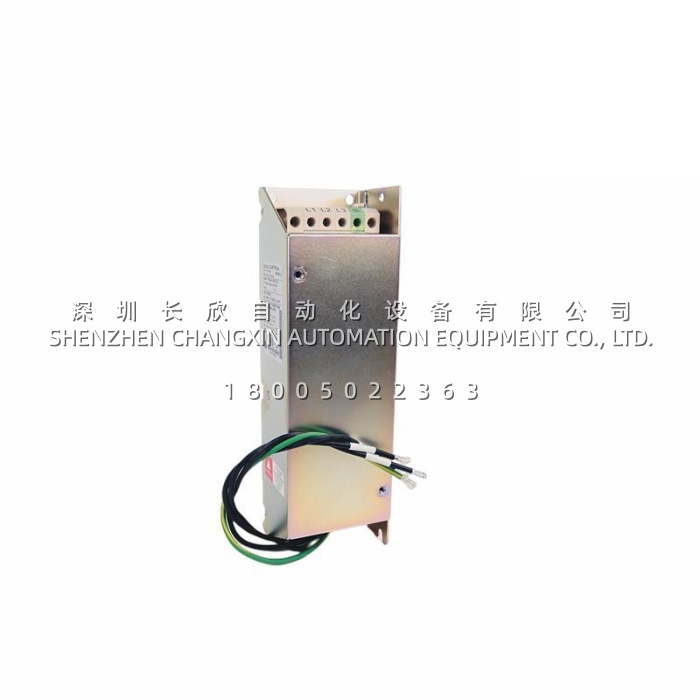
In a packaging line retrofit for a beverage bottling plant in Southeast Asia, the engineering team struggled with chronic EtherCAT communication dropouts and sporadic HMI black-screen events whenever the ABB drives ramped up to full speed. The root cause was traced to high-frequency noise coupling from the drive power lines into the control cabinet’s shared grounding system. By integrating the 25-RF7P5-AL directly onto each drive chassis, the facility achieved immediate stabilization of the EtherCAT network, eliminated nuisance trips, and brought the entire line into compliance with EN 61800-3 first-environment emission limits. This case underscores how the 25-RF7P5-AL resolves one of the most common pain points in modern automation: electromagnetic interference that degrades the reliability of sensitive control equipment and erodes overall production uptime.
Parameter
| Main Parameters | Value/Description |
|---|---|
| Product Model | 25-RF7P5-AL |
| Manufacturer | ABB |
| Product Category | EMC / EMI Filter Kit |
| Rated Voltage | 120–240 V AC (typical); up to 480 V AC / 600 V AC for 3-phase variants |
| Current Rating | Up to 50 A @ 250 V AC (typical for 7.5 kW class) |
| Frequency Range | 10 Hz – 300 MHz (broadband suppression) |
| Noise Attenuation | Up to 40 dB (20 kHz – 30 MHz band); 95 dB @ 20 kHz typical |
| Input Power Handling | Up to 1000 VA |
| Mounting Method | Panel-mount / direct chassis mount |
| Connection Type | Quick-connect terminals / screw terminal blocks |
| Housing Material | High-grade conductive plastics / polycarbonate |
| Protection Class | IP20 (for installation inside protective enclosure) |
| Operating Temperature | -20 °C to +70 °C |
| Certifications | CE, UL, CSA |
Technical Principles and Innovative Values
- Innovation Point 1: Dual-Mode Noise Suppression Architecture. The 25-RF7P5-AL employs a balanced combination of inductive chokes and X/Y rated capacitors to attack both common-mode and differential-mode noise simultaneously. Common-mode noise — the primary culprit behind interference in shared-ground control cabinets — is suppressed at the source, preventing it from radiating into sensitive PLC, encoder, and communication cables.
- Innovation Point 2: Factory-Validated Mechanical Integration. Unlike generic third-party filters that require custom fabrication, the 25-RF7P5-AL ships as a complete kit with pre-fabricated brackets, busbars, and hardware tailored for seamless mounting onto the target drive chassis. This eliminates engineering guesswork, reduces installation time, and guarantees correct electrical clearances.
- Innovation Point 3: Broadband Attenuation with Minimal Insertion Loss. The filter’s carefully tuned LC network delivers steep attenuation across the 10 Hz – 300 MHz spectrum without degrading drive efficiency or introducing measurable voltage drop. At the critical 20 kHz switching frequency of modern IGBT drives, attenuation reaches up to 95 dB — effectively neutralizing the noise that would otherwise propagate along power lines.
- Innovation Point 4: Global Compliance Built-In. The 25-RF7P5-AL is certified to CE, UL, and CSA standards, ensuring that drive installations in North America, Europe, and Asia-Pacific all meet local electromagnetic compatibility regulations out of the box, removing the burden of post-installation compliance testing from the end user.
Application Cases and Industry Value
In a water treatment facility on the U.S. Gulf Coast, a network of ABB drives controlling centrifugal pumps began triggering false alarms on neighboring Rosemount pressure transmitters and intermittent “device not responding” errors on the Modbus TCP backbone. After the plant installed the on each of the six affected drives, electromagnetic emission measurements dropped by more than 30 dB, bringing the site comfortably within FCC Part 15 and EN 61800-3 limits. The instrumentation team reported a 92% reduction in spurious transmitter alarms, and the maintenance department logged zero drive-related communication faults over the following six months. Beyond the measurable performance gains, the plant supervisor highlighted the labor savings: each unit took less than 20 minutes to mount and wire, versus the 2–3 hours previously required to source, fabricate, and validate a generic filter assembly.