
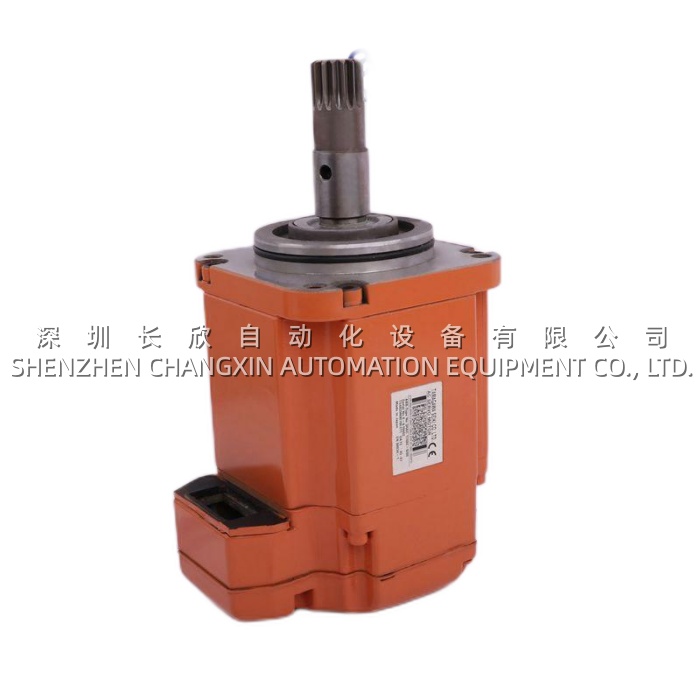
Technical Specifications
| Parameter Name | Parameter Value |
|---|---|
| Product Model | 3HAC10602-2 |
| Manufacturer | ABB Robotics |
| Product Type | Servo Motor Assembly (Axis 4 & Axis 6) |
| Compatible Robot | ABB IRB 2400 / IRB 2400L / IRB 2400T (full series) |
| Motor Type | Permanent-Magnet Synchronous (PMSM) |
| Rated Voltage | 230 VAC (from robot drive cabinet) |
| Max Continuous Torque | Axis 4: 12 Nm / Axis 6: 8 Nm (typical) |
| Max Speed | 3000 rpm |
| Feedback Device | Incremental optical encoder, 2048 PPR |
| Brake | Spring-applied, power-off engaged (standard ABB robot wrist brake) |
| Connector Type | Circular aviation-style plugs (power / brake / encoder), matched to IRB 2400 harness |
| Cooling | Natural convection (fanless) |
| Protection Class | IP54 (dust / splash) |
| Operating Temperature | 0 °C to +50 °C |
| Storage Temperature | –20 °C to +70 °C |
| Mounting | Wrist flange, bolt-on to IRB 2400 Axis-4 / Axis-6 casting |
| Dimensions | Approx. 250 × 150 × 100 mm (envelope, w/ connector boss) |
| Weight | ≈ 4.2 kg (complete assembly incl. brake & encoder) |
| Humidity | 5–95 % RH, non-condensing |
| Compliance | CE, ISO 9001 (ABB Robotics production standard) |
Main Features and Advantages
Shared SKU for Two Wrist Axes. The biggest commercial advantage of the ABB 3HAC10602-2 is that it serves both Axis 4 and Axis 6 on the IRB 2400. These two axes share the same wrist envelope and motor flange, differentiated only by the reduction stage and the IRC5 calibration record. For a plant running 10–20 IRB 2400 cells, stocking 3HAC10602-2 alone covers the majority of wrist-motor failure modes; you do not need separate Ax-4 and Ax-6 spares. This halves the spare-capital tied up in robot joints.
Wrist-Matched Durability. Axis 4 and Axis 6 are the robot’s most cycled axes in welding and handling — every gun tip-change, every part reorient, every arc-on/off toggles one or both. The ABB 3HAC10602-2 uses ABB-standard deep-groove ball bearings with lifetime grease, vacuum-impregnated stator windings (moisture + flux-fume resistance in body-shop environments), and a cast-aluminum shell that spreads heat evenly so thermal expansion stays symmetric — important because Ax 4/Ax 6 sit inside the wrist where three motors share one small air pocket. IP54 keeps metal dust, cooling-tower mist, and occasional wash-down splash off the windings; in IRB 2400 Foundry/Casting variants the robot shell goes to IP67, and the 3HAC10602-2 motor internals hold up behind that envelope.
Plug-and-Play into IRC5. The encoder on the ABB 3HAC10602-2 is pre-matched to ABB’s IRC5 servo drive encoder interface (2048 PPR incremental). After mechanical swap, the IRC5 “Replace Unit” wizard recognizes the new motor, and the robot’s existing calibration file (stored on the controller compact flash / RobotWare) carries the zero-position — so you do not need to physically mark the flange before removal (though best practice still says mark it). Brake release, encoder zero, and power-up self-test all run automatically. A cell that was logging “motor overtemperature” or “encoder glitch” on Ax 4 typically comes back to <0.05 mm repeatability on the first teach-pendant test program after a ABB 3HAC10602-2 swap.
Shielded Signal Integrity. The encoder tail on the ABB 3HAC10602-2 is fully shielded and clamped to the motor housing, and the three-connector set (power / brake / encoder) uses ABB’s standard robot circular locks that cannot vibrate loose under 450 °/s wrist flips. In plants where the IRB 2400 shares a bus with large spot-welder transformers or hydraulic power units, this shielding discipline prevents the “lost pulse” events that cheaper third-party wrist motors introduce — pulses that manifest as micro-jitters in the weld gun trajectory and eventually as reject welds.
Diagnostic Clarity. When a ABB 3HAC10602-2 is ageing (typically 8–12 years in two-shift welding), the IRC5 flex pendant will log a pattern: intermittent “encoder communication error” on Ax 4 or Ax 6 during high-speed reorient moves, or “motor overtemperature” on one wrist axis while the neighbor stays cool — a sign of winding insulation breakdown or bearing drag. Because the ABB 3HAC10602-2 is a complete assembly (motor + brake + encoder pre-harnessed), swapping the whole unit clears all three potential failure modes (windings, brake coil, encoder) in one move, rather than troubleshooting which sub-element died.
Application Field
The ABB 3HAC10602-2 deploys wherever IRB 2400 robots deploy, and the IRB 2400’s install base is heavily weighted toward arc welding, spot welding, material handling, and machine-tending cells — so the motor’s application map follows those processes.
Automotive body shop is the single largest bucket. IRB 2400 in 7–16 kg payload variants is a workhorse arc-welding and stud-welding platform; Ax 4 (wrist roll) and Ax 6 (flange flip) execute the gun-orientation moves that keep the weld torch normal to the seam as the part indexes. In a typical bodyshop trim-line cell, the ABB 3HAC10602-2 on Ax 4/Ax 6 sees 200,000+ cycles/month of start-stop reorient. Motor ageing here shows up as “gun-tip wander” — the TCP drifts 0.3–0.5 mm over a shift because the wrist motor’s bearing preload has relaxed or the encoder has micro-gaps. Swapping the 3HAC10602-2 restores TCP stability without re-teaching the entire seam program.
3C / electronics assembly is a second heavy user. Small-parts pick-place, screwdriving, and dispensing cells on IRB 2400 7 kg variants use Ax 4/Ax 6 intensively for part reorient between feeder and nest. The ABB 3HAC10602-2 in this context benefits from the 2048 PPR encoder’s resolution — the IRC5 can hold ±0.02 mm repeatability at the tool tip through high-speed wrist flips, which matters when the “part” is a phone mid-frame or a camera module.
General industry material-handling and machine-tending round out the map. IRB 2400 in die-cast tending (extracting from 400-ton press, quenching, trim press load) runs Ax 4/Ax 6 hard because the extractor gripper must flip the part 180° (Ax 6) and roll it into the quench (Ax 4) within a 4-second cycle. The cast-aluminum shell and IP54 rating of the ABB 3HAC10602-2 hold up to the die-lube mist and the press-hall ambient (often 35–42 °C near the die spray). In foundry/casting variants of IRB 2400 (IP67 robot shell), the motor sits behind the sealed wrist so it sees less direct abuse, but the 0…+50 °C motor rating still governs — plants in tropical press shops sometimes add a small wrist-shaft purge air to keep the motor ambient bounded.
Retrofit and service context: IRB 2400 is a mature platform (launched late 1990s, still widely installed), so many plants are now in year 10–18 of robot life. The ABB 3HAC10602-2 is one of the top three spare SKUs ordered during robot mid-life refurb, alongside the Ax 1–3 shoulder motors and the wrist reducers. A common failure pattern: the technician blames the reducer (Harmonic/Cyclo wrist unit) because the axis feels “notchy,” but a thermal check shows the motor drawing 30 % above nameplate at no-load — meaning the 3HAC10602-2 windings or brake are dragging, and the reducer is innocent. Swapping the motor first (cheaper, faster) before cracking the reducer is the recommended diagnostic sequence.