Technical Specifications
| Parameter | Value |
|---|---|
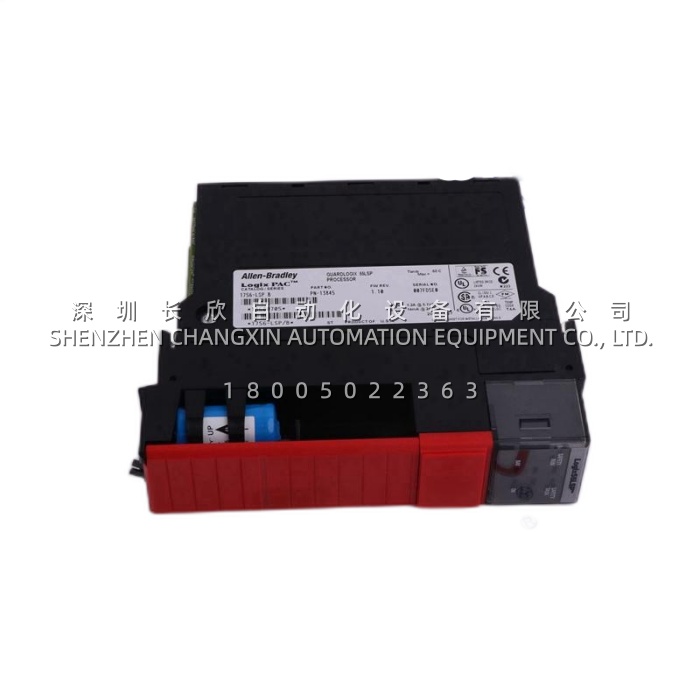
| Product Model | 1756-IF4FXOF2F/A (Series A) |
| Manufacturer | Allen-Bradley / Rockwell Automation |
| Product Type | ControlLogix High-Speed Analog Input/Output Combo Module |
| ControlLogix Platform | 1756 chassis, backplane-powered, single slot |
| Input Channels | 4 single-ended, individually configurable |
| Input Ranges | ±10 V, 0–10 V, 0–5 V, ±5 V, 1–5 V, 0–20 mA, 4–20 mA, ±20 mA |
| Input Resolution | 24-bit delta-sigma A/D, 18-bit + sign effective |
| Input Accuracy | ±0.02% full scale, ±2 LSB (typ., 25 °C, end-to-end) |
| Input Conversion Time | < 100 µs per channel |
| Input Update / Sampling | 5 µs channel update; module scan-synchronous operation |
| Input Filtering | Programmable digital filter per channel (noise rejection / averaging) |
| Output Channels | 2, voltage and current separately configurable |
| Output Ranges | ±10 V, 0–10 V, 0–20 mA, 4–20 mA |
| Output Resolution | 18-bit + sign |
| Output Settling Time | 20 µs to ±0.1% of step |
| Output Update | 5 µs (backplane-to-output) |
| Fault / Watchdog Action | Hold last value or programmable fault state; drive disable on fault |
| Field Wiring | Removable terminal block, screw-clamp, DIN-rail style |
| Terminal Block | 1756-TBNH (standard); 1756-TBSH (fused) |
| Wire Size | 0.2–2.5 mm² (24–12 AWG), stranded or solid, shielded recommended |
| Isolation | 250 V continuous reinforced isolation, channel-to-backplane |
| Backplane Current | 1.0 A @ 5.1 VDC, 0.030 A @ 24 VDC (typical) |
| Operating Temperature | 0…60 °C (32…140 °F) |
| Storage Temperature | -40…85 °C (-40…185 °F) |
| Relative Humidity | 5…95% non-condensing |
| Enclosure / Mounting | Open-style, 1756 chassis slot; panel and DIN-rail chassis options |
| Programming | Studio 5000 Logix Designer / RSLogix 5000, tag-based |
| Compatible Controllers | ControlLogix L7x, L8x, GuardLogix (match firmware/major revision) |
| Status Indicators | Module OK, Network/Backplane, per-channel I/O status LEDs |
| Lifecycle Status | Mature / legacy sourcing; spare, refurbished and repair support |
Main Features and Advantages
Speed that actually reaches the controller. The headline numbers on the 1756-IF4FXOF2F/A are easy to quote and harder to find on a real module: 5 µs input and output update, sub-100 µs conversion, 20 µs output settling. What that buys you is an analog loop that runs inside the task, not downstream of it. A tension regulator, a hydraulic pressure clamp or a force-feedback test stand sees a controller command and a measured response that belong to the same scan. There is no point specifying a fast servo and then hanging it on a 100 ms universal analog card; the 1756-IF4FXOF2F closes that gap on the rack backplane.
Independent channels, one consistent config model. Every input on the 1756-IF4FXOF2F/A is its own signal path — own range, own filter, own open-circuit and over-range status, own calibration coefficients. Mix a ±10 V encoder-derived speed signal, a 4–20 mA load cell, a 0–5 V potentiometric feedback and a ±20 mA valve feedback on one module without cross-talk or compromise. The same principle holds on the outputs: voltage and current ranges are set per channel, so one output can drive a ±10 V velocity command while the other sources a 4–20 mA setpoint to a legacy drive. Configuration lives in plain Logix tags, which means scaling, clamping and alarming are visible in the project rather than hidden in a vendor dialog.
Fault behaviour designed for machinery, not laboratories. Fast analog is only useful if it fails safely. On a backplane fault, processor-mode change or watchdog expiry the 1756-IF4FXOF2F/A can hold the last output value or drive the channel to a programmed fault state, and the controller sees the transition through standard status bits immediately. On the input side, open-circuit and out-of-range detection catches the broken shield, the loose crimp and the transmitter that has gone silent before the product does. For a machine where an analog zero equals “close the valve now,” that distinction between a real zero and a dead wire is the entire safety case.
Clean integration, no extra power, no extra tools. The module is backplane-powered, so there is no 24 VDC distribution, no fuse holder and no separate supply to trace when the cabinet goes dark. The 1756-TBNH removable block lets you swap the module with the field wiring intact — a real shift-saver when the wiring is shielded, dressed and labelled. Diagnostics flow through the same Logix alarm model as the rest of the chassis, so your HMI and your SCADA see module health in the same way they see a discrete I/O fault. That consistency is why maintenance teams trust the 1756-IF4FXOF2F/A on live lines: the failure looks familiar before they even open the door.