
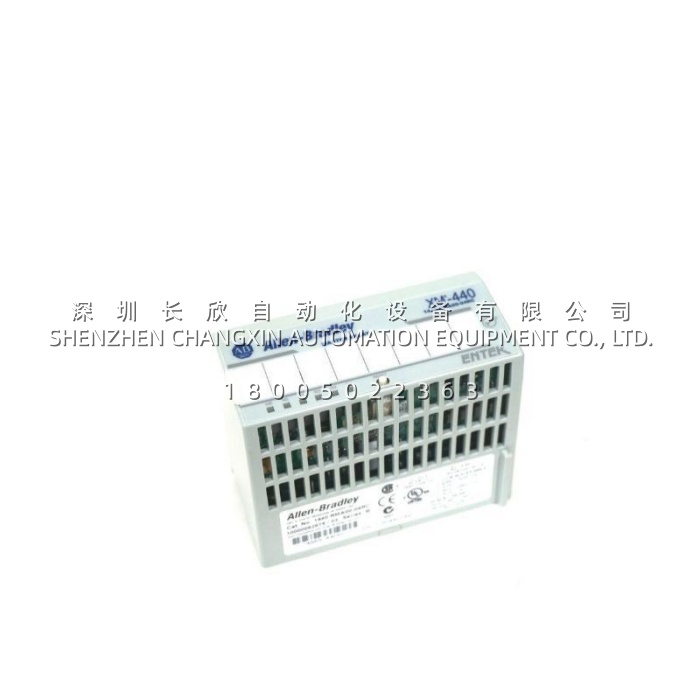
Product Overview
The 1440-RMA00-04RC is an Allen-Bradley distributed I/O module in the 1440 XM (eXtreme Measurement) series, manufactured by Rockwell Automation. Its function is to acquire temperature data from resistance temperature detectors and convert those measurements into analogue signals that can be used locally or communicated to a control system. The 1440-RMA00-04RC is therefore a temperature-measurement I/O module, not a general-purpose discrete I/O module, not a safety module and not a member of the ControlLogix 1756 product family.
The suffix coding of the 1440-RMA00-04RC is consistent with the XM naming convention: the “04” denotes four input channels, while the “RC” denotes the RTD input type in a compact form factor. Each channel accepts a PT100 sensor, normally connected with three wires, or a PT1000 sensor, connected with two or three wires. The module provides 24 VDC sensor excitation on each channel, with a fixed excitation current of 2.5 mA. A 4–20 mA analogue output is produced for each channel, allowing the temperature measurement to be presented as a standard industrial current signal.
The 1440-RMA00-04RC is designed to operate as part of an XM distributed I/O network. DeviceNet connectivity is provided through a separate XM communication module, so the temperature module itself can be located close to the sensors while the network interface is mounted at the appropriate point in the cabinet. This reduces long sensor wiring runs and supports a clean distributed architecture for temperature monitoring.
The 1440-RMA00-04RC is a mature product and should be matched carefully to the host communication module, network configuration and sensor wiring. It is particularly valuable as a replacement module in existing XM installations that already use the defined sensor types and 4–20 mA output structure.
Technical Specifications
| Parameter Name | Parameter Value |
|---|---|
| Product Model | 1440-RMA00-04RC |
| Manufacturer | Allen-Bradley / Rockwell Automation |
| Product Family | 1440 XM (eXtreme Measurement) distributed I/O |
| Product Type | 4-Channel RTD Temperature Input Module |
| Number of Channels | 4 |
| Input Type | RTD (Resistance Temperature Detector) |
| Supported Sensors | PT100 (3-wire connection); PT1000 (2- or 3-wire connection) |
| Sensor Excitation | 24 VDC per channel |
| Excitation Current | 2.5 mA fixed |
| Output Signal | 4–20 mA analogue output per channel |
| Communication | DeviceNet, via a separate XM communication module |
| Network Media | DeviceNet cable and connectors |
| Mounting | XM distributed I/O mounting arrangement; verify against the installation manual |
| Approvals | CE (Europe); cULus (United States/Canada) |
| Enclosure Consideration | Compact design; verify ingress protection against the application requirement |
| Operating Temperature | Confirm against the applicable 1440 XM product documentation |
| Storage Temperature | Confirm against the applicable documentation |
| Humidity | Non-condensing conditions |
| Compatibility | Requires compatible XM communication module and DeviceNet configuration |
| Lifecycle Status | Legacy/mature product; availability through independent spare-part channels |
Main Features and Advantages
The defining feature of the is its dedicated four-channel RTD acquisition capability. Rather than using a general analogue input to condition a temperature signal externally, the module provides excitation and measurement designed for PT100 and PT1000 sensors. This gives a well-defined interface for common industrial temperature transducers and reduces the need for separate signal-conditioning hardware.
Each channel of the supplies 24 VDC excitation at a fixed 2.5 mA. This is suitable for the supported PT100 and PT1000 sensor arrangements and keeps the sensor interface consistent across all four channels. The module also provides a 4–20 mA output per channel, so the measured temperature can be used as a conventional analogue signal by local instrumentation or by the control system through the appropriate analogue input.
Distributed installation is a key advantage. The is intended to be located near the measurement points, with DeviceNet communication handled by a separate XM module. This allows temperature sensors to be wired over short distances while the digital network carries the information back to the cabinet. It is particularly useful where multiple temperature points are spread across a machine or process area.
The module’s CE and cULus approvals support its use in installations that require compliance with European and North American equipment requirements. The compact design helps keep panel space reasonable in distributed I/O applications. For plants maintaining an installed XM system, the offers a direct replacement route that preserves the original sensor wiring, excitation arrangement and analogue output structure.