
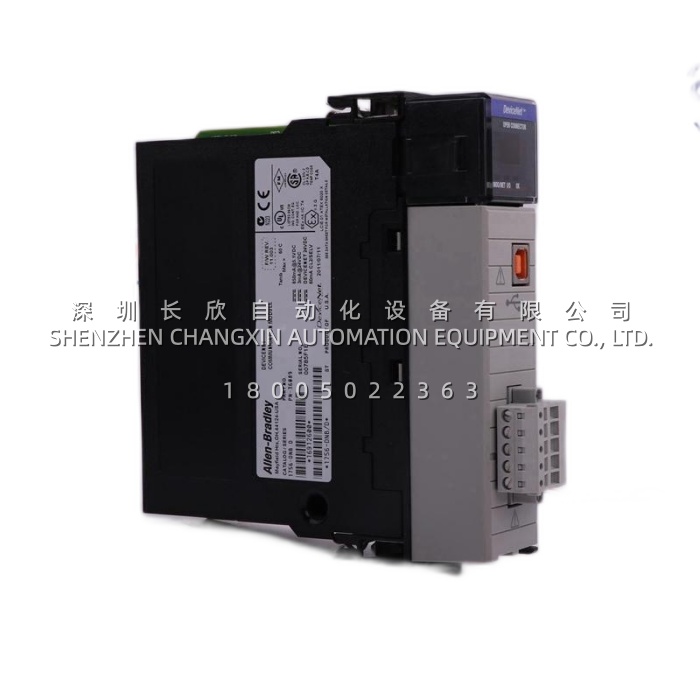
Application Scenarios
In a steam turbine generator set at a power plant, axial thrust position is one of the most safety-critical measurements. If the rotor shifts axially beyond allowable limits, the turbine blades can contact stationary components, causing catastrophic damage worth millions in repairs and lost generation. The 1440-TPS02-01RB continuously monitors eddy current or LVDT position transducers mounted on the turbine bearing pedestals, converting their signals into precise position readings. When thrust position approaches alarm thresholds, the module activates its onboard relays to trigger operator alerts or initiate protective shutdown sequences . Without reliable position monitoring, turbine operators are blind to rotor migration—one of the leading causes of turbine failure. The 1440-TPS02-01RB provides that essential visibility, operating within the XM architecture to deliver deterministic protection independent of the plant’s main control system.
Parameter
| Main Parameters | Value/Description |
|---|---|
| Product Model | 1440-TPS02-01RB (XM-320) |
| Manufacturer | Allen-Bradley / Rockwell Automation |
| Product Category | Position Measurement Module |
| Measurement Channels | 2 independent channels |
| Input Signal Types | Eddy current transducer, LVDT, voltage signals from position sensors |
| Transducer Power | Isolated 24V, configurable +24V or -24V |
| Voltage Range | Selectable between -24V and +24V |
| 4…20mA Outputs | 2 isolated outputs, max load 600 Ω |
| Buffered Outputs | 2 (one per channel) |
| Communication | DeviceNet (125/250/500 Kbps), RS-232 serial (19.2 Kbps) |
| Relay Output | 1 onboard DPDT (2 Form C); expandable to 4 with XM-441 |
| Relay Rating | Max 125V DC/AC, 3.5 A (derates to 2 A at 65°C) |
| Power Supply | 24V DC, max 200 mA, typical 165 mA |
| Operating Temperature | -20°C to +65°C |
| Physical Dimensions | 97 x 94 x 94 mm (H x W x D) |
| Terminal Base | 1440-TB-B (keyswitch position 4) |
Technical Principles and Innovative Values
- Innovation Point 1: Dual-Channel Independent Measurement with Configurable Signal Conditioning. The 1440-TPS02-01RB supports two fully independent measurement channels, each capable of accepting eddy current, LVDT, or voltage-based position signals. Transducer power is software-configurable for either +24V or -24V excitation, eliminating the need for external signal conditioners and simplifying wiring in turbine supervisory cabinets . Sensitivity and voltage range are user-configurable via software, allowing a single module type to serve multiple position measurement applications across a plant.
- Innovation Point 2: Integrated Protection Relay with Flexible Alarm Logic. Unlike passive measurement modules, the 1440-TPS02-01RB incorporates an onboard DPDT relay capable of directly driving alarm indicators or initiating shutdown sequences. Each channel supports two alarm and danger setpoint pairs with selectable operators (greater than, less than, inside/outside range), adjustable hysteresis, and time delays from 0 to 25.5 seconds . The setpoint multiplier function allows temporary setpoint adjustment during startup, preventing nuisance trips during transient conditions.
- Innovation Point 3: Head-to-Head and Radial Cancel Measurement Modes. The 1440-TPS02-01RB supports specialized measurement modes beyond simple dual-channel operation. Head-to-head mode combines readings from two opposing sensors for differential expansion measurement. Radial cancel mode subtracts one channel from another to eliminate common-mode effects, useful in applications where two sensors monitor the same physical parameter from different directions . These modes reduce the need for external math modules and improve measurement integrity.
- Innovation Point 4: DeviceNet Integration with Delta Time Buffer. The module communicates all measurement data and status over DeviceNet using a standard EDS file, integrating seamlessly with ControlLogix, PLC-5, and SLC platforms . The built-in delta time buffer stores up to 2048 records at intervals from 1 to 3600 seconds, triggered by relay activation or DeviceNet command. This enables post-event analysis of position trends leading up to an alarm or trip, supporting root-cause investigation without external data loggers.