Application Scenarios
A municipal water authority runs a filtration plant where the original design put the processor in a central control room and the I/O in six field cabinets spread across the site — chemical dosing, filter gallery, backwash pumps, sludge handling, inlet works and outlet monitoring. Re-homing all that I/O would mean pulling thousands of metres of new cable through a plant that cannot be taken offline, so the serial I/O architecture has to stay.
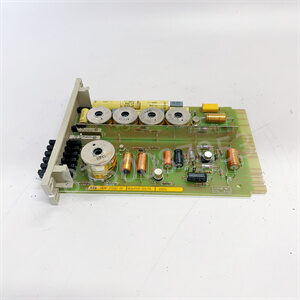
Each field cabinet holds one 621-9940C in slot N of a full-size rack (or slot H of a half rack where space is tight). The module is configured purely in hardware: SW1 sets the absolute starting address, SW2 sets the fault-state behaviour of the rack outputs, and SW3–SW5 declare whether each slot carries 0, 8, 16 or 32 points. When a backwash pump cabinet was recently extended with sixteen extra status points, the technician simply re-set SW3 on the 621-9940C and dropped in a 16-point card — no programming terminal, no firmware load, no controller downtime. The pain point the module removes is exactly this: distributed I/O that can be expanded, re-ranged or replaced in the field without touching the head-end engineering.
Parameter
| Main Parameters | Value / Description |
|---|---|
| Product Model | 621-9940C (base model 621-9940; the C suffix denotes the CE-conformant variant) |
| Manufacturer | Honeywell |
| Product Category | Serial I/O Module (SIOM) — remote serial I/O card-file controller / serial communication interface card |
| Host System | Honeywell IPC 620 / IPC 621 programmable controller family (620-15, 620-20, 620-25, 620-35, Logic Manager) |
| Rack Slot Assignment | Slot N in a full-size I/O rack; slot H in an I/O half rack |
| I/O Point Density | Each I/O slot independently set to 0, 8, 16 or 32 points; mixed densities allowed in one rack, total must remain within the 620 Logic Controller I/O capacity |
| Configuration Interface | Four 8-position DIP switch banks (SW1–SW4) plus one 4-position DIP switch (SW5) on the circuit board — no software tool required |
| Starting Address Range | SW1 selects the absolute card-file starting address from 0 to 2,032 in increments of 8; overlapping or above-limit addresses are prohibited |
| Serial Link Physical Layer | Two-pair shielded serial cable, Belden 9729 or equivalent; 200 ohm (1/2 W) terminating resistor required at each extreme end, 300 ohm where the installation specifies it, two resistors in the last drop of a multidrop channel |
| Communication Integrity & Diagnostics | CRCC appended to every SLM/SIOM message, automatic retry on CRC error or timeout, per-drop off-line isolation, SIOM off-line flag and off-line rack address posted in status registers 2040–2047 |
| Power Supply | Fed from the I/O rack power supply through the backplane (621-9933C / 621-9934C class); a standard rack supply supports up to 3 serial/analog modules, an extended supply up to 11 |
| Physical & Environmental | Approx. 264 × 32 × 127 mm, 0.61 kg; operating 0 °C to +60 °C, storage −40 °C to +85 °C, 5–95 % RH non-condensing; front terminal block and status LEDs |
| Compliance & Service Rating | CE conformant to the low-voltage and EMC directives; carries the C suffix only — it is not rated for insertion or removal with the rack powered (only the R suffix authorises that) |
Technical Principles and Innovative Values
Innovation Point 1: Node-level intelligence instead of dumb repeating. The 621-9940C is not a passive line extender. It controls its own card file, reads the rack backplane, writes output/PUSH data to the I/O cards, and answers the Serial Link Module with input/PULL data inside the same message turnaround. Because the serial I/O scan runs asynchronously to the processor scan, a remote drop hundreds of metres away does not stretch the controller’s ladder execution time.
Innovation Point 2: A hardware-defined personality. Every behavioural decision on the 621-9940C — starting address, card-fault recognition, communication-fault response, normal or test mode, and the point density of each slot — is made by DIP switches on the board. There is no firmware to load, no configuration database to restore, no battery to replace and no engineering workstation to connect. A failed unit can be swapped in minutes by a technician who has never opened the project file, which is a decisive advantage on a 24/7 process line.
Innovation Point 3: Graceful degradation under fault. Each message exchanged by the 621-9940C carries a cyclic redundancy check character. On a CRC mismatch or timeout the link retries; if a second attempt also fails, only the affected drop takes itself off-line while every other drop on the same multidrop channel keeps running. The off-line flag and the starting address of the faulted rack are written into registers 2040–2047, so the controller itself can raise an alarm naming the exact cabinet. Conventional parallel I/O loses an entire rack — and often the whole link — for the same class of fault.
Innovation Point 4: Point density you actually pay for. The 621-9940C lets each slot be declared at 0, 8, 16 or 32 points, and those densities can be mixed inside one rack. A machine builder can concentrate points where the wiring is dense and spread them out where process security matters, without buying capacity that will never be used.
Innovation Point 5: Cabling economy on brownfield sites. One two-pair Belden 9729 trunk serves a multidrop chain of card files, replacing hundreds of home-run conductors back to the processor room. On retrofit projects this is frequently the single largest cost avoided, and the 621-9940C is the component that makes the topology possible.
Application Cases and Industry Value
Case 1: Six-drop filtration plant, municipal water. A water treatment authority operating a 1980s-era Honeywell IPC 620 installation found its remote I/O spread over six field cabinets fed by a single serial channel per wing. When one cabinet’s SIOM began dropping off-line intermittently, the status registers showed the fault at a specific starting address rather than a generic link failure, and maintenance walked straight to the correct cabinet. Replacing the 621-9940C restored the drop in under an hour. Because the link isolates a failed drop instead of collapsing the channel, the other five cabinets never lost control during the incident — the plant kept producing water throughout. Over the following year the authority standardised on holding one tested spare 621-9940C per drop type, cutting its worst-case repair time from days of fault-finding to a single shift.
Case 2: Staged modernisation without rewiring, specialty chemicals. A chemical producer needed to bring legacy IPC 620 remote I/O into a modern control platform but could not justify re-pulling field cable through classified areas. The chosen route was to keep every 621-9940C in place and replace only the head-end: third-party IPC-620 serial I/O scanner modules are designed to work with 621-9940 SIOM modules and substitute for the original Serial Link Module, mapping the existing drops into a contemporary controller’s tag database. The plant therefore preserved its entire field wiring investment, avoided a classified-area cable scope, and gained a migration path that can be executed drop by drop during scheduled turnarounds. The 621-9940C went from being an obsolescence risk to being the anchor of a phased upgrade.