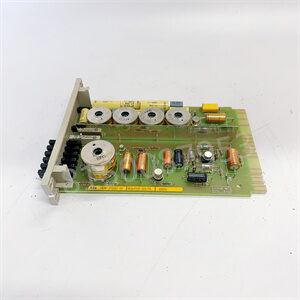
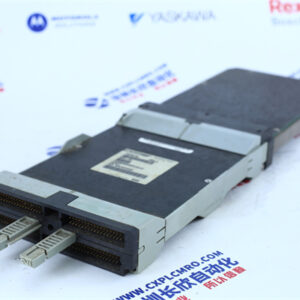
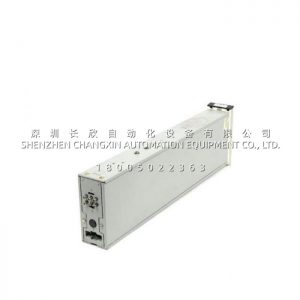
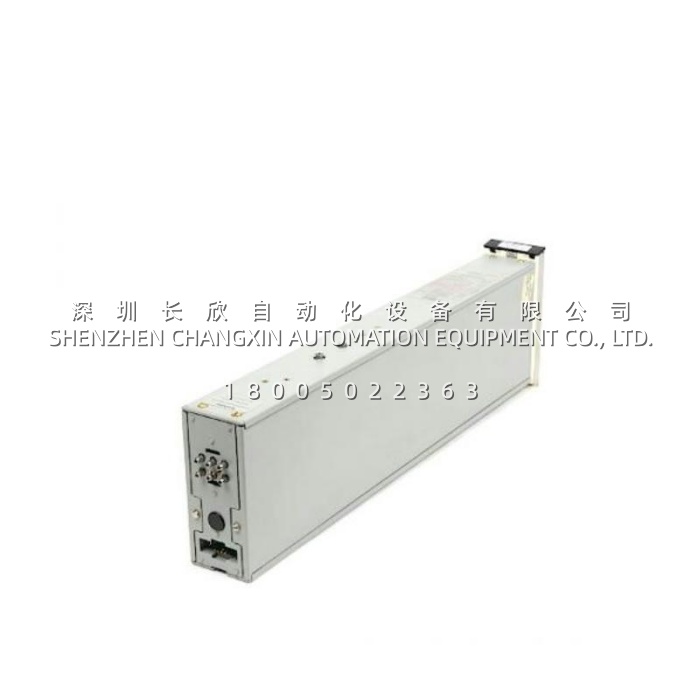
Application Scenarios
Consider an aging refinery’s boiler feedwater control loop, where a malfunctioning pneumatic controller is causing erratic steam drum pressure, forcing operators to manually throttle the valve—a risky and inefficient practice. A maintenance engineer sources a Foxboro 130M-N5 as a direct drop-in replacement for the failed unit. After installation, the controller receives a 3-15 psi signal from the pressure transmitter and compares it to the setpoint dialed in by the operator. The Foxboro 130M-N5‘s built-in PID logic then automatically adjusts the output to the steam valve actuator, stabilizing the pressure within ±0.5% of span . The engineer can seamlessly switch between Auto and Manual modes using the front-panel A/M switch, ensuring “bumpless” transfer that prevents process upsets during critical startup or upset conditions . This quick intervention eliminates the need for a costly, time-consuming DCS upgrade, keeping the unit online with minimal downtime.
In a chemical plant operating in a Class I, Division 1 hazardous area, electronic controllers are unsuitable due to the explosion risk. The Foxboro 130M-N5 is the perfect fit. With no electrical components, it is inherently intrinsically safe . The plant uses the 130M-N5 to regulate reactor temperature. The pneumatic controller takes the 3-15 psi signal from a temperature transmitter and modulates a cooling water valve. The force-balance mechanism responds quickly—typically within 2 seconds—to variations, maintaining tight temperature control even under fluctuating feed conditions . Its robust construction and ability to operate in temperatures from -40°C to +85°C make it a reliable workhorse in this harsh environment .
Parameters
| Main Parameters | Value/Description |
|---|---|
| Product Model | 130M-N5 |
| Manufacturer | Foxboro (now Schneider Electric) |
| Product Category | Pneumatic Indicating PID Controller |
| Input Signal (PV) | 3-15 psi (0.2-1.0 bar / 20-100 kPa) |
| Output Signal (OUT) | 3-15 psi (0.2-1.0 bar / 20-100 kPa) |
| Supply Air | 20-22 psi (1.4-1.5 bar) clean, dry instrument air |
| Control Modes | PID (Proportional + Integral + Derivative) |
| Accuracy | ±0.5% of span (typical) |
| Display | Vertical scale with two pointers (Green=PV, Red=SP) |
| A/M Switching | Bumpless transfer between Auto and Manual |
| Air Consumption | ~0.5 m³/h (Auto); ~1.0 m³/h (Manual) |
| Mounting | Panel mount in 101/102 series rack (1 unit high) |
| Operating Temp. | -20°C to +60°C / -40°C to +85°C (varies by source) |
| Dimensions (H×W×D) | 17.8 x 5.1 x 30.5 cm |
| Weight | 0.5 kg (approx.) |
Technical Principles and Innovative Values
Innovation Point 1: Pure Pneumatic Force-Balance Computing
The core of the Foxboro 130M-N5 is a mechanical force-balance system using metal bellows, a nozzle-flapper amplifier, and precision linkages . Instead of electronic chips, it uses air pressure and mechanical force to perform the mathematical calculations for PID control. The process variable (PV) and setpoint (SP) pressures act on opposing bellows. Any imbalance moves a beam, altering the flapper position relative to a nozzle. This changes the output pressure, which is fed back to a “feedback” bellows to restore equilibrium. The result is a stable, proportional output that precisely corresponds to the deviation between PV and SP. This makes the 130M-N5 inherently intrinsically safe (no risk of sparking) and immune to electromagnetic interference—a critical feature for legacy chemical and oil/gas plants .
Innovation Point 2: Modular “Slide-Out” Serviceability
The Foxboro 130M-N5 is designed with separate Auto and Manual control units housed in the same shelf . If the automatic PID module fails, an operator can physically slide out the auto unit from the rack while the manual unit continues to control the process . Both sections have jack-plug pneumatic connections with built-in check valves, so they can be removed from the shelf without disconnecting any piping . This hot-swappable design minimizes downtime for maintenance in continuous process industries, a stark contrast to integrated electronic controllers that require a full system shutdown for repair.
Innovation Point 3: Integral Balancing for Bumpless Transfer
The 130M-N5 uses an “integral balance” method during Auto/Manual transfers . When switching from Manual to Auto, the controller automatically ramps the output to match the current manual output pressure before engaging, ensuring no sudden “bump” in the process variable.