Application Scenarios
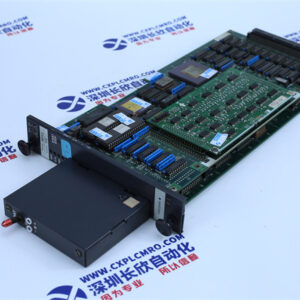
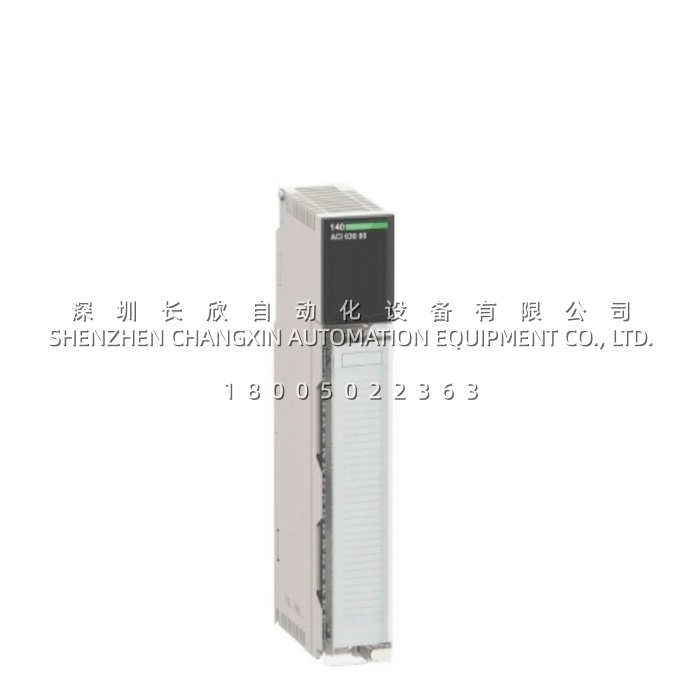
Consider a chemical processing plant where precise temperature and pressure monitoring is critical to product quality and safety. The existing control system struggled with signal drift and noise interference from nearby high-power equipment, causing inconsistent readings and occasional false alarms. The SCHNEIDER 140ACI03000 directly addresses this pain point with its differential input design and common mode rejection better than -72 dB at 60 Hz, effectively eliminating noise from interference. The module’s 8-channel configuration allows a single module to monitor multiple sensors simultaneously—reactor temperatures, pipeline pressures, and tank levels—reducing rack space requirements and simplifying system architecture. When a sensor line breaks, the built-in broken wire detection (for current mode) and undervoltage detection (for voltage mode) alert operators immediately, preventing undetected sensor failures from compromising process control.
Parameter
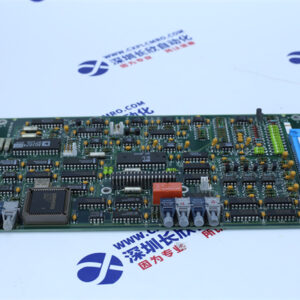
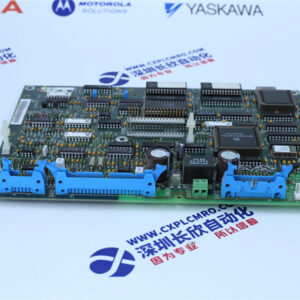
| Main Parameters | Value/Description |
|---|---|
| Product Model | 140ACI03000 |
| Manufacturer | Schneider Electric |
| Product Category | Analog Input Module |
| Number of Inputs | 8 (differential input type) |
| Analog Input Resolution | 12 bits |
| Linear Measuring Range | 1-5V / 4-20mA |
| Input Impedance | >20 MΩ (voltage) / 250 Ω (current) |
| Absolute Maximum Input | 50 VDC / 25 mA |
| Absolute Accuracy Error | ±0.05% of full scale typical / ±0.1% maximum |
| Linearity Error | ±0.04% |
| Update Time | 5 ms |
| Isolation (Channels to Bus) | 1000 VDC (3000 VDC for 60 seconds) |
| Isolation (Between Channels) | 30 VDC |
| Bus Current Requirement | 240 mA |
| Power Dissipation | 2 W |
| Operating Temperature | 0°C to +60°C |
| Storage Temperature | -40°C to +85°C |
| Addressing Requirement | 9 input words |
| Net Weight | 0.3 kg |
| Certifications | UL 508, CSA C22.2 No 142, FM Class 1 Division 2 |
Technical Principles and Innovative Values
Innovation Point 1: Differential Input Design for Superior Noise Immunity
The SCHNEIDER 140ACI03000 employs differential inputs, providing exceptional common-mode rejection of better than -72 dB at 60 Hz. This design eliminates interference from ground loops and electromagnetic noise common in industrial environments, ensuring accurate readings even when installed near variable frequency drives or high-power switching equipment.
Innovation Point 2: Channel-Level Diagnostics for Maintenance Optimization
Each input channel on the SCHNEIDER 140ACI03000 features independent diagnostic capabilities. In current mode (4-20mA), the module detects broken wires; in voltage mode (1-5V), it detects undervoltage conditions. The fault status is immediately indicated by 8 red LEDs—one per channel—enabling rapid fault localization and reducing mean time to repair.
Innovation Point 3: Multi-Signal Compatibility with Per-Channel Configuration
Unlike fixed-range modules, the SCHNEIDER 140ACI03000 supports both voltage and current signals and allows each of its 8 channels to be independently configured. This flexibility enables a single module to accommodate mixed sensor types—pressure transmitters (4-20mA) alongside temperature sensors (1-5V)—maximizing hardware utilization and simplifying spare parts inventory.
Innovation Point 4: Industrial-Grade Isolation for System Protection
The SCHNEIDER 140ACI03000 provides robust isolation with 1000V DC between channels and the backplane bus (tested at 3000V DC for 60 seconds) and 30V DC between channels. This protection prevents high-voltage transients from field sensors from damaging the controller, significantly enhancing overall system reliability and safety.