
Description
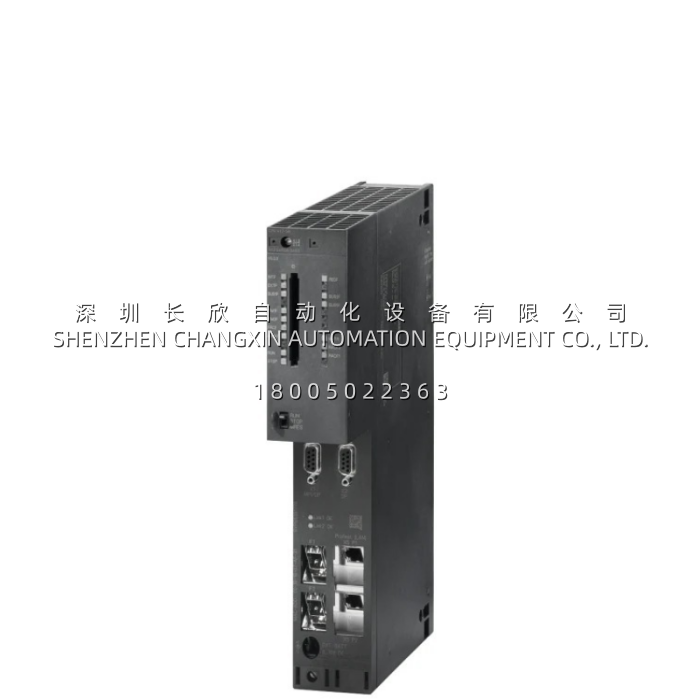
The Siemens 6ES7 417-5HT06-0AB0 (CPU 417-5H PN/DP) is the highest-performance central processing unit in the SIMATIC S7-400H family, purpose-built for high-availability (H) and fail-safe (F/FH) automation systems. With 32 MB of integrated work memory (16 MB program + 16 MB data), bit execution down to 7.5 ns, and five onboard interfaces including PROFINET with a 2-port switch, this V6-firmware flagship sits at the heart of large PCS 7 plants where “zero unplanned downtime” is not negotiable.
Application Scenarios
A double-shaft lime kiln plant in northern China was running its combustion and draft control on a first-generation S7-400H V4 pair that had begun showing their age — the original CPUs lacked PROFINET, forcing the panel builder to burn two CP 443-1 slots just for host communication, and the 10 MB / 6 MB memory split on the older 416-5H was starting to creak under the plant’s growing CFC chart count after a PCS 7 V8.1 upgrade. The revamp swapped both CPUs for the Siemens 6ES7 417-5HT06-0AB0, keeping the existing UR2-H rack and PS 407 supplies. The gains were immediate: the V6’s integrated PN 2-port switch absorbed the PlantBus and TerminalBus connections that previously ate CP cards, freeing two slots for extra CP 443-5 DP masters; the 16+16 MB memory comfortably swallowed the expanded CFC/FB pool; and the dual-sync-fiber between the 6ES7 417-5HT06-0AB0 pair held event-driven synchronization (Siemens patent — sync on change, not on timer) so that when maintenance pulled the active CPU for a planned firmware match-downgrade, the standby picked up mid-scan with zero process disruption. Three years post-retrofit, the kiln’s “unavailability due to PLC” KPI reads 0.00 % — the kind of number plant managers put in board decks.
Parameter
| Main Parameters | Value/Description |
|---|---|
| Product Model | 6ES7 417-5HT06-0AB0 |
| Manufacturer | Siemens (SIMATIC S7-400H) |
| Product Category | Central Processing Unit (H / F/FH capable) |
| Firmware Version | V6.0 (latest V6.0.11, Nov 2025) |
| Work Memory | 32 MB total (16 MB program + 16 MB data) |
| Execution Speed | 7.5 ns (bit/word/fixed-point), 15 ns (floating-point) |
| Interfaces | 1× MPI/DP, 1× DP, 1× PN (2-port switch), 2× Sync module slots |
| S7 Connections | 120 (max) |
| I/O Address Space | 16 384 bytes digital, 16 384 analog |
| Block Capacity | 16 000 DB / 8 000 FB / 8 000 FC (64 KB each) |
| Backplane 5 V Draw | Typ. 1.6 A / Max 1.9 A |
| Operating Temperature | 0 °C to +60 °C |
| Safety Compatibility | S7-400F/FH with F-Runtime license |
Technical Principles and Innovative Values
Innovation Point 1: Integrated PN 2-port switch eliminates a CP 443-1. Earlier 417-5H V4.x units needed a separate CP 443-1 to talk to the PCS 7 OS server via ISO-on-TCP. The 6ES7 417-5HT06-0AB0 (V6) bakes a 2-port PN switch right onto the CPU — PlantBus and TerminalBus land directly on the CPU, and the “fault-tolerant ISO-on-TCP” session survives a CPU master/slave flip without re-connect. For a standard AS 417H bundle, that’s one fewer card to buy, stock, and cool.
Innovation Point 2: Event-driven H-sync, not timer-driven. Siemens’ patented sync mechanism between the two 6ES7 417-5HT06-0AB0 CPUs fires on state change rather than on a fixed 200 ms heartbeat. The result: tighter data consistency between master and standby, and the standby can shadow even fast-cycling CFC chunks (motor ramps, PID cascades) without the “sync lag” that occasionally tripped mismatches on older V4 pairs during high-I/O-scan windows.
Innovation Point 3: 10 km fiber sync + F/FH safety in one slot. Populate the two IF slots on the 6ES7 417-5HT06-0AB0 with the -5AB06 sync modules and you get redundant fiber pairs rated to 10 km — handy for split-MCC or remote-rack layouts where the standby CPU lives in a different building. Add an F-Runtime license and the same CPU becomes an S7-400F/FH: same 7.5 ns execution, same 120 S7 connections, but with F-runtime for silo-/turbine-grade safety loops. One SKU, two career paths.
Application Cases and Industry Value
Case 1 — Vanadium-Titanium Steel Blast Furnace (North China). The project deployed fifteen PCS 7 controllers, four of them 6ES7 417-5HT06-0AB0 redundant pairs (≈ 8 000 total I/O) on a 1 000 Mbit fiber PlantBus with SCALANCE X414-3. The 417H pairs ran the burden/wind/taphole logic for two large blast furnaces plus a shared desulfurization station. The plant cited “zero CPU-originated trips in the first 18 months” — attributed to the 6ES7 417-5HT06-0AB0‘s 120 S7-connection budget comfortably absorbing the OS-server redundancy, WinCC/InfoServer, and three tiers of ET 200M PN/DP drops without hitting the comms ceiling that a 416-5H would have brushed against.
Case 2 — Municipal Waste-to-Energy (2 × 417H). A 2 × 417H configuration on PCS 7 controlled grate-furnace + stoker on #1 CPU and steam turbine + aux on #2, with 11 ET 200M drops on dual-DP at 1.5 Mbit/s. The 6ES7 417-5HT06-0AB0 pairs handled SOE (sequence-of-events) timestamping for turbine trip diagnostics at < 1 ms resolution — something the older S5 replacement couldn’t touch. Post-commissioning, the plant shaved ~12 % off mean-time-to-diagnose for furnace upsets because the 417H’s integrated diagnostics flagged DP-slave sync-loss vs. true trip vs. sensor drift without scrolling through interlock pyramids.