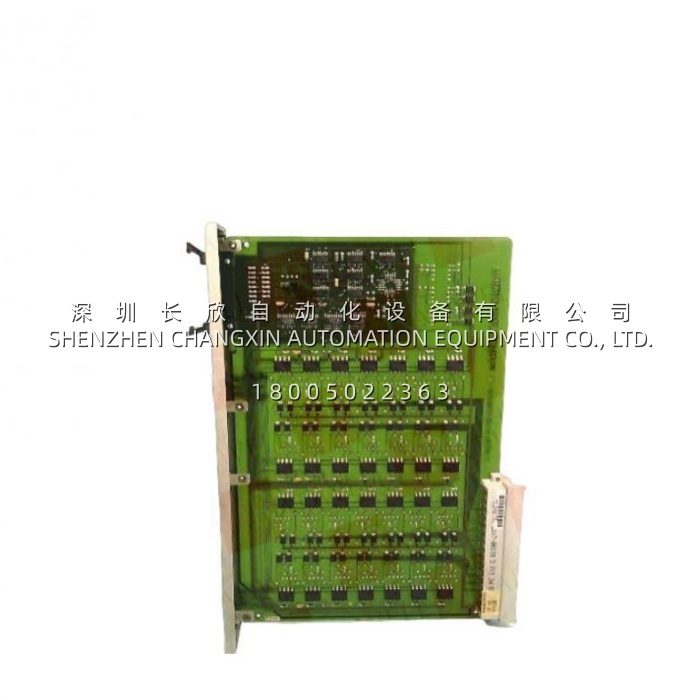
Technical Specifications
| Parameter | Value |
|---|---|
| Product Model | 6DS1703-8RR |
| Manufacturer | Siemens |
| Product Type | MS Point Extension Module (Measurement I/O) |
| Number of Channels | 8 isolated thermocouple inputs |
| Supported Sensors | Thermocouples (multiple types) and Pt100 RTD |
| Input Range | –5 mV to +55 mV |
| Channel Isolation | 1.5 kV AC, channel-to-earth |
| Terminal Rating | 300 V AC / DC |
| Accuracy Contribution | < ±0.2 °C (module error budget, excl. sensor) |
| Operating Voltage | 24 V DC (backplane / rack supplied) |
| Operating Temperature | –20 °C to +70 °C |
| Storage Temperature | –40 °C to +85 °C |
| Humidity | 5–95% RH, non-condensing |
| Weight | 0.32 kg |
| Protection Rating | IP20 (cabinet-dependent) |
| Mounting | Standard 6DS rack / DIN-rail compatible carrier |
Main Features and Advantages
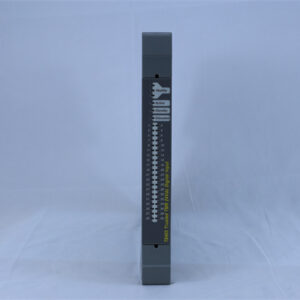
High-density, low-footprint expansion: The Siemens 6DS1703-8RR delivers eight independent, isolated thermocouple channels in a single slim 6DS slice, letting engineers add temperature measurement points to an existing Teleperm M or Simatic rack without re-architecting the control layer. This is especially valuable in brownfield retrofits where rack slots, power budgets, and CPU scan-load are all constrained.
Galvanic isolation and noise immunity: Each channel on the Siemens 6DS1703-8RR is rated at 1.5 kV AC channel-to-earth, creating a galvanic break between millivolt-level sensor loops and the high-noise plant floor. In facilities where 230 V AC instrumentation trays run parallel to T/C homeruns, this isolation prevents flashover and backplane damage during wiring faults or transient ground surges—a common failure mode in older cable plants.
Precision cold-junction compensation: The < ±0.2 °C accuracy figure for the Siemens 6DS1703-8RR reflects the combined stability of its internal ADC linearity and CJC circuit, not merely a generic “module spec.” For sub-ambient or tight-tolerance processes (e.g., reactor jacket control, food-pasteurization profiling), this level of module-budget precision means the total-loop error is dominated by sensor class rather than I/O noise.
Input range headroom: The –5 mV to +55 mV span includes a deliberate negative offset so that minor negative-temperature drifts or sensor asymmetry near ambient don’t clamp against ADC zero. This design choice, baked into the Siemens 6DS1703-8RR, keeps low-temperature monitoring continuous rather than truncated.
Mechanical resilience: At 0.32 kg with a polymer-composite housing, the Siemens 6DS1703-8RR minimizes inertial load on the backplane connector during high-vibration service (turbine decks, compressor skids, marine propulsion spaces). Low-mass I/O reduces connector-fretting risk that heavier metal-housed modules suffer in long-term resonance.
Environmental hardening: Rated to 70 °C ambient and 95% non-condensing humidity, the Siemens 6DS1703-8RR stays online in hot, un-air-conditioned MCC rooms and coastal chemical plants where commercial-grade I/O would already be derating. Combined with 300 V AC/DC terminal dielectric strength, it tolerates the rough wiring practices sometimes seen in expedited turnaround projects.
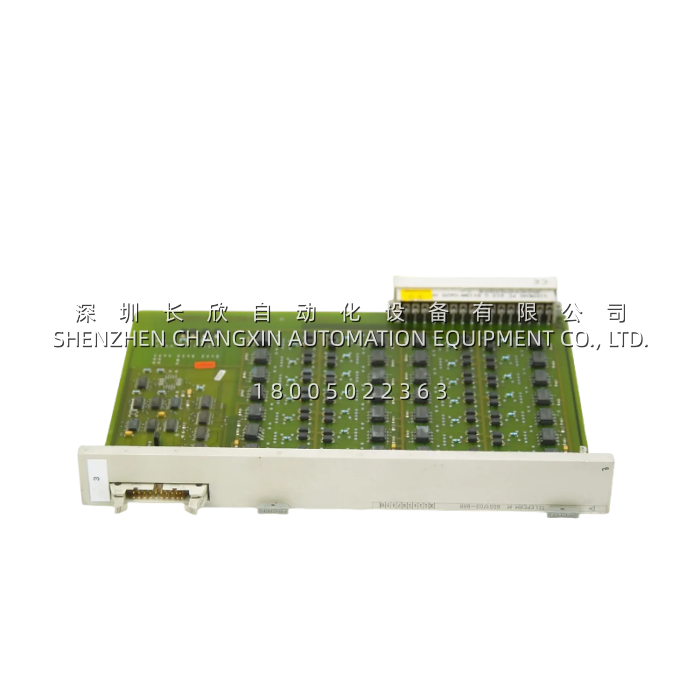
Technical Specifications
| Parameter | Value |
|---|---|
| Product Model | 6DS1703-8RR |
| Manufacturer | Siemens |
| Product Type | MS Point Extension Module (Measurement I/O) |
| Number of Channels | 8 isolated thermocouple inputs |
| Supported Sensors | Thermocouples (multiple types) and Pt100 RTD |
| Input Range | –5 mV to +55 mV |
| Channel Isolation | 1.5 kV AC, channel-to-earth |
| Terminal Rating | 300 V AC / DC |
| Accuracy Contribution | < ±0.2 °C (module error budget, excl. sensor) |
| Operating Voltage | 24 V DC (backplane / rack supplied) |
| Operating Temperature | –20 °C to +70 °C |
| Storage Temperature | –40 °C to +85 °C |
| Humidity | 5–95% RH, non-condensing |
| Weight | 0.32 kg |
| Protection Rating | IP20 (cabinet-dependent) |
| Mounting | Standard 6DS rack / DIN-rail compatible carrier |
Main Features and Advantages
High-density, low-footprint expansion: The Siemens 6DS1703-8RR delivers eight independent, isolated thermocouple channels in a single slim 6DS slice, letting engineers add temperature measurement points to an existing Teleperm M or Simatic rack without re-architecting the control layer. This is especially valuable in brownfield retrofits where rack slots, power budgets, and CPU scan-load are all constrained.
Galvanic isolation and noise immunity: Each channel on the Siemens 6DS1703-8RR is rated at 1.5 kV AC channel-to-earth, creating a galvanic break between millivolt-level sensor loops and the high-noise plant floor. In facilities where 230 V AC instrumentation trays run parallel to T/C homeruns, this isolation prevents flashover and backplane damage during wiring faults or transient ground surges—a common failure mode in older cable plants.
Precision cold-junction compensation: The < ±0.2 °C accuracy figure for the Siemens 6DS1703-8RR reflects the combined stability of its internal ADC linearity and CJC circuit, not merely a generic “module spec.” For sub-ambient or tight-tolerance processes (e.g., reactor jacket control, food-pasteurization profiling), this level of module-budget precision means the total-loop error is dominated by sensor class rather than I/O noise.
Input range headroom: The –5 mV to +55 mV span includes a deliberate negative offset so that minor negative-temperature drifts or sensor asymmetry near ambient don’t clamp against ADC zero. This design choice, baked into the Siemens 6DS1703-8RR, keeps low-temperature monitoring continuous rather than truncated.
Mechanical resilience: At 0.32 kg with a polymer-composite housing, the Siemens 6DS1703-8RR minimizes inertial load on the backplane connector during high-vibration service (turbine decks, compressor skids, marine propulsion spaces). Low-mass I/O reduces connector-fretting risk that heavier metal-housed modules suffer in long-term resonance.
Environmental hardening: Rated to 70 °C ambient and 95% non-condensing humidity, the Siemens 6DS1703-8RR stays online in hot, un-air-conditioned MCC rooms and coastal chemical plants where commercial-grade I/O would already be derating. Combined with 300 V AC/DC terminal dielectric strength, it tolerates the rough wiring practices sometimes seen in expedited turnaround projects.