
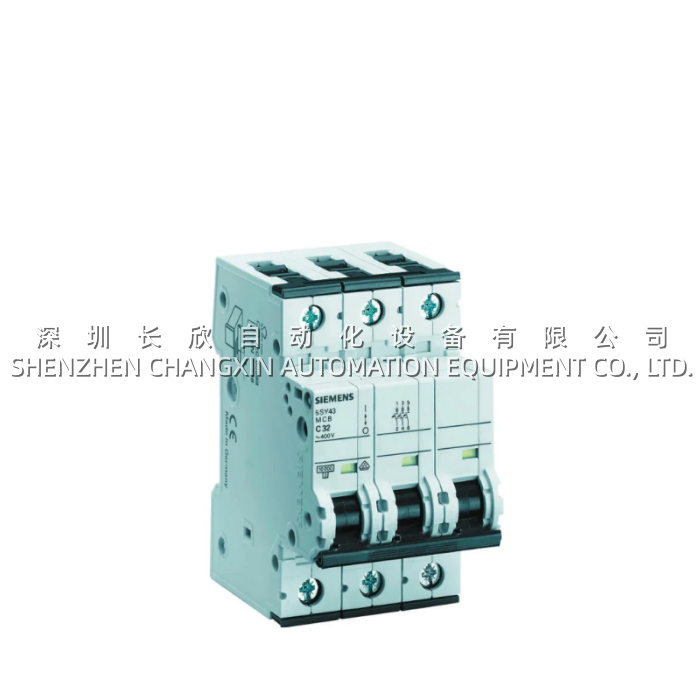
Application Scenarios
At a bottling-line OEM’s panel shop in Eastern Germany, the standard 24 V DC control architecture for each filler carousel used a 400→230 V control transformer (160 VA, ~0.7 A primary at 400 V) feeding a 3-phase bridge rectifier + 24 V SMPS cascade. The original build had used three 6.3 A gL fuses in a 3-pole fuse-holder for the transformer primary — massively oversized, and when a secondary-side short on the 24 V bus reflected back, the fuses took 2–3 seconds to clear, blowing the rectifier diodes before the upstream MCCB even noticed. The redesign swapped the fuse-holder for a Siemens 5SY4301-7: 1 A C-curve is a tight fit to the 0.7 A FLC (In ≥ 0.7 A, OK per IEC 60364 for transformer primary), and the 5–10×In magnetic band (5–10 A pickup) rides through the transformer’s magnetizing inrush (≈8–10×FLC for <100 ms) without nuisance tripping, but still catches a genuine secondary fault in <0.1 s because the reflected primary current jumps past 10 A fast. Post-retrofit, the shop saw zero “blown rectifier from slow primary fuse” callbacks across 40 machines in 18 months. The lead designer’s note: “The Siemens 5SY4301-7 is one of those parts you don’t notice until you realize your fuse-holder was never the right answer for a 1 A transformer.” For control-XFMR primaries, instrument 3-phase feeds, and small drive-control-voltage branches, the 1 A 3-pole MCB is a quiet hero.
Parameter
| Main Parameters | Value/Description |
|---|---|
| Product Model | 5SY4301-7 |
| Manufacturer | Siemens (SENTRON 5SY4 series) |
| Product Category | Miniature Circuit Breaker (MCB) |
| Poles | 3-pole (3-pole, non-N-switched) |
| Rated Current (In) | 1 A |
| Trip Characteristic | C-curve (magnetic 5–10×In = 5–10 A pickup) |
| Thermal Trip Band | 1.13–1.45 A (per IEC, matches In=1 A) |
| Rated Operating Voltage | 400 V AC (max 480 V AC per UL listing); 60 V DC |
| Rated Insulation Voltage (Ui) | 440–500 V |
| Rated Impulse Withthstand (Uimp) | 4–6 kV (pollution degree 3) |
| Short-Circuit Breaking (Icn) | 10 kA @ 400 V (EN 60898-1) / 35 kA Icu @ 400 V (IEC 60947-2) |
| Mounting | 35 mm DIN rail, tool-less double-slide latch |
| Terminals | Dual-chamber screw, 0.75–25 mm² (solid/multi), 14–4 AWG |
| Width / Height / Depth | 53 mm (3 TE) / 90 mm / 76 mm (built-in depth 70 mm) |
| Mechanical Life | ~20 000 ops |
| Electrical Life | ~10 000 ops (@ In) |
| Protection Class | IP20 (front side) |
| Operating Temp | –25 °C to +55 °C (IEC; some sources –25 to +45 °C for UL) |
| Certifications | IEC/EN 60898-1, IEC/EN 60947-2, UL 1077, CE |
| Weight | ~0.48 kg |
Technical Principles and Innovative Values
- Innovation Point 1 — C-Curve Tuned for Mildly Inductive Control Loads: The Siemens 5SY4301-7‘s magnetic trip at 5–10×In (5–10 A) is deliberately softer than a D-curve (10–20×) but firmer than a B-curve (3–5×). This makes it the sweet spot for control-transformer primaries, contactor-coil feeds, and instrument 3-phase branches where inrush (transformer magnetizing, SMPS surge) hits 8–10×FLC for <100 ms — the C-curve rides through, while a B would nuisance-trip and a D is overkill for a 1 A branch.
- Innovation Point 2 — Dual-Chamber Screw Terminals with Rear Busbar Option: The 5SY4 family’s terminals accept both a feeder cable and a rear DIN-busbar simultaneously (dual-chamber), meaning you can daisy-chain the 400 V phase bar through the Siemens 5SY4301-7‘s line side while landing the load-side cable — no pigtail jumpers eating panel space. Top/bottom feed reversible, same screw torque both sides.
- Innovation Point 3 — Tool-Less DIN Slide with Handle Locking: The Siemens 5SY4301-7 snaps onto 35 mm rail via a double-slide mechanism — no screwdriver to lock/unlock the foot. The toggle also has a locking cutout for a padlock/tagout (handle locking device) to prevent unauthorized re-closure during LOTO — small detail, but the difference between “compliant” and “write-up” on a pharma or food audit.
- Innovation Point 4 — 10 kA Breaking in 3 TE Footprint with Accessory Ecosystem: At 53 mm width (3 modular spacings), the Siemens 5SY4301-7 still clears 10 kA — not the 25 kA of the 5SY6/5SY8 premium tiers, but more than enough downstream of a 25–50 kA MCCB. And because the entire 5SY family shares one accessory set (5ST auxiliary contacts, 5SV RCCB add-ons, shunt/UV trips), the Siemens 5SY4301-7 can gain a 1NO+1NC fault/alarm contact via a side-clip 5ST3010 without growing the footprint.
Application Cases and Industry Value
A regional water-treatment plant running 12 sludge-dewatering centrifuges had each centrifuge’s local control panel fed from a 400 V 3-phase 16 A MCB in the MCC, then stepped down via a 400→230 V 250 VA control transformer → 24 V SMPS for the VFD keypad, solenoid bank, and local ET 200 I/O. The original MCC build had used 2 A B-curve MCBs on the transformer primary as “best effort” — but the centrifuge’s VFD ramp-ups occasionally coupled noise back that made the 24 V bus dip, and the B-curve’s 3–5×In magnetic (6–10 A) was borderline with the transformer’s inrush on cold start, causing ~1 nuisance trip per month per machine during winter. They swapped the 2 A B-curve for Siemens 5SY4301-7 (1 A C-curve): the 1 A thermal dial sits closer to the 0.62 A FLC (better overload protection — the old 2 A was lazy), and the C-curve’s 5–10× band (5–10 A) still rides the inrush while the tighter thermal catches a genuine overload faster. Nuisance trips dropped to zero over the next 14 months, and the plant’s electrical lead noted the 1 A rating “finally makes the primary protection honest instead of decorative.” For control-XFMR primaries, the Siemens 5SY4301-7 is one of those “right-size” parts that fixes a problem you didn’t know your BOM had.