
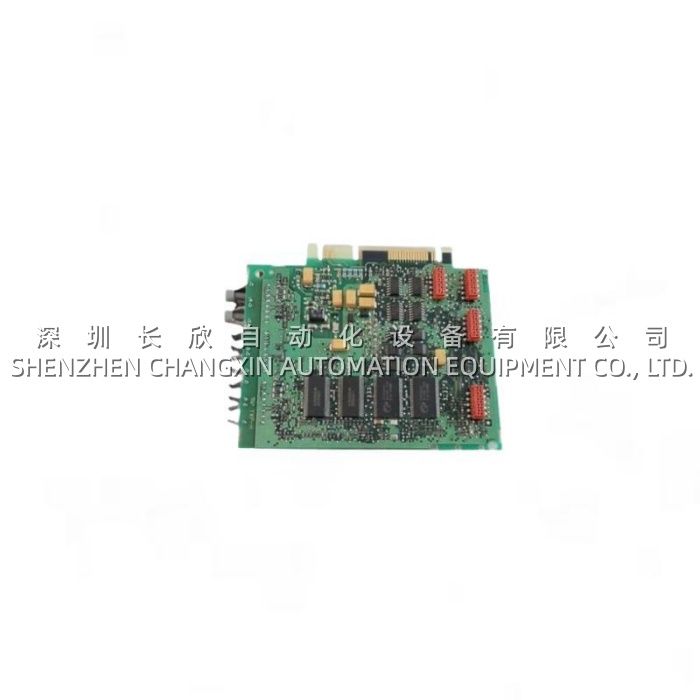
Product Overview
The ABB 3BSE018137R1 (CI858-1) is the DriveBus communication interface module — formally a CEM (Communication Extension Module) — for ABB’s AC 800M controller family, bridging the controller’s CEX-Bus to ABB drives and ABB Special I/O units over the proprietary DriveBus protocol. While the model suffix “-1” and the user tag “motherboard” suggest a carrier/backbone role, the ABB CI858-1 is more precisely a smart interface card: it carries its own Motorola DSP56303 (72 MHz), a Xilinx XC2S50 FPGA for the CEX-Bus link, 1 MB Flash, 768 kB SRAM, 32 kB boot PROM and a 32 × 16 kB dual-port RAM (DPRAM) window that the AC 800M CPU and the CI858 DSP share for cyclic data exchange. The “motherboard” label is fair informally — this card is the logic+mux hub that terminates three optical fibre ports (DriveBus to drives / I/O Bus to Special I/O / PC-Tool to DriveWindow) and converts between CEX-Bus packet traffic and 8 Mbit/s DDCS-format DriveBus frames.
In the AC 800M rack, the ABB 3BSE018137R1 plugs into a CEX-Bus slot (typically adjacent to the PM86x/PM89x processor unit), draws +24 V from the CEX-Bus backplane, and internally DC/DC-converts to +5 V / +3.3 V / +2.5 V for the logic and LVDS fibre transceivers. Up to two CI858-1 modules can be hosted on a single AC 800M controller, and a single ABB CI858-1 can address up to 24 ABB drives (ACS800, ACS880, ACS580, etc.) on its DriveBus channel; when more than one drive is connected, an NDBU (DriveBus Branching Unit) is required to turn the logical bus into a physical star — and NDBUs can be chained if the drive count grows.
The ABB 3BSE018137R1 is purpose-built for ABB’s “sectional drive” pitch — paper-machine drive sections, rolling-mill main + helper drives, crane DAC (distributed axis control), mine winder auxiliaries — where a cluster of ABB drives needs tight cyclic data (torque/speed setpoint, actual, fault word) plus DriveWindow/ DriveDebug diagnostic passthrough, all on native fibre without a protocol gateway. The fibre isolation also breaks ground loops between the drive cubicle room and the AC 800M control cabinet — a real problem in rolling-mill and paper-machine basements where drive DC buses and controller grounds don’t agree. Hot-swap is supported (CEX-Bus handles power-sequencing on insertion), G3 corrosion protection per ISA 71.04, marine approvals (ABS, BV, DNV-GL, LR), and the card ships as the CEM alone or as a kit with TP858 base depending on the order code.
Technical Specifications
| Parameter | Value |
|---|---|
| Product Model | ABB 3BSE018137R1 (CI858-1) |
| Manufacturer | ABB |
| Product Type | AC 800M CEX-Bus Communication Extension Module – DriveBus Interface (CEM) |
| Communication Protocol | ABB DriveBus (DDCS-based), Master mode |
| Transmission Speed | 8 Mbit/s |
| Max Drives per CI858-1 | 24 ABB drives (via NDBU branching when >1) |
| Max per AC 800M | 2 |
| Processor | Motorola DSP56303, 72 MHz |
| FPGA | Xilinx XC2S50 (CEX-Bus interface) |
| Memory | 32 kB Boot PROM (AT27LV256) + 1 MB Flash (Am29DL800B) + 768 kB SRAM + 32×16 kB DPRAM (dual-port) |
| CEX-Bus Clock | 64 MHz, ~1.25 MB/s transfer to AC 800M CPU |
| Optical Interfaces | 3 × fibre ports: Ch0 DriveBus (10 Mbit/s DDCS), Ch1 I/O Bus (5 Mbit/s), Ch2 PC-Tool |
| Power Supply | +24 V DC from CEX-Bus backplane (no external PSU needed) |
| Current Consumption | Typ. 200 mA @ 24 V |
| Hot-Swap | Supported |
| Redundancy (module/line) | No (use 2 × for controller-level redundancy) |
| Operating Temp. | 0 to +55 °C |
| Storage Temp. | –40 to +70 °C |
| Corrosion Class | G3 per ISA 71.04 |
| Protection | IP20 (cabinet install) |
| Marine Certifications | ABS, BV, DNV-GL, LR |
| Dimensions (W×H×D) | 59 × 185 × 127.5 mm |
| Weight (with TP base) | ~700 g |
| Compatible Base | TP858 (CEM baseplate) |
| Related Branching Unit | ABB NDBU-01 / NDBU-02 |
| Engineering Tools | ABB Control Builder M / PCM600, DriveWindow, DriveDebug |
| Standards | CE, RoHS (EU/UAE/CN), WEEE 2012/19/EU, IEC 61000-6-2/4 |
Main Features and Advantages
Native DriveBus — no gateway, no protocol tax:
The speaks ABB’s own DriveBus natively, meaning an AC 800M controlling a yard of ACS880s gets cyclic torque/speed/status + acyclic parameter access + DriveWindow pass-through on the same fibre pair. No Profibus DP proxy, no Modbus/TCP gateway, no GSD-file dance — the maps drive PPO telegrams straight into the AC 800M DPRAM window. For OEMs standardising on ABB drives + ABB DCS, this is the cleanest integration path.
DSP + FPGA + DPRAM architecture:
The isn’t a dumb transceiver — the Motorola DSP56303 (72 MHz, 94 user I/O pins) runs the DDCS framing / deframing, the Xilinx XC2S50 handles CEX-Bus timing, and the 32 × 16 kB DPRAM gives the PM processor and the DSP each a 16-bit interrupt + 8 semaphores for lock-free shared-memory exchange. That architecture is why the ABB 3BSE018137R1 can sustain 8 Mbit/s DriveBus while the AC 800M CPU handles the rest of the 800xA plant — the CEM offloads the DDCS stack entirely.
Optical fibre with star-topology via NDBU:
Each breaks out three optical ports. The DriveBus port goes to the first ABB drive (or to an NDBU-01); if the application has 6 ACS880s on a paper-machine section, the NDBU fans them into a star while the AC 800M sees one logical bus. NDBUs chain if the drive count passes 24 (though that forces a second ABB 3BSE018137R1 on the same controller — max 2 CI858 per AC 800M). The fibre itself gives >2 kV isolation between drive-room earth and controller-room earth, and is immune to the EMI that swamps RS-485 in rolling-mill basements.