
Application Scenarios
In a heavy-plate steel mill in Northern Europe, the 5-stand hot-strip finishing train was running on first-generation PPD113 boards (early R0001 revision) that had been in service since the 2008 commissioning. During a scheduled roll change, the drive engineer noticed sporadic “position loop sync loss” alarms at full threading speed—1500 m/min—corresponding to micro-delays in the fiber-optic I/O handshake between the AC800PEC rack and the power-stage gate units. The root cause: aging CPLD timing drift on the old board, exacerbated by ambient temperatures that regularly hit 55°C in the mill basement. The plant swapped all four PPD113s to the 3BHE023784R2630 (R2630 current revision) during a 12-hour weekend window. The R2630’s tighter 100 µs base cycle, refreshed 32-bit MCU clock tree, and re-qualified conformal coating brought alarm counts from ~14 per shift to zero over the following three months. More critically, the drive commissioner noted that “the position loop felt tighter”—settling time on thread-in dropped 180 ms, translating to ~12 fewer cobble events per month. For a mill where one cobble costs €40 k in recovered scrap and lost tonnage, the four-board retrofit paid for itself before the first coil shipped on Monday morning.
h2 Parameter
| Main Parameters | Value/Description |
|---|---|
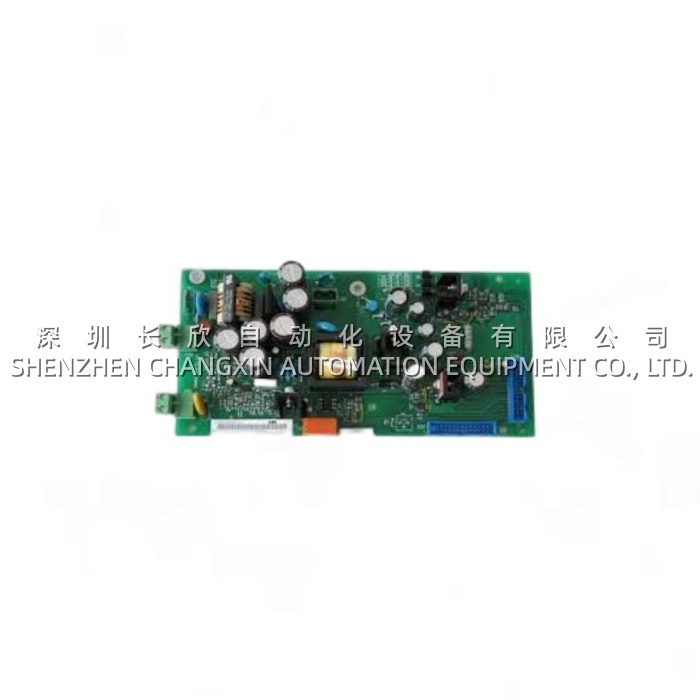
| Product Model | 3BHE023784R2630 (PPD113 B01-26-111000) |
| Manufacturer | ABB |
| Product Category | AC800PEC Control / Positioning Module |
| Processor | 32-bit industrial MCU, 66 MHz clock |
| Control Cycle | Down to 100 µs (deterministic, fiber-sync) |
| Memory | 2 MB Flash / 256 KB RAM |
| Analog Input | 16 ch, configurable voltage/current |
| Analog Output | 12 ch, 12-bit resolution |
| Digital I/O | 32 isolated channels (logic-level) |
| Communication Slots | ANYIO-1: CEX2-Bus RS422; ANYIO-2: Anybus/Modbus RTU; +3× UF D128 optional slots |
| Isolation | Logic↔I/O: 1500 VDC; fiber I/O for HV-stage decoupling |
| PCB Coating | Acrylic conformally coated (MIL-I-46058C) |
| Operating Temp. | -25°C to +70°C |
| Dimensions / Weight | ≈450 × 100 × 145 mm / ≈2.59 kg |
| Mounting | Rack-mounted card (AC800PEC chassis) |
h2 Technical Principles and Innovative Values
- Innovation Point 1: 100 µs Deterministic Cycle with Fiber I/O: Unlike general-purpose PLCs that scan in the 1–10 ms band, the 3BHE023784R2630 runs a 100 µs base task with fiber-optic distributed I/O synchronization. This matters in static excitation and rolling-mill drives where gate-fire commands must align with <1° electrical-angle precision—any slip shows up as torque ripple or, worse, commutation overlap faults.
- Innovation Point 2: Multi-Slot Protocol Expansion (CEX2 + Anybus + UF D128): The front panel carries two ANYIO slots and three optional-module positions. The 3BHE023784R2630 therefore isn’t locked to one bus—CEX2-Bus RS422 talks to ABB upstream controllers, Anybus/Modbus RTU handles third-party drives, and UF D128 slices add encoder or specialized I/O. One board, three protocol domains, zero gateway boxes.
- Innovation Point 3: R2630 Revision — Qualified Drop-In for Early R0001 Units: ABB phased the R2630 as the current-build replacement for early PPD113 revisions. The 3BHE023784R2630 retains pin- and firmware-compatible behavior with the AC800PEC rack but refreshes the timing silicon and coating spec. For plants sitting on 15-year-old R0001 stock, this is the “no-rewire upgrade” path—swap the board, match the firmware in Control Builder M, and the rack comes back qualified.
h2 Application Cases and Industry Value
A 320 kA aluminum smelter potline in the Middle East runs six 12-pulse rectifier groups, each governed by an AC800PEC rack headed by a PPD113. After a bus fault on Potline 3 tripped two rectifier groups simultaneously—traced post-incident to a CEX2-Bus CRC error on an aging PPD113—the plant standardized all six groups on the 3BHE023784R2630. Eighteen months later, the smelter reported zero unplanned rectifier trips attributed to the control tier, and pot-current regulation variance tightened from ±2.1% to ±1.4%, directly improving metal purity metrics. The electrical superintendent’s comment: “We don’t see the PPD113 until we go looking for it in the spare list—and that’s exactly how a control module should behave in a potroom.”
Beyond smelters and mills, the same 3BHE023784R2630 footprint shows up in hydroelectric generator excitation (UNITROL-adjacent but PEC-architectured), HVDC valve-base electronics, and large-scale test-stand dynamometers. Its value proposition is consistent: when the controlled plant costs eight figures and the control loop runs in triple-digit microseconds, the module price is rounding error—availability and revision currency are what matter.