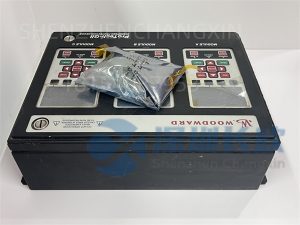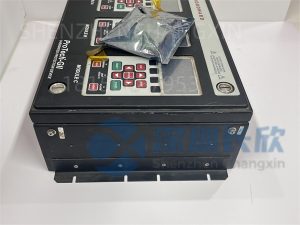
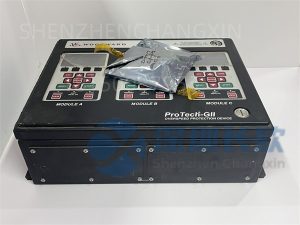
WOODWARD 8237-1246 Isochronous Load Sharing Controller – Precision Synchronization in Multi-Engine Power Plants
In multi-engine power generation facilities—whether on remote mining sites, offshore platforms, or island microgrids—the ability to balance load seamlessly across multiple diesel or gas generators is not just an operational convenience; it’s a fundamental requirement for efficiency, equipment longevity, and grid stability. At the heart of this critical function lies the WOODWARD 8237-1246 Isochronous Load Sharing Controller, a high-precision electronic governor interface designed to enable true isochronous load sharing among parallel-connected engines. Unlike traditional droop control systems that allow frequency to vary with load, the 8237-1246 maintains a constant system frequency while dynamically distributing real and reactive power in exact proportion to each unit’s capacity. This capability ensures smooth transitions during load changes, prevents engine hunting, and eliminates the risk of overloading any single generator—making it indispensable for mission-critical and isolated power networks.
The Challenge of Parallel Operation Without Compromise
When multiple generators operate in parallel without proper coordination, even minor mismatches in speed or voltage regulation can lead to serious issues: circulating currents, uneven wear, load oscillations, or—in worst cases—cascading trips. Droop-based load sharing, while simple and robust, inherently sacrifices frequency stability for load distribution. In applications where sensitive equipment (such as hospital imaging systems, data centers, or process control instrumentation) demands rock-solid 50/60 Hz power, droop control falls short.
This is where the WOODWARD 8237-1246 excels. Operating in isochronous mode, it locks all connected engines to a precise frequency setpoint. Through continuous communication over a dedicated load-sharing bus (typically using Woodward’s proprietary LON or CAN-based protocol), the controller measures total system load and instantly recalculates each engine’s fuel or throttle command to maintain perfect proportional load sharing—down to ±1% accuracy. Reactive power (kVAR) sharing is similarly managed via automatic voltage regulator (AVR) coordination, ensuring balanced excitation across alternators.
Critically, the 8237-1246 supports both islanded (off-grid) and grid-connected modes, automatically switching strategies when synchronization with the utility occurs. This dual-mode intelligence makes it ideal for hybrid plants that must transition between autonomous and grid-tied operation—common in renewable-integrated microgrids or backup power systems.
Real-World Validation: Stability Where It Matters Most
A compelling demonstration of the WOODWARD 8237-1246’s impact occurred at a copper mine in northern Chile. The site relies on six 2.5 MW natural gas generators operating in parallel to power crushing and conveying systems. Prior to installation, the plant used droop control, which caused noticeable frequency dips during conveyor startups—triggering nuisance trips in variable frequency drives (VFDs). After retrofitting with 8237-1246 controllers, frequency deviation during the same load step dropped from ±0.8 Hz to less than ±0.05 Hz. More importantly, load sharing became so precise that maintenance records showed a 30% reduction in differential wear on cylinder heads and turbochargers across the fleet over two years. “We went from constantly balancing loads manually to a ‘set-and-forget’ system,” noted the site’s chief electrical engineer. “The 8237 didn’t just improve power quality—it extended our engine overhaul intervals.”
Another example comes from a Caribbean resort island that operates a 10 MW microgrid powered by four diesel generators. During peak tourist season, sudden load swings from air conditioning systems would cause audible “hunting” in older droop-controlled units. After deploying the WOODWARD 8237-1246. the island achieved silent, seamless load transitions—even during full hotel occupancy. Guests no longer noticed flickering lights or HVAC cycling, and fuel consumption dropped by 4% due to optimized engine loading.
Technical Architecture: Precision Engineered for Reliability
The WOODWARD 8237-1246 combines analog signal integrity with digital communication robustness:
Control Modes: True isochronous speed control with dynamic load sharing; automatic transition to droop upon grid connection.
Communication: Dedicated load-sharing bus (twisted-pair shielded cable) supporting up to 32 units; opto-isolated inputs for noise immunity.
Inputs/Outputs: Accepts 4–20 mA or 0–10 V speed references; provides PWM or analog outputs to electronic governors; includes discrete I/O for sync check, breaker status, and alarm signaling.
Synchronization: Built-in synchronizer function with voltage/frequency matching and phase-angle monitoring for safe breaker closure.
Environmental Rating: Designed for harsh industrial environments (-40°C to +70°C); conformal-coated PCB for humidity and dust resistance.
Diagnostics: Front-panel LEDs indicate communication status, sync readiness, and fault conditions; full event logging via Modbus RTU for integration with SCADA.
Unlike software-only solutions running on general-purpose PLCs, the 8237-1246 is a dedicated hardware controller with deterministic response times measured in milliseconds—essential for damping transient oscillations before they destabilize the system.
Expert Guidance: Best Practices for Implementation
Seasoned power systems engineers emphasize several key considerations when deploying the WOODWARD 8237-1246:
“Isochronous load sharing only works if your prime movers respond identically. Match your engines—and your governors.”
— Senior Power Systems Consultant, Global EPC Firm
Prime Mover Matching: Ensure all engines are of similar age, model, and maintenance condition. Significant differences in turbo lag or fuel response can degrade sharing performance.
Cabling Discipline: Use shielded, twisted-pair cable for the load-sharing bus, grounded at one end only to prevent ground loops. Keep runs under 1.000 feet without repeaters.
Governor Compatibility: Verify compatibility with your existing electronic or mechanical-hydraulic governors (e.g., Woodward 2301A, EGCP-3. or third-party units with analog input capability).
Commissioning Protocol: Perform a full load-step test at 25%, 50%, 75%, and 100% total load to validate sharing accuracy and transient response.
Redundancy Planning: For critical facilities, consider dual 8237-1246 units with automatic failover—a feature supported in newer firmware versions.
The Strategic Value of Precision Control
In an era where energy resilience and operational efficiency are inseparable, the WOODWARD 8237-1246 Isochronous Load Sharing Controller represents more than a control module—it embodies a philosophy of intelligent resource orchestration. By ensuring every engine in a multi-unit plant contributes its fair share, it minimizes mechanical stress, maximizes fuel economy, and delivers the stable, high-quality power that modern industry demands.
For operators of remote mines, marine vessels, military bases, and microgrids, this controller is not a luxury add-on but a foundational element of reliable power architecture. In the delicate dance of parallel generation, where harmony equals stability and imbalance invites failure, the WOODWARD 8237-1246 ensures every engine moves in perfect step—silently, precisely, and without compromise.