
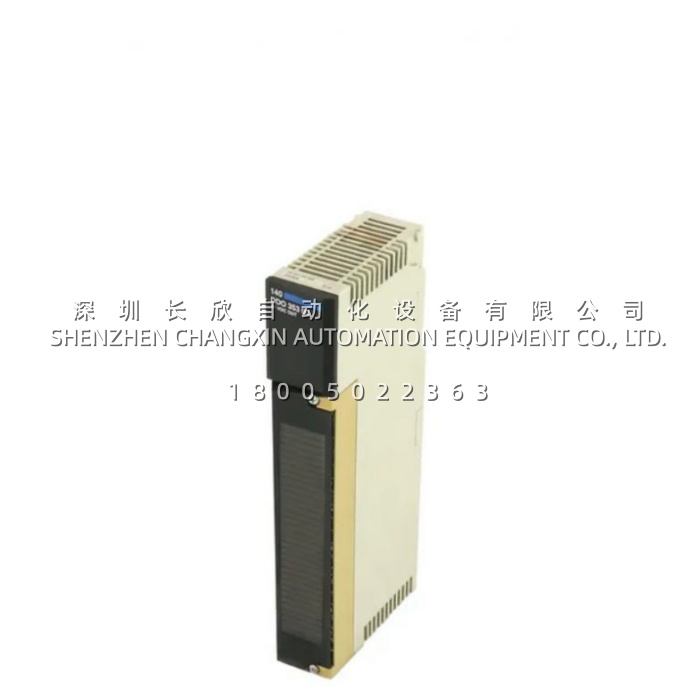
Application Scenarios
In a bottling and packaging plant running a Modicon Quantum Hot-Standby pair, the pneumatic solenoid bank for the case-erector and flipper stations was distributed across two older 16-point output cards. As the line accelerated to 600 bottles per minute, the maintenance team hit two recurring problems: a shorted valve coil would take down an entire 16-point card and the corresponding machine section, and the mixed sink/source wiring made troubleshooting a maze of cross-referenced drawings. Consolidating onto the 140DDO35300 changed the failure math immediately. The 32 outputs are arranged as 4 groups of 8, each protected by its own 5 A internal fuse, so a shorted coil now disables only its group of eight — the other 24 outputs keep the line running while maintenance isolates the offending valve. The source (PNP) logic also standardized the wiring convention across the plant: every output now sources +24V, matching the 3-wire PNP sensors already dominant in the plant, which cut wiring errors and commissioning rework. During a recent belt-drive failure, the <1 ms switching consistency of the 140DDO35300 preserved the precise timing of the star-delta transition sequence — no missed steps, no scrapped cases. This is the practical value the 140DDO35300 delivers: fault containment, predictable timing, and cleaner panel architecture in fast, continuous-discrete operations .
Parameter
| Main Parameters | Value/Description |
|---|---|
| Product Model | 140DDO35300 (also styled 140-DDO-353-00) |
| Manufacturer | Schneider Electric (Modicon / Square D) |
| Product Category | DC Discrete Output Module (solid-state) |
| Series / Platform | Modicon Quantum PAC / PLC |
| Number of Outputs | 32 channels |
| Channel Grouping | 4 groups × 8 channels (independently fused) |
| Output Logic | Positive logic — Source (PNP) |
| Nominal Output Voltage | 24 V DC |
| Output Voltage Limits | 19.2 … 30 V DC |
| Absolute Max. Output | 56 V for a 1.3 s decaying pulse |
| Current per Point | 0.5 A maximum |
| Current per Group | 4 A maximum (8 channels) |
| Current per Module | 16 A total maximum |
| Surge Current | ≤ 5 A for 0.0005 s |
| Voltage Drop | ~0.4 V at 0.5 A |
| Response Time | ≤ 1 ms (Off→On); ≤ 1 ms (On→Off) |
| Leakage Current | 0.4 mA at 30 V |
| Isolation (channel-to-bus) | 1780 Vrms DC for 1 minute |
| Isolation (group-to-group) | 500 Vrms DC for 1 minute |
| Protection | Internal 5 A fuse per group (non-user-replaceable) |
| Addressing Requirement | 2 output words |
| Bus Current Requirement | 330 mA @ 5 V DC (backplane) |
| Power Dissipation | 1.75 W + (0.4 V × total load current) |
| Signaling / Diagnostics | 32 green channel LEDs, 1 red Fault LED, 1 green Active (bus) LED |
| Fault Indication | Blown fuse, loss of field power |
| Terminal Block | 140XTS00200 (removable, 40-pin) |
| Operating Temperature | 0 … +60 °C (32 … 140 °F) |
| Storage Temperature | -40 … +85 °C |
| Relative Humidity | ≤ 95 % (non-condensing) |
| Operating Altitude | ≤ 5000 m |
| EMC / ESD Immunity | 4 kV contact / 8 kV air (IEC 801-2); 10 V/m (80–2000 MHz) |
| Certifications | CE, UL 508, CSA C22.2 No. 142, FM Class 1 Div. 2, GOST, ABS, BV, DNV GL, RINA, RMRS, C-Tick |
| Weight | ~0.45 kg (0.99 lb) |
| Status | Discontinued 15-Sep-2023; end-of-service 31-Dec-2024 |
| Recommended Replacement | BMXDDO3202K (Modicon X80) |
Technical Principles and Innovative Values
- Innovation Point 1: Four Independently Fused Output Banks Containing Faults Locally. Rather than protecting all 32 outputs behind one common fuse, the 140DDO35300 splits the load into 4 groups of 8, each fused at 5 A. A shorted solenoid or jammed contactor coil blows only its own group, leaving the remaining three banks live. This granular fault containment is the single biggest availability advantage over single-common modules, and it is why the 140DDO35300 is so widely specified in continuous-process and high-speed packaging lines .
- Innovation Point 2: True Solid-State Switching at ≤ 1 ms in Both Directions. Each output uses a transistor switch with no mechanical contacts, so there is no arc erosion, contact bounce, or wear-out mechanism — and no delay asymmetry. The 140DDO35300 transitions Off→On and On→Off in ≤ 1 ms, giving deterministic timing to sequenced actuators, star-delta starters, and high-speed reject gates. That repeatability is difficult to achieve with relay-based outputs .
- Innovation Point 3: Source (PNP) Logic with High-Noise Immunity. In source topology the module supplies +24V to the load, with the return path completed through the common. This is the preferred convention for 3-wire PNP sensors and devices, and it offers stronger immunity to ground-shift noise than sink (NPN) wiring. Deploying the 140DDO35300 lets an entire panel standardize on one logic convention, reducing drawing complexity and field wiring mistakes .
- Innovation Point 4: Dual-Stage Isolation — Channel-to-Bus plus Group-to-Group. The module is isolated at 1780 Vrms between the field channels and the logic/backplane side, and 500 Vrms between output groups. This two-tier galvanic separation prevents ground loops and stops a fault on one bank from coupling into the backplane or adjacent groups — critical in electrically noisy environments such as motor-control centers and substations .
- Innovation Point 5: Per-Channel + Module-Level Diagnostics Visible at the Rack. Thirty-two green LEDs mirror individual output state, a green Active LED confirms backplane communication, and a single red Fault LED reports a blown group fuse or loss of field power. Combined with the status reported to the CPU, the 140DDO35300 gives technicians immediate visual confirmation of which bank has faulted — shrinking mean time to diagnose and repair without a laptop .
Application Cases and Industry Value
In a bulk-material handling terminal on the U.S. Gulf Coast, a conveyor and diverter network was controlled by a Modicon Quantum rack populated with the 140DDO35300. The 32-point density allowed one slot to manage an entire conveyor section — start/stop contactors, diverter-gate solenoids, and a pilot-light array — reclaiming precious rack real estate in a crowded MCC. During a scheduled audit, the maintenance team found that the solid-state design had logged millions of operations with no contact wear, a stark contrast to the relay outputs they had replaced. More importantly, the grouped protection had already paid for itself: an earlier incident involving a shorted gate solenoid had blown just one 5 A group fuse, and the other three groups kept the conveyor sequencing so the terminal never had to stop the ship-loader. The plant’s electrical supervisor credited the 140DDO35300 with both lower spare-parts consumption and fewer emergency dispatches — a combination that justified stocking a small shelf quantity before the module reached end-of-service .