Product Overview
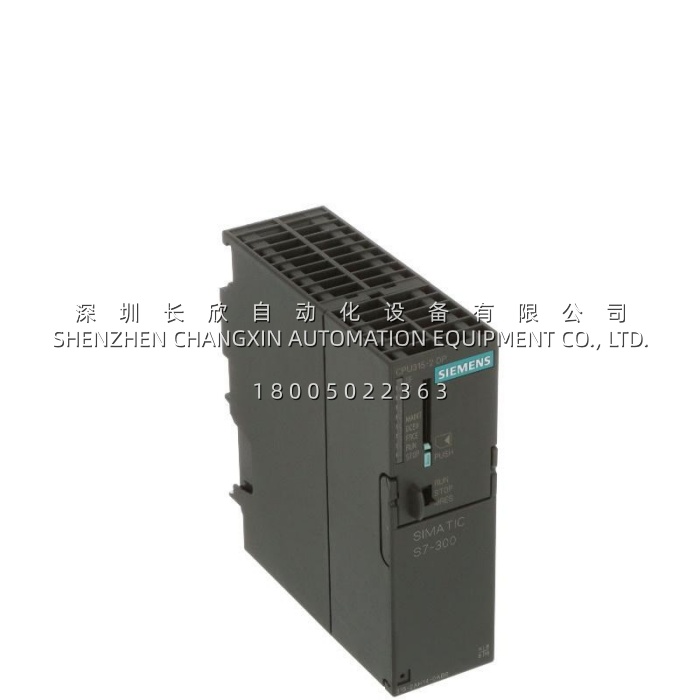
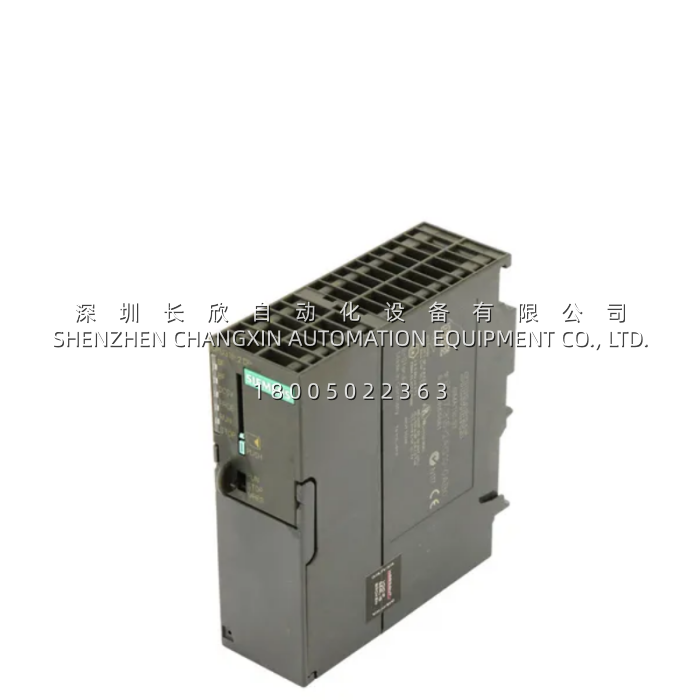
The Siemens 6ES7 315-2AH14-0AB0 is a SIMATIC S7-300 CPU 315-2DP, occupying the mid-performance tier of Siemens’ most widely deployed modular PLC family. Positioned between the entry-level CPU 312/314 and the high-end CPU 317, the Siemens 6ES7 315-2AH14-0AB0 delivers 256 KB of integrated work memory, 0.1 µs binary instruction execution, and a combined MPI/PROFIBUS DP interface that operates master or slave at up to 12 Mbps—making it the default choice for medium-complexity machine and plant automation where distributed I/O (ET 200 family) and PROFIBUS-connected drives must be orchestrated from a single rack. The “-2AH14” hardware revision belongs to the MMC-based generation of S7-300 CPUs, meaning the Siemens 6ES7 315-2AH14-0AB0 stores user programs and retentive data on a removable Micro Memory Card (load memory expandable to 8 MB) and eliminates the need for a backup battery—a significant lifecycle simplification compared to the older flash-card + battery architecture of earlier S7-300 releases.
Within a SIMATIC S7-300 rack, the Siemens 6ES7 315-2AH14-0AB0 acts as the central processing and communication anchor: it scans the backplane bus to poll up to 32 signal/modules (digital, analog, function, communication), executes the user OB/FB/FC cycle in LAD/FBD/STL/SCL/GRAPH, and maintains the MPI interface (default address 2) for PG programming, HMI panels (KTP/TP series), and inter-CPU links. The DP port on the Siemens 6ES7 315-2AH14-0AB0 simultaneously supports DP-V0/V1 telegrams, enabling both cyclic I/O exchange with ET 200M/ET 200S/ET 200pro distributed heads and acyclic parameterization of PROFIBUS drives (e.g., MICROMASTER, SINAMICS) and field instruments. With 8192-byte digital I/O address space and 512-byte analog I/O address space, the Siemens 6ES7 315-2AH14-0AB0 comfortably covers mid-size machine cells (conveyor zones, packaging heads, process skid auxiliaries) and scales into distributed architectures via multiple ET 200 drops on a single DP string. The module is programmed in STEP 7 V5.x (with Hardware Update) or TIA Portal, and retains password protection, SFC/SFB libraries, and nested block depth consistent with the S7-300 instruction set.
Technical Specifications
| Parameter | Value |
|---|---|
| Product Model | 6ES7 315-2AH14-0AB0 |
| Manufacturer | Siemens |
| Product Type | SIMATIC S7-300 CPU 315-2DP (Central Processing Unit) |
| Work Memory | 256 KB (integrated) |
| Load Memory | MMC required, max. 8 MB |
| Bit Operation Time | 0.1 µs |
| Word Operation Time | ~0.2 µs |
| Integrated Interfaces | 1× MPI, 1× PROFIBUS DP (Master/Slave, 9.6 kbps – 12 Mbps) |
| Digital I/O Address Space | 8192 bytes input / 8192 bytes output |
| Analog I/O Address Space | 512 bytes input / 512 bytes output |
| Max. Expandable Modules (per rack) | 32 modules |
| Power Supply | 24 V DC (integrated regulator) |
| Operating Temperature | 0 °C to +60 °C (standard S7-300 grade) |
| Dimensions (W×H×D) | 40 × 125 × 130 mm |
| Weight | ~0.29 kg |
| Programming Software | STEP 7 V5.x (with H/W update) / TIA Portal |
| Mounting | S7-300 rack, DIN rail via carrier |
Main Features and Advantages
Balanced mid-tier performance: The Siemens 6ES7 315-2AH14-0AB0 hits the sweet spot where 128 KB (CPU 314) is too tight for structured FB/FC reuse and 1 MB (CPU 317) is overkill for a single machine cell. At 256 KB work memory and 0.1 µs/bit, the Siemens 6ES7 315-2AH14-0AB0 handles dozens of FB calls, PID loops, motion interlocks, and recipe logic without scan-time stress—typical OB1 cycle stays well under 10 ms for a few-hundred-I/O cell, which keeps PROFIBUS DP token rotation and HMI refresh responsive.
Dual-role PROFIBUS DP at 12 Mbps: The DP port on the Siemens 6ES7 315-2AH14-0AB0 is not a “slave-only” stub—it can be configured as DP Master (connecting ET 200M/ET 200S/ET 200pro heads, drives, DP valve islands, DP weight controllers) or as DP Slave (if the cell reports upward to a PCS 7 OS or a larger S7-400 master). This flexibility means the Siemens 6ES7 315-2AH14-0AB0 works equally well as a standalone machine controller and as a distributed node in a plant-wide PCS 7 or S7-400 architecture. At 12 Mbps top speed, a typical ET 200M drop with 32 DI + 32 DO + 8 AI exchanges in <2 ms per slave, keeping the DP token happy even with 8–12 slaves on one Siemens 6ES7 315-2AH14-0AB0 master string.
Battery-less via MMC: One of the quietest but most valuable changes in the “-AH14” hardware generation is the move to MMC-based program+data retention. The Siemens 6ES7 315-2AH14-0AB0 stores the full user project on the MMC (64 KB / 128 KB / 512 KB / 2 MB / 4 MB / 8 MB selectable), and retentive data survives power loss without a 3.6 V backup battery that older S7-300 CPUs demanded. No more “CPU SF + BF blinking because the battery died three years ago and nobody noticed”—the Siemens 6ES7 315-2AH14-0AB0 just boots from MMC every time. MMC also makes cloning a cell trivial: pull the card from a running Siemens 6ES7 315-2AH14-0AB0, plug into PG, copy project, push to spare—no online upload hassle.
MPI for PG/HMI without burning a DP slot: The MPI port (RS-485, multi-drop, default 187.5 kbps but selectable) on the Siemens 6ES7 315-2AH14-0AB0 handles PG connection for download/monitor, plus 1–2 HMI panels (KTP700/KTP1200) on the same MPI daisy chain. This keeps the DP port clean for field I/O and drives, avoiding the “DP bandwidth tax” of mixing PG traffic onto the same 12 Mbps token. On smaller cells with no PROFIBUS drives, the Siemens 6ES7 315-2AH14-0AB0 can even run MPI-only—but most specs wire DP because ET 200 price/performance beats localized S7-300 SM slices on anything beyond 2–3 doors of I/O.
32-module rack + 3 EU expansion: The Siemens 6ES7 315-2AH14-0AB0 supports up to 32 modules in the local rack and can extend via IM 365/IM 360-361 to 3 Expansion Units (EU) at up to 10 m CC-to-EU distance. That translates to roughly 1024 DI/DO and 256 AI/AO locally, plus more across the EUs—more than enough for a mid-size packaging head, bottling filler, or process-skid auxiliary panel. The backplane bus on the Siemens 6ES7 315-2AH14-0AB0 is the standard S7-300 16-bit parallel bus, so all SM 300-series slices (321 DI, 322 DO, 331 AI, 332 AO, 336 F-AI, 335 TMR, etc.) snap in without special configuration beyond HW Config.
Software ecosystem maturity: The Siemens 6ES7 315-2AH14-0AB0 programs in STEP 7 Classic (V5.2 SP1+ with Hardware Update for the -AH14 MLFB) and is also supported in TIA Portal (with the S7-300 profile). LAD, FBD, STL, SCL, CFC, GRAPH, HiGraph—all compile to the same 315 execution core. Password protection on blocks, SFC/SFB library (including PID, date/time, comms), and 8 nesting levels give the Siemens 6ES7 315-2AH14-0AB0 the same software toolset as its pricier S7-300 siblings, so code written for a 314 ports cleanly and scales when moved to a Siemens 6ES7 315-2AH14-0AB0 for a larger cell.