
Product Overview
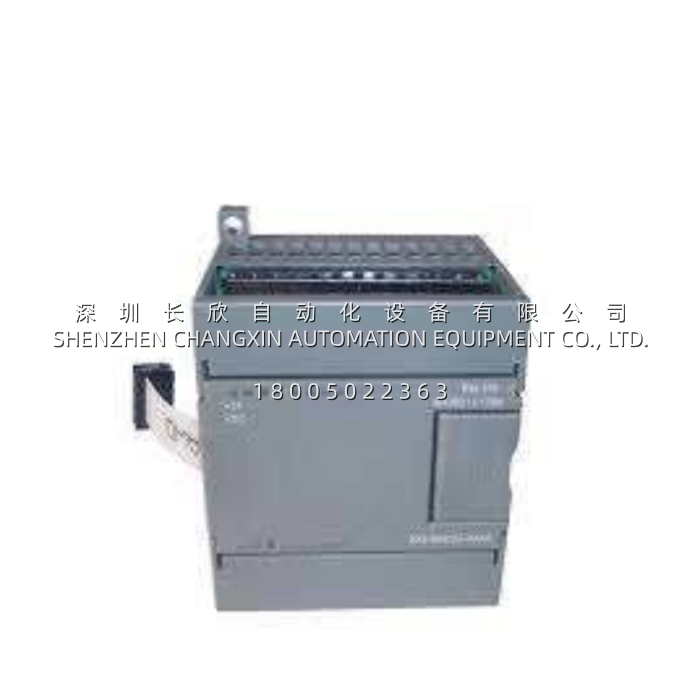
The Siemens 6ES7 235-0KD22-0XA8 is the EM 235 analog input/output mixed module belonging to the SIMATIC S7-200 CN product line, engineered as the standard 4AI + 1AO expansion for S7-200 CPU222, CPU224, CPU224XP, and CPU226 controllers. The “-0XA8” suffix designates the China-domestic (CN) version of the module, with the import-original ordering number being 6ES7235-0KD22-0XA0—both share identical footprint, electrical behavior, and DIP-switch configuration, and are cross-substitutable in the field. The Siemens 6ES7 235-0KD22-0XA8 is positioned as the “one-module-does-both” analog solution for S7-200 panels where both sensing (temperature, pressure, flow, load cell, 0–10 V transducer) and actuating (analog setpoint to VFD, positioner, SSR ramp) are required but a full separate AI + AO expansion pair would over-consume the S7-200’s limited expansion slot budget (max 7 expansions per CPU).
The Siemens 6ES7 235-0KD22-0XA8 delivers four differential analog input channels (AIW0–AIW6) through a 12-bit A/D converter with selectable unipolar and bipolar ranges covering ±25 mV micro-voltage up to ±10 V industrial span, plus 0–20 mA (enabled by shorting RC to A+ to engage the onboard 250 Ω shunt). The single analog output (AQW0) is programmable as ±10 V (≥5 kΩ load) or 0–20 mA (≤500 Ω load) through 11-bit D/A. Configuration is hardware-based: a 6-position DIP switch bank (SW1–SW6) sets gain, attenuation, and range for all four AI channels simultaneously—a design choice that keeps firmware simple but means the four inputs must share a common signal type per installation. The module draws 30 mA from the S7-200 5 V backplane bus and 60 mA from L+ (24 V DC, 20.4–28.8 V range), with ~2 W typical dissipation, housed in the classic S7-200 expansion envelope 71.2 × 80 × 62 mm, 186 g, IP20, 35 mm DIN rail mount.
Critically for MRO buyers: the Siemens 6ES7 235-0KD22-0XA8 is not compatible with S7-200 SMART or S7-1200/1500—it is strictly for the S7-200 22x generation. With the S7-200 platform discontinued (EM235 spare-part status since Oct 2017), the Siemens 6ES7 235-0KD22-0XA8 is now primarily a lifecycle-extension spare for thousands of S7-200 panels still running in Asia, Eastern Europe, and the Middle East across plastics, textiles, packaging, water treatment, and small-process OEM machines.
Technical Specifications
| Parameter Name | Parameter Value |
|---|---|
| Product Model | 6ES7 235-0KD22-0XA8 |
| Manufacturer | Siemens |
| Product Type | Analog Input/Output Mixed Expansion Module |
| Series / Platform | SIMATIC S7-200 CN (EM 235) |
| Compatible CPU | S7-200 CPU222 / CPU224 / CPU224XP / CPU226 (22x series only) |
| Analog Input Channels | 4, differential (AIW0, AIW2, AIW4, AIW6) |
| AI Input Ranges (DIP-selectable) | Unipolar: 0–25/50/100/250/500 mV, 0–1/2.5/5/10 V, 0–20 mA; Bipolar: ±25/50/100/250/500 mV, ±1/2.5/5/10 V |
| AI Resolution | 12 bit + sign; e.g. 2.5 mV @ ±10 V, 5 μA @ 0–20 mA |
| AI Conversion Time | < 0.25 ms per channel sweep (4 ch total ~200 μs) |
| AI Input Impedance | ≥ 10 MΩ (voltage), 250 Ω (current, via RC–A+ short) |
| AI Max Destruction Limits | 30 V DC / 32 mA |
| AI Common-Mode Rejection | 40 dB, DC to 60 Hz |
| Analog Output Channels | 1 (AQW0), programmable voltage or current |
| AO Output Ranges | ±10 V (load ≥ 5 kΩ); 0–20 mA (load ≤ 500 Ω) |
| AO Resolution | 11 bit |
| AO Setting Time | 100 μs (voltage), 2 ms (current) |
| Accuracy | ±0.5 % FS typical @ 25 °C; ±2 % FS over 0…55 °C |
| Backplane 5 V Bus Current | max. 30 mA |
| External L+ 24 V Current | max. 60 mA (with 20 mA output load) |
| Typical Power Dissipation | ~2 W |
| Supply Range (L+) | DC 20.4 – 28.8 V |
| Isolation | None (AI/AO not isolated from backplane; analog ground shared with PLC logic ground) |
| Dimensions (W × H × D) | 71.2 × 80 × 62 mm |
| Weight | approx. 186 g |
| Mounting | 35 mm DIN rail |
| Degree of Protection | IP20 (cabinet-only) |
| Operating Temp (horizontal) | 0 … +60 °C; vertical 0 … +40 °C |
| Status LED | 24 V DC OK (lit = healthy L+; off = L+ missing) |
| Lifecycle | Discontinued Oct 2017, spare-part only |
| Note | CN version (6ES7…-0XA8) interchangeable with import (6ES7235…-0XA0) |
Main Features and Advantages
The Siemens 6ES7 235-0KD22-0XA8 earns its longevity through a pragmatic “mixed-signal in one slot” proposition that matches the S7-200’s expansion-slot scarcity. Four differential AI + one programmable AO in a single 71 mm-wide brick means a CPU224 with seven slots free can absorb this plus six digital expansions, whereas splitting AI and AO into separate EM231 + EM232 would burn two slots for the same I/O count. For OEMs who standardized on S7-200 for small-machine control—injection molding auxiliaries, textile-sizing drivers, packaging-former temperature zones, water-treatment skid pH/ORP—the Siemens 6ES7 235-0KD22-0XA8 has been the default analog module for two decades.
The DIP-switch configuration scheme (SW1–SW6) is the module’s defining trait and worth understanding deeply. Unlike modern S7-1200/1500 analog modules where range is software-parameterized per channel, the Siemens 6ES7 235-0KD22-0XA8 uses six slide switches on the module side to select gain and attenuation for all four AI channels as a group. SW1/SW2 select the base range (e.g., ±10 V, ±5 V, 0–20 mA, etc.), SW3–SW6 fine-tune gain/attenuation steps. The advantage: deterministic, firmware-corruption-proof range selection that survives a CPU memory reset—the module comes up in the DIP-stated range every time. The trade-off: all four channels must share the same range family (though within that family the S7-200’s scaling instructions can map each channel differently in software). For many S7-200 applications—four Pt100 via transmitters all 4–20 mA, or four 0–10 V pressure transducers—this is fine. For mixed-signal applications (one mV thermocouple, one 0–10 V, one 4–20 mA), you’d need two Siemens 6ES7 235-0KD22-0XA8 modules or split to EM231/EM232. DIP changes require a power cycle to take effect—plan the FAT accordingly.
Differential input topology is another quiet win. The four AI channels on the Siemens 6ES7 235-0KD22-0XA8 are differential (not single-ended), giving ~40 dB common-mode rejection to 60 Hz and allowing the module to reject ground-offset noise that would trash a single-ended input in a panel where the 24 V supply and sensor grounds aren’t perfect. Input impedance at ≥10 MΩ (voltage mode) means the module loads the source negligibly—important when the transmitter is loop-powered and the loop resistance budget is tight. Current mode engages a precision 250 Ω shunt when the installer shorts RC to A+, converting 0–20 mA to 0–5 V internally for the 12-bit ADC—standard S7-200 practice, but worth calling out because forgetting the short is the #1 commissioning mistake on a fresh Siemens 6ES7 235-0KD22-0XA8.
One caution that belongs in “advantages” only as a managed reality: the Siemens 6ES7 235-0KD22-0XA8 has no galvanic isolation between field side and backplane logic, and the analog ground ties to the S7-200’s logic ground. In clean panel environments this is irrelevant; in noisy VFD-heavy or welded-adjacent panels, best practice is to add external signal isolators on the AI feeds and keep shield drain wires grounded at exactly one point (typically the sensor end, not the module end, depending on the noise topology). Siemens documentation calls this out explicitly for the EM235, and the Siemens 6ES7 235-0KD22-0XA8 CN version carries the same non-isolated architecture as the import -0XA0.
Application Field
The Siemens 6ES7 235-0KD22-0XA8 lives almost exclusively in legacy S7-200 22x panels that are still the automation heart of small- to mid-size machines and local process skids. In plastics injection and blow-molding auxiliaries, the module typically handles barrel-zone temperature (4–20 mA from a temperature transmitter on a J/K/T thermocouple) on the four AI channels, while the AO drives a 0–10 V setpoint into a solid-state relay ramp or a small proportional valve for cooling-fan or oil-temperature trim. Here the Siemens 6ES7 235-0KD22-0XA8 is valued because the S7-200 CPU (224 or 224XP) already runs the machine sequence, and adding one mixed analog module covers both sensing and actuation without eating the expansion budget.
Textile dyeing and finishing lines form a second dense cluster: tension-zone load cells (mV-level, hence the ±25/±50 mV DIP ranges on the Siemens 6ES7 235-0KD22-0XA8), guide-roll pressure transducers (4–20 mA), and dye-bath temperature (Pt100 + transmitter) can all land on the four differential AI, while the AO feeds a 0–10 V speed trim to a dye-padder drive or a steam-valve positioner. Packaging formers and filling machines are a third pattern—four load-cells for net-weight checkweighers go to AI, AO sends a 4–20 mA trim to the vibratory pan feeder. Water/wastewater local skids (pH, ORP, dissolved oxygen 4–20 mA transmitters × 3–4, AO driving a chemical-dosing pump 0–10 V) are a fourth. In all these cases the Siemens 6ES7 235-0KD22-0XA8 is rarely specified on new projects today (S7-200 SMART or S7-1200 G2 took over), but it remains the correct spare for the installed base.
A specific regional note: the “-0XA8” CN suffix means this module was stocked and sold through Siemens China domestic channel, priced for the Chinese OEM/end-user market, while the “-0XA0” is the import original. For plants in China, Southeast Asia, and South Asia where the BOM calls out the CN number, supplying a Siemens 6ES7 235-0KD22-0XA8 keeps the store-records clean; for export-oriented service providers, cross-supplying the -0XA0 is equally valid—electrically identical. Either way, the Siemens 6ES7 235-0KD22-0XA8 is the part that keeps a 15-year-old S7-200 panel from becoming a “replace the whole CPU and rewrite the ladder” capex event.