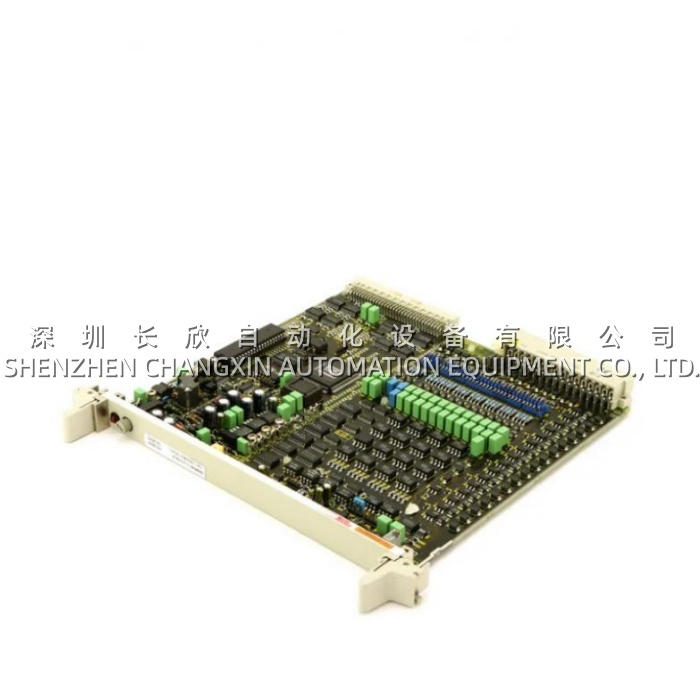
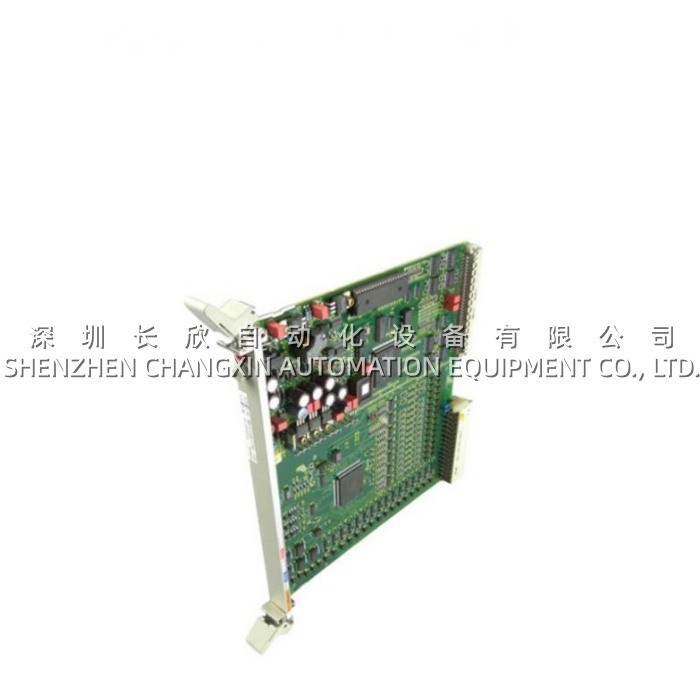
Product Overview
The 6DP1230-8CC is Siemens’ FUM230 analog transmitter signal conditioning module, purpose-built for the Teleperm XP distributed control system’s AS620B automation station. Within the 6DP FUM (Function Module) family — which spans FUM210 (binary), FUM230 (analog input), FUM280 (analog output), FUM310 (positioning), FUM511/531 (process-control macros) — the 6DP1230-8CC owns the 16-channel 0/4–20 mA analog-input slot. Its core job is to ingest field-current loops from 2-wire or 4-wire transmitters (pressure, temperature, flow, level, analytical), apply galvanic isolation and noise suppression on-module, distribute the conditioned signal to the AS620B’s processing chain, and run per-channel diagnostics (transducer-supply monitor, over/under-range detection, wire-break/open-circuit detection) that the Teleperm XP OS (OM650/GS/ES) surfaces as priority-1 alarms. The 6DP1230-8CC also carries a built-in 24 V DC transducer power supply per channel, eliminating external barrier/isolator racks for typical 2-wire 4–20 mA loops — a design choice that differentiates FUM230 from “dumb” AI cards that expect externally-powered loops.
Mechanically, the 6DP1230-8CC follows the ES902C packaging format: printed-circuit board 233 × 220 mm (extended double Eurocard), 20.32 mm slot width (1⅓ standard slots), metallic front panel 20 mm wide × 230.35 mm high, with two DIN 41612 connectors on the rear — upper X1 (C-style, 96-way) for backplane bus interfaces, lower X5 (G-style, 64-way) for field/I/O termination. The module seats in the AS620B FUM subrack alongside other 6DP1230/1280/1310/1511 siblings. Siemens discontinued the 6DP1230-8CC effective 2012-10-30 under PM410-class PLM with no direct replacement in the current Siemens catalog — the spiritual successor architecture is PCS 7 with S7-410 CPU + ET 200M/ET 200SP analog modules, but that is a full DCS migration, not a like-for-like submodule swap. Today the 6DP1230-8CC trades almost exclusively as tested-refurb or NOS spare for power-plant, chemical, petrochemical, and metallurgy DCS cells still running Teleperm XP AS620B racks — cells where ripping to PCS 7 is capex the plant won’t approve while the boiler/turbine/process loop still holds spec.
Technical Specifications
| Parameter Name | Parameter Value |
|---|---|
| Product Model | 6DP1230-8CC |
| Manufacturer | Siemens |
| Product Type | FUM230 Analog Transmitter Signal Conditioning Module |
| System / Platform | Teleperm XP DCS, AS620B Automation Station |
| Analog Inputs | 16 channels |
| Input Signal | 0–20 mA / 4–20 mA |
| Transmitter Loop | 2-wire or 4-wire compatible |
| Transducer Supply | Built-in 24 V DC (per-channel) |
| Limit Values | 4 configurable high/low limits per channel |
| Signal Correction | Zero & span calibration per channel |
| Diagnostics | Transmitter supply monitor, over-range/under-range, wire break (open circuit) |
| Redundancy | Suitable for redundant deployment (dual AS620B hot-standby) |
| Mechanical Format | ES902C, 233 × 220 mm PCB, 20.32 mm slot (1⅓ std) |
| Connectors | 2 × DIN 41612: X1 C-style 96-way (backplane), X5 G-style 64-way (field/I/O) |
| Front Panel | Metallic, 20 mm W × 230.35 mm H |
| Operating Temp | –20 … +60 °C |
| Status | Discontinued 2012-10-30, PM410, no direct replacement |
Main Features and Advantages
Built-in 24 V DC transducer supply — eliminates external loop power. The standout differentiator of the 6DP1230-8CC versus generic AI cards is the on-module 24 V DC transducer supply per channel. In a Teleperm XP rack serving a boiler/turbine or reactor-unit DCS, the field typically lands 50–200 × 2-wire 4–20 mA transmitters (pressure taps, thermowell TC+transmitter, magnetic flow, vortex, pH/ORP, gas analyzers). A dumb AI card would require external 24 V barrier/isolator racks for every loop; the 6DP1230-8CC powers the loop itself, and the ‘s power budget + FUM slot count already accounts for the ~20 mA/ch + margin. For retrofit engineers, this means the 6DP1230-8CC drop-in preserves the entire loop architecture — no re-wiring to external PSU racks, no barrier re-calibration, no OM650 loop-tag re-mapping.
4 limit values per channel + integrated diagnostics. Each of the 16 AI channels on the 6DP1230-8CC supports 4 independently configurable high/low limits — e.g., HH (high-high trip), H (high alert), L (low alert), LL (low-low trip) — all processed on-module before the CPU sees the value. This offloads the APF/ASM application cycle and keeps limit-evaluation deterministic even under load spikes. Diagnostics are channel-level: transmitter-supply voltage monitor (catches a failing 24 V reg on that channel before the loop drifts), measurement over/under-range (catches a plugged impulse line or a transmitter in burn-out >22 mA / <3.6 mA), and wire-break/open-circuit detection (catches a corroded terminal or a chewed field cable). All four diagnostic states propagate to the Teleperm XP OS as priority-coded alarms — critical for power-plant T2000/OM650 consoles where an undiagnosed LL on a drum-level tap can cascade to a turbine trip.
Per-channel zero & span correction. The 6DP1230-8CC supports software-driven zero and span calibration per channel — not just a global gain/offset but per-AI trim stored on the module. In process DCS with 16-channel density, field transmitters drift asymmetrically (one pressure tap fouls, one thermowell ages, one magnetic flow electrode polarizes), and being able to trim per-channel from the ES (Engineering Station) without touching the transmitter (some are in radially distant or classified zones) is a maintenance win. The 6DP1230-8CC correction values survive a module swap — the trim set lives in the project archive (APF/ASM download), so a replacement 6DP1230-8CC picks up the same zero/span map on next download.
Redundant-deployment capable. The 6DP1230-8CC is qualified for redundant pairing — two racks, hot-standby, each with its own FUM230 population, field loops fanned A/B or A-only with the B-side cold-following. This matters in nuclear aux, turbine-protect, and reactor-unit DCS where the analog-input layer itself cannot be a single point of failure. Siemens’ own FUM902 technical spec calls this out explicitly for the FUM230 family (6DP1230-8AA → 8BB → 8CC suffix progression; 8CC is the later batch with same X1/X5 pinout as 8BB and 8AA, upgrade-kit compatible across suffixes).
ES902C mechanical + metallic front. The 6DP1230-8CC uses the extended double Eurocard format with metallic front panel — not plastic — important in power-plant cabinets where vibration (near turbine deck) and EMI (near 6 kV/10 kV switchgear) are real. The two DIN 41612 connectors (X1 backplane C-style 96-way, X5 field G-style 64-way) separate bus traffic from field wiring — a Teleperm XP architectural constant that keeps the backplane clean. Slot width is 20.32 mm (1⅓ standard), so an FUM subrack of N slots fits fewer FUM230s than a 20 mm card would — plan rack population accordingly when mixing FUM210 (binary, narrower) and /280 (analog, 1⅓ slot).
Suffix progression & cross-compatibility. The 6DP1230-8CC is the later suffix in the lineage: 8AA → 8BB → 8CC. Siemens’ FUM902 doc states 8AA may be upgraded to 8BB software/hardware level with a kit; 8CC is the sustained-production batch before 2012 discontinuation. For spares planning, 8BB and 8CC are generally cross-deployable in the same rack (same X1/X5 pinout, same 16 AI + 24 V supply + 4 limits architecture) — the 8CC just represents later manufacturing batches with component updates. This matters because the surplus market carries 8BB and 8CC mixed, and plants can cross-inventory them.