
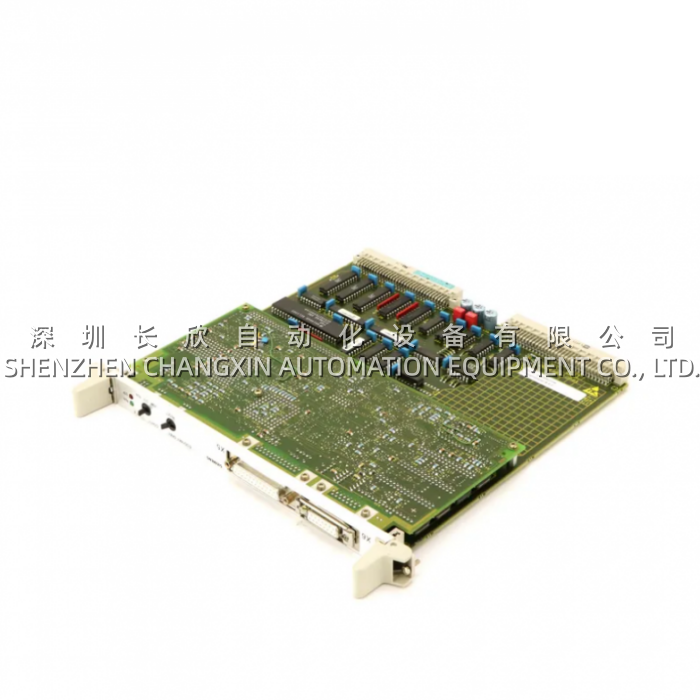
Description
The Siemens 6DD1661-0AB1, also designated as the CSH11 communication module, is a specialized interface module engineered for the Siemens SIMADYN D high-performance drive and automation control system. This module serves as the critical link between the SIMADYN D rack and SINEC H1 industrial Ethernet networks, enabling seamless data exchange with supervisory control systems, PCs, and other industrial devices .
At its core, the Siemens 6DD1661-0AB1 integrates an onboard CP1470 communication processor dedicated to handling the industrial Ethernet protocol stack and packet forwarding . It operates as a slave interface on the SINEC H1 bus, allowing SIMADYN D systems to participate in distributed control architectures and factory-wide data integration strategies .
Application Scenarios
A large steel processing facility operating multiple SIMADYN D-controlled rolling stands needed to integrate its legacy drive systems with a new plant-wide SCADA system for centralized monitoring and production reporting. The existing SIMADYN D racks lacked a direct pathway to the corporate Ethernet network. By deploying the Siemens 6DD1661-0AB1 in each rack, the engineering team established SINEC H1 connections to a central switch, enabling real-time data acquisition from drive parameters, torque values, and operational statuses. The 6DD1661-0AB1 allowed the SCADA system to poll data from the SIMADYN D controllers without interrupting the real-time control loops, achieving seamless integration between the control layer and information layer.
The Siemens 6DD1661-0AB1 addresses the critical challenge of connecting legacy SIMADYN D systems to modern industrial networks. Without this module, drive systems would remain information silos, requiring manual data collection and limiting visibility into production performance . The 6DD1661-0AB1 enables remote diagnostics, centralized alarming, and data historian integration—capabilities essential for Industry 4.0 readiness.
Parameters
| Main Parameters | Value/Description |
|---|---|
| Product Model | 6DD1661-0AB1 (CSH11) |
| Manufacturer | Siemens AG |
| Product Category | SIMADYN D Communication Module / Slave Interface |
| Communication Protocol | SINEC H1 Industrial Ethernet |
| Onboard Processor | CP1470 Communication Processor |
| Interface X5 (Parameterization) | 25-pin Sub-D, RS-232 (V.24) and 20mA TTY |
| Interface X6 (Network) | 15-pin Sub-D, SINEC H1 branch connection |
| +5V Backplane Current | 2.5 A (typical) |
| +15V Backplane Current | 100 mA (without bus coupler) / 600 mA (with bus coupler) |
| Module Width | 20.14 mm (standard SIMADYN D module) |
| Weight | Approx. 0.5–0.7 kg |
| Compatible Racks | SR12.1, SR12.3, SR24.1, SR24.3 (forced ventilation required) |
| Product Status | End of lifecycle since October 2017 |
| Configuration Software | SINEC NML (order no. 6GK1740-0AB01-0EA0) |
Technical Principles and Innovative Values
Innovation Point 1: Dedicated Communication Processor Architecture
The Siemens 6DD1661-0AB1 employs a CP1470 communication processor that offloads all Ethernet protocol handling from the SIMADYN D main CPU. This design ensures that high-speed network packet processing does not consume critical computational resources needed for real-time drive control . Data exchange between the module and the main CPU occurs via an efficient dual-port RAM, enabling high-speed data transfer with physical and logical separation of communication and control tasks .
Innovation Point 2: Dual-Mode Parameterization Interface
The 6DD1661-0AB1 provides a versatile 25-pin Sub-D interface (X5) supporting both RS-232 (V.24) and 20mA TTY electrical standards . This allows initial configuration via a standard PC running SINEC NML software or through a Siemens PG programmer, offering flexibility during commissioning. The standard baud rate of 9.6 kbaud ensures reliable communication with legacy engineering tools.
Innovation Point 3: Comprehensive Onboard Diagnostics
The Siemens 6DD1661-0AB1 features a detailed status indication system using dual-color LEDs and a three-position function selection switch (ADM/RUN/STP) . The LED combinations provide specific diagnostic information: