
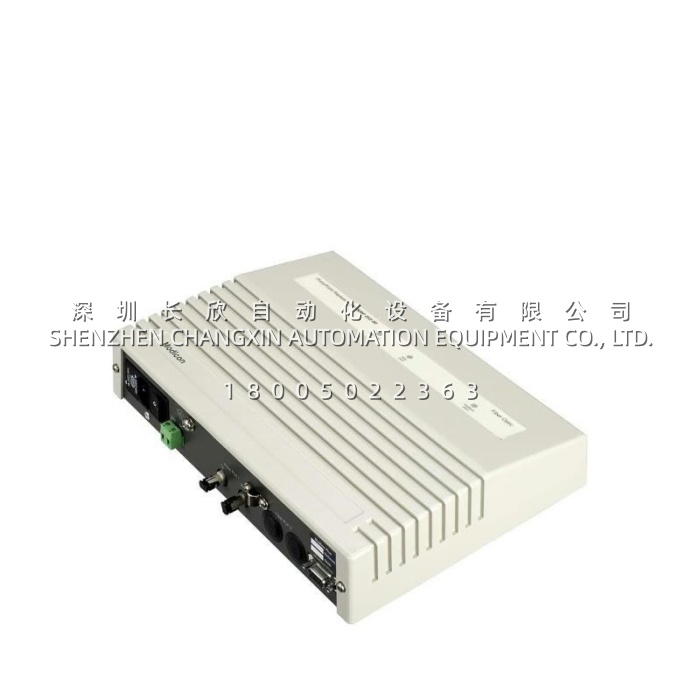
Product Overview
The Schneider Electric 490NRP25400 is a fiber optic line drop repeater built for Modbus Plus (MB+) networks on the Modicon platform. It sits at the physical layer, converting the electrical MB+ signal carried on twisted-pair copper into optical pulses for transmission over multimode fiber, and converting received light back into the electrical domain at the far end. Because the conversion is transparent to the protocol, the 490NRP25400 requires no addressing, no configuration software and no firmware setup — it regenerates the token and the data passing through it and nothing else changes on the network.
What separates this unit from a plain media converter is the “line drop” function. The 490NRP25400 carries two ST optical ports for the fiber backbone plus a 9-pin D-sub female connector that provides a local copper MB+ drop point. That combination lets a designer run a noise-immune fiber backbone between buildings while still giving a local I/O rack, an operator panel or a programming laptop a familiar 9-pin connection at the remote end, without installing a second conversion device.
The practical driver is distance and interference. Copper Modbus Plus segments run to roughly 450 m before signal quality degrades, and in plants with large drives, welders or long earth paths the electrical noise arrives well before that limit. Fiber removes both problems: a multimode hop through the 490NRP25400 covers around 2 km, and the optical link introduces full galvanic isolation, so ground loops and surge paths are broken rather than managed. Operating at the fixed 1 Mbit/s MB+ data rate with Bi-Phase S encoding, the unit mounts on a panel or shelf, is powered from 115/230 VAC or 24 VDC, and is rated for 0 °C to 60 °C. Schneider Electric has discontinued the part and lists no direct replacement, which is why it remains a common spare-part purchase for installed Modicon Quantum and Momentum systems.
Technical Specifications
| Parameter Name | Parameter Value |
|---|---|
| Product Model | 490NRP25400 |
| Manufacturer | Schneider Electric (Modicon) |
| Product Type | Fiber Optic Line Drop Repeater / Line-Drop Transceiver |
| Series / Platform | Modicon Modbus Plus networking (Quantum, Momentum, Premium environments) |
| Network Protocol | Modbus Plus (MB+), Bi-Phase S encoded |
| Data Rate | 1 Mbit/s fixed |
| Electrical Interface | 1 × 9-pin “D” female connector for Modbus Plus trunk or drop cable |
| Optical Interface | 2 × ST-type connectors (TX and RX) |
| Optical Wavelength | 820 nm |
| Fiber Type | Multimode, 62.5/125 µm (50/125 µm in many listings) |
| Maximum Distance per Hop | Up to 2 km multimode, fiber-budget dependent (some listings cite 3 km on low-loss 62.5/125 µm) |
| Power Supply | 115/230 V AC nominal or 24 V DC |
| Power Consumption | Approx. 1.25 W typical for the DC variant (250 mA at 5 V DC quoted for backplane-powered listings) |
| Galvanic Isolation | Full optical isolation of the link; 500 V DC network-to-ground quoted in third-party documentation |
| Diagnostics | LED indication for power and link status |
| Mounting Method | Panel or shelf mounting inside a control cabinet |
| Operating Temperature | 0 °C to 60 °C |
| Storage Temperature | −40 °C to +85 °C |
| Relative Humidity | 5–95% non-condensing |
| Weight | Approx. 1.81 kg (4.00 lb) as listed by Schneider; other listings quote 0.45–0.8 kg — confirm on the unit label |
| Certifications | CE, UL, CSA |
| Country of Origin | France (some units marked USA, depending on production run) |
| Lifecycle Status | Discontinued / obsolete; no direct replacement specified by Schneider Electric |
Main Features and Advantages
Line drop rather than simple conversion: Most fiber media converters give you two ports and nothing else. The Schneider Electric 490NRP25400 gives you a fiber pass-through and a local copper MB+ port on the same device, so a remote substation can hang a Momentum rack or a programming terminal off the backbone without a second box. In retrofit work this is the difference between adding one panel-mounted unit and adding two plus the wiring between them.
No configuration burden: The 490NRP25400 works at the physical layer. There are no node addresses to set, no DIP switches, no firmware to load and no entry in the PLC configuration. A maintenance technician can swap a failed unit during a shutdown and bring the segment back without touching the application program, which matters when the outage window is measured in minutes.
Distance beyond copper limits: A copper Modbus Plus trunk runs to roughly 450 m per segment. Fiber through the 490NRP25400 reaches around 2 km per hop on 62.5/125 µm multimode, and hops can be cascaded in a daisy-chain or star arrangement. For a plant spread across several buildings, or a conveyor line running kilometres, that removes the cascade of copper repeaters that would otherwise be needed — and each of those repeaters is another power supply, another enclosure and another failure point.
Immunity to electrical noise: Optical fibre does not conduct, so the link is immune to EMI and RFI and carries no ground loop. In steel mills, mines and water treatment plants where variable-speed drives and large motors share cable trays with communication wiring, this alone justifies the conversion. Lightning-induced surges also stop at the optical boundary instead of propagating down the copper trunk into every node on the segment.
Installed-base compatibility: The 490NRP25400 works with existing Modbus Plus cabling, connectors and terminators, so extending a legacy network does not force a migration. Given that Schneider lists no direct replacement, keeping a tested spare on the shelf is the pragmatic position for any site still running MB+.
Application Field
Long-distance links between control buildings: In steel plants, cement works and mines, the PLC rack in the main substation often needs to talk to a remote I/O drop several hundred metres away, across a cable route that runs past drives and transformers. The 490NRP25400 converts both ends to fiber and carries the MB+ token across that distance without repeaters in between, which is the standard fix for a segment that has become unreliable on copper.
High-interference production areas: Welding lines, induction furnaces and large press drives generate electrical noise that corrupts copper fieldbus segments intermittently — the classic symptom being communication faults that appear during production and vanish when the line stops. Fibre through the 490NRP25400 eliminates the coupling path entirely, and the diagnostic LEDs on the unit make it possible to confirm whether a fault is on the optical side or the copper drop.
Water and wastewater networks: Lift stations, remote pumping units and treatment basins are spread over wide areas and connected back to a central SCADA over distances that copper MB+ cannot cover. Installing the 490NRP25400 at each outstation allows a fibre backbone to serve sites that are kilometres apart, with local 9-pin access retained for maintenance staff using a laptop.
Power generation and utilities: Unit auxiliaries, ash handling and coal conveying systems frequently run legacy Modicon hardware with MB+ networks installed decades ago. When a copper segment fails or a new building is added to the network, the 490NRP25400 extends the existing architecture rather than forcing a protocol migration, which keeps the project inside the maintenance budget instead of becoming a controls upgrade.
Legacy system sustainment: Because Schneider Electric has discontinued the part with no replacement designated, plants running Modicon Quantum or Momentum systems treat the 490NRP25400 as a strategic spare. Sourcing a new-surplus unit is often the only way to restore a failed fibre segment without redesigning the network around a different medium or protocol.