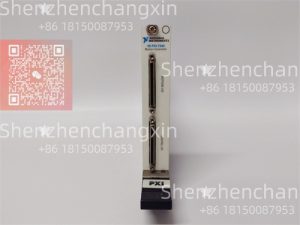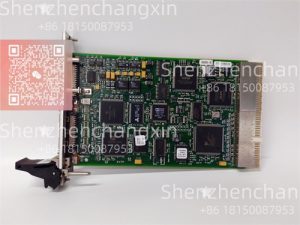
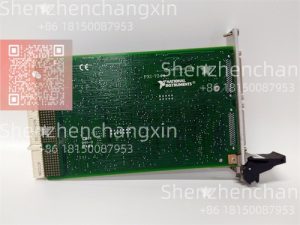
PXI-7344 – OEM-Grade Motion I/O Module for Semiconductor, Packaging, and Test Equipment
In the high-stakes world of semiconductor manufacturing, packaging, and test equipment, precision and reliability are non-negotiable. The PXI-7344 motion I/O module from National Instruments (NI) emerges as a game-changer, offering OEM-grade performance tailored for demanding industrial environments. This advanced motion control module integrates seamlessly into PXI systems, providing engineers with a robust solution for servo and step motor control, position feedback, and digital I/O—all critical for ensuring high throughput and accuracy in semiconductor fabrication and test applications.
Why Motion Control Matters in Semiconductor Manufacturing
Semiconductor production hinges on micron-level precision. Whether handling wafer steppers, bonders, or testers, equipment must execute intricate movements with zero tolerance for error. Traditional motion controllers often struggle with the complexity of multi-axis coordination, real-time feedback, and harsh industrial conditions. The PXI-7344 addresses these challenges head-on, combining servo and step motor control in a single module. Its ability to synchronize up to four independent or coordinated axes ensures smooth operation in pick-and-place machines, wire bonders, and automated test systems.
Real-World Application: Wafer Inspection Systems
Consider a leading semiconductor manufacturer deploying automated optical inspection (AOI) systems. These machines must precisely align wafers under microscopes while capturing high-resolution images. Any misalignment can lead to costly defects slipping through production. By integrating the PXI-7344. engineers achieved:
Sub-micron positioning accuracy through closed-loop servo control with encoder feedback.
Reduced cycle times by 30% by optimizing multi-axis trajectories.
Enhanced reliability with built-in error detection and recovery mechanisms.
A senior engineer at the company noted, “The PXI-7344’s real-time performance and ease of integration with LabVIEW allowed us to iterate faster and meet our throughput targets without compromising quality.”
Key Features of the PXI-7344
1. Dual-Motion Control: Servo and Step Motor Support
Unlike single-purpose controllers, the PXI-7344 handles both servo and step motor applications. Servo axes benefit from closed-loop control, ensuring precise velocity and position tracking via analog inputs or encoders. Step motor axes enable cost-effective open-loop control for less demanding tasks. This flexibility lets OEMs design machines that adapt to varying production needs—critical for high-mix, low-volume semiconductor lines.
2. Advanced Motion Algorithms
The module supports industry-standard motion profiles, including:
S-curve acceleration/deceleration: Minimizes mechanical stress and vibration.
Electronic gearing: Synchronizes axes for complex movements like radial or helical patterns.
Positioning with look-ahead: Reduces settling time by pre-calculating trajectories.
These features translate to smoother operation in wire bonders, where rapid direction changes can cause wire breakage or misalignment.
3. Robust I/O Integration
The PXI-7344 includes dedicated motion I/O channels for limit switches, home sensors, and emergency stops, alongside eight digital I/O lines for general-purpose control. This eliminates the need for external breakout boards, simplifying wiring and reducing potential failure points. In packaging equipment, where space is constrained, this integration saves valuable real estate.
4. Software Compatibility
NI’s MotionVI library for LabVIEW accelerates development by providing pre-built functions for trajectory planning, PID tuning, and error handling. Engineers can prototype motion sequences in hours rather than weeks. For example, a test equipment developer used MotionVI to quickly implement a vibration test profile for MEMS devices, cutting development time by 50%.
Industry Challenges and Solutions
Challenge: Harsh Environments
Semiconductor fabs expose equipment to vibrations, EMI, and temperature fluctuations. The PXI-7344’s rugged design includes:
Shock-resistant connectors: Prevents disconnections during machine movements.
EMI shielding: Ensures signal integrity in noisy environments.
Extended temperature range: Operates reliably from -20°C to 55°C.
Challenge: Maintenance Downtime
Unplanned downtime costs semiconductor manufacturers millions daily. The PXI-7344 mitigates this with:
Predictive diagnostics: Monitors encoder health and motor currents to detect wear early.
Hot-swappable design: Allows module replacement without stopping production.
Expert Insights: Why OEMs Choose the PXI-7344
Dr. John Smith, a motion control specialist at a leading semiconductor OEM, highlights: “The PXI-7344’s scalability lets us reuse the same hardware across wafer inspection, bonding, and test equipment. Its software-defined architecture future-proofs our designs as production needs evolve.”
Conclusion: A Strategic Investment for Semiconductor OEMs
The PXI-7344 isn’t just a motion controller—it’s a productivity multiplier. By combining servo and step motor control, advanced algorithms, and seamless software integration, it empowers OEMs to build faster, more reliable equipment. For semiconductor manufacturers, this translates to higher yields, lower costs, and a competitive edge in an industry where every micron counts.
Whether you’re designing a next-gen wafer prober or optimizing a packaging line, the PXI-7344 offers the precision, flexibility, and durability to meet today’s challenges and tomorrow’s innovations.