Application Scenarios
A large regional hospital in a hurricane-prone area faced a critical vulnerability: its legacy backup power system had a single point of failure and could not automatically synchronize multiple generator sets during prolonged grid outages. During a major storm, this flaw risked a complete power loss in surgical suites and intensive care units. The facility’s engineering team implemented a new distributed generation system centered on the WOODWARD 8440-2052 controller. The module was configured to manage three 2MW diesel gensets. When the next storm caused a grid failure, the WOODWARD 8440-2052 instantly initiated the AMF sequence, started all three units, and seamlessly synchronized them to the emergency bus within seconds—all without manual intervention. More impressively, its built-in load-sharing algorithms dynamically balanced the electrical load between the gensets based on real-time demand from different hospital wings. This not only ensured uninterrupted power but also optimized fuel consumption and reduced engine wear. The controller directly solved the core pain points of automation reliability and system resilience, transforming the backup power system from a liability into a robust asset.
Technical Principles and Innovative Values
Innovation Point 1: Scalable Architecture for Distributed Control. Unlike fixed-capacity controllers, the WOODWARD 8440-2052 is built on a modular, network-centric philosophy. Its native support for the CANopen protocol allows it to act as a master node, commanding a network of up to 32 generator sets. This enables the creation of sophisticated microgrids or large-scale standby power plants from a single control point, a significant differentiator that reduces wiring complexity and centralizes management.
Innovation Point 2: Integrated Three PID Controllers for Precision Regulation. The “P2” designation indicates this variant includes three freely configurable PID (Proportional-Integral-Derivative) controllers. This allows engineers to implement complex, multi-loop control strategies within the same hardware. For example, one PID can manage engine speed (governor control), another can regulate generator voltage (AVR function), and a third can be dedicated to a specialized process like coolant temperature or fuel pressure, eliminating the need for external PLCs for basic control loops.
Innovation Point 3: Comprehensive Protection Suite with Configurable Setpoints. The module goes beyond simple control to offer an embedded protection system. It continuously monitors speed, frequency, voltage, current, power factor, and excitation levels. Each parameter has independently configurable alarm and shutdown setpoints, allowing for tailored protection schemes that match the specific engine and generator manufacturer’s tolerances. This proactive approach prevents catastrophic failures by isolating faults before they cause damage.
Application Cases and Industry Value
Case Study: Data Center Campus with N+1 Redundancy.
A hyperscale data center operator required an ultra-reliable backup power system for a new campus, where even a momentary power flicker could result in millions of dollars of lost revenue. The design specified an N+1 redundant configuration across eight 3MW natural gas generator sets. The WOODWARD 8440-2052 was selected as the primary system controller for its proven multi-unit management. During commissioning, the controller’s ToolKit software was used to fine-tune the load acceptance and rejection response of each genset to within 100 milliseconds, ensuring no voltage dip during simulated grid failures.
The true value was demonstrated during a scheduled utility maintenance when the data center intentionally islanded on generator power. The WOODWARD 8440-2052 successfully orchestrated the entire fleet, managing load demand as server workloads fluctuated throughout the 48-hour test. Its integrated synchroscope and breaker control logic enabled smooth bus transfers. The facility manager reported, “The 8440-2052 gave us the confidence to run on backup power as a routine operation. Its diagnostics predicted a slight fuel valve drift on unit #5. which we scheduled for service without impacting availability. It’s not just a controller; it’s our power resilience assurance platform.”
Related Product Combination Solutions
Woodward 8440-1041 I/O Expansion Module: Expands the digital and relay I/O capacity of the 8440-2052. providing additional points for connecting sensors, alarms, and auxiliary equipment without needing a separate controller.
Woodward 9907-167 Human-Machine Interface (HMI): A dedicated touchscreen panel that provides an enhanced graphical interface for local monitoring and control of the genset system managed by the 8440-2052. ideal for operator rooms.
Woodward 8237-1001 easYgen Unit: A legacy or more economical controller for single-genset applications, which can be networked or upgraded to a system managed by a central 8440-2052.
Woodward 8440-1546H Compact Genset Controller: A DIN-rail mounted controller for individual generator units that can act as a slave node on the same CANopen network supervised by the master 8440-2052. perfect for scalable system designs.
Woodward 8440-1817 Module (5A CT Version): A variant with high-current sensing capability, used in parallel with the 8440-2052 for applications requiring direct, high-accuracy measurement from large alternators.
Woodward 8440-2085 XT Upgrade Module: Provides expanded relay outputs for interlock-intensive setups, complementing the 8440-2052 in complex sequencing applications like black start procedures.
Woodward CPC-MB300 Gateway: A Modbus-to-CAN gateway that allows the 8440-2052 to communicate with and integrate into broader SCADA or Building Management Systems (BMS) that use Modbus TCP/IP or RTU protocols.
Woodward ToolKit™ Software: The essential PC-based configuration, programming, and diagnostic tool for setting up, monitoring, and troubleshooting the application logic running on the WOODWARD 8440-2052.
Installation, Maintenance, and Full-Cycle Support
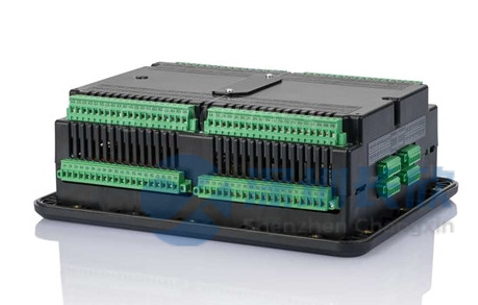
Installation of the WOODWARD 8440-2052 is designed for front-panel mounting, offering flexibility for both new cabinet builds and retrofit projects. The module is secured to the panel using its integrated mounting points, with careful attention to cable routing for the CT (Current Transformer) leads to avoid electrical noise interference. Pre-installation involves verifying the power supply (8-40 VDC) and ensuring all sensor inputs (MPU for speed, CTs for current) are correctly specified and wired. Configuration is highly efficient using Woodward’s ToolKit software, which features graphical programming, pre-configured function blocks for common tasks (like synchronization), and simulation modes to test logic before live deployment.
Routine maintenance is primarily focused on monitoring and data analysis rather than physical servicing. Technicians should periodically check the front-panel LCD for active alarms or warnings and verify the integrity of connections during scheduled generator exercises. The module’s extensive event logging and data buffering capabilities are its greatest maintenance assets; downloading these logs quarterly via the communication port can reveal trends like increasing crank times or slight fuel inefficiencies, enabling truly predictive maintenance. Should a module fault occur, replacement is straightforward: after ensuring the genset is in a safe state, the faulty unit can be disconnected and swapped. Its modular design means the new 8440-2052 can be quickly loaded with the saved configuration file, minimizing downtime. We provide end-to-end support, from initial system architecture design and configuration file development to 24/7 technical troubleshooting assistance and guaranteed access to genuine Woodward spare parts, ensuring your power control system delivers peak performance throughout its lifecycle.