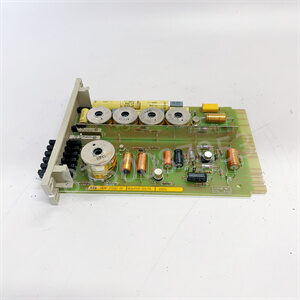
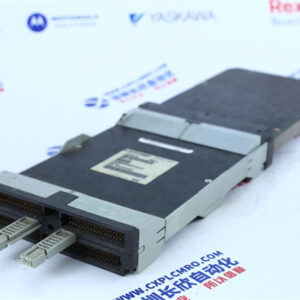
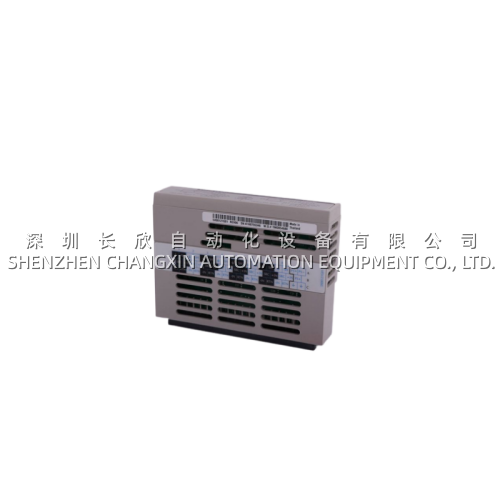
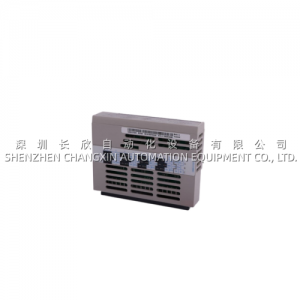
Technical Specifications
|
Parameter Name
|
Parameter Value
|
|---|---|
|
Product Model
|
1C31204G01
|
|
Manufacturer
|
Westinghouse (Emerson Automation Solutions – Ovation DCS)
|
|
Product Type
|
Remote I/O Node Processor Module (RIO Drop Head)
|
|
Compatible System
|
Emerson Ovation DCS (WFC / WCC controller drops)
|
|
Local I/O Channels (faceplate)
|
16 × 24 V DC digital, software-configurable DI/DO
|
|
Signal Level
|
24 V DC sink/source, ON ≥15 V / OFF ≤5 V thresholds
|
|
Channel Isolation
|
1500 V AC (channel-to-channel & channel-to-logic)
|
|
Upstream Communication
|
Ovation fiber-optic link, 850 nm multimode transceiver
|
|
Fiber Reach
|
Up to ~2 km (node-to-controller / node-to-node, plant-dependent)
|
|
Downstream Bus
|
Ovation I/O bus to local AI/AO/DI/DO/TI modules on base
|
|
Power Supply
|
Redundant 24 V DC via Ovation I/O base (backplane)
|
|
Power Monitoring
|
Redundancy loss detection & fault report to controller
|
|
Operating Temperature
|
-40 °C to +70 °C
|
|
Storage Temperature
|
-40 °C to +85 °C
|
|
Humidity
|
5 % to 95 % RH, non-condensing (IEC 60068-2)
|
|
Mounting
|
Ovation I/O base chassis / DIN-rail cabinet mounting
|
|
Protection
|
IP20 (intended for enclosed control cabinet)
|
|
Diagnostics
|
Onboard self-diag, fault isolation, hot-swap capable (redundant config)
|
Main Features and Advantages
Fiber-optic upstream for turbine-bay EMI immunity. The defining design win of Westinghouse 1C31204G01 is its 850 nm multimode fiber uplink to the Ovation controller drop, supporting ~2 km reach between node and controller. In a combined-cycle or coal-fired house, the distance from the central control room to the gas-turbine annex, boiler roof, or circulating-water pump yard routinely exceeds 300–800 m—well beyond reliable RS-485 or profibus-copper distance, and straight into VFD-switching-noise territory. By moving the I/O close to the device and linking back on fiber, Westinghouse 1C31204G01 eliminates ground-loop headaches and lets the plant run 4160 V / 13.8 kV drive neighborhoods without DCS-point flapping. This is why Ovation RIO drops are the default architecture for Balance-of-Plant (BOP) and auxiliary skids.
Configurable 16-channel 24 V DC faceplate I/O. Beyond hosting daughter modules, the Westinghouse 1C31204G01 itself breaks out 16 digital points on the processor front connector—each software-selectable as DI or DO, sink or source. This is deliberately sized for “node-local” signals: RIO-drop health LED, local alarm contact, manual override pushbutton, or a small cluster of valve-limit switches that don’t justify a full 32-point DO daughter card. Having the node-level I/O saves a slot on the base for higher-density analog or specialty modules.
Redundant 24 V DC with fault telemetry. The Westinghouse 1C31204G01 draws from the Ovation I/O base’s redundant 24 V DC feeder (typical plant standard: two 24 V DC UPS legs, A/B). The node continuously monitors both legs and reports a redundancy-loss alarm to the Ovation controller if one feeder fails—so the control room sees “RIO-Drop-A-Power-Fail” before the drop actually blinks, enabling the electrician to swap the faulty PSU while the drop still runs on the good leg. In turbine-aux loops where a dropped RIO means a forced outage, this telemetry is the difference between a planned maintenance window and a scram.
Hot-swap and self-diagnostics for high-availability DCS. In a redundant RIO configuration (two Westinghouse 1C31204G01 nodes serving the same I/O base, or controller-redundant drop design), the module is designed for online removal and re-insertion—the Ovation firmware preserves I/O state during the swap and re-syncs the node on re-seat. Combined with template-level online self-diagnostic, self-recovery, and fault-isolation logic, the Westinghouse 1C31204G01 keeps mean-time-to-repair measured in minutes rather than hours. For plants still running 20-year-old Ovation hardware, this hot-swap path is the primary reason the RIO node hasn’t been forcibly retired—swapping a dead Westinghouse 1C31204G01 during a turnaround weekend is a 15-minute job for a DCS tech.
Legacy lifecycle reality and sparing strategy. Emerson continues to support Ovation but the Westinghouse 1C31204G01 itself is effectively obsolete/new-surplus-only. Plants that standardized on Ovation RIO drops in the 2000s now face the classic spare-parts cliff: the node is cheap ($800–$2000 secondary market) but a single-node failure can idle a 40-point drop covering BFPT, CWP, or HPCI auxiliaries. The smart play—reflected in how major generators stock spares—is to hold 1–2 cold-spare Westinghouse 1C31204G01 per 10–15 deployed drops, plus a matched spare I/O base and power module, so a failure never escalates past “swap-before-lunch.”