Application Scenarios
In an automotive body shop’s respot-welding cell, the main S7-400 controller sits in the central electrical house 80 meters away, while the weld-gun clamp/open, part-present, and safety gate interlocks live on the cell frame itself—a harsh, oily environment where running 40 individual 24 V pairs back to the main rack would mean a cable tray the size of a forearm. The integrator instead hung an IM 151-1 PROFIBUS head module, a PM-E power module, and three Siemens 6ES7 131-4BD01-0AA0 slices on a 35 mm DIN rail inside a small IP54 local box on the cell frame. Because the 6ES7 131-4BD01-0AA0 is only 15 mm wide and the TM-E15C26 spring terminals were pre-wired on the bench, the entire cell I/O fit in a 200 mm-wide cabinet. Six months later, a fork truck clipped the box and one DI slice lost two channels to a shorted BERO. The maintenance tech popped the 6ES7 131-4BD01-0AA0 off the TM while the line was running—ET 200S supports hot-swapping on the electronic-module side—and clicked a spare in. Total downtime: the time it takes to walk 15 paces. The cell lead later said the 6ES7 131-4BD01-0AA0 “looks like a toy compared to the old S5 rack, but it’s the reason we hit 98 % OEE that quarter.”
h2 Parameter
| Main Parameters | Value/Description |
|---|---|
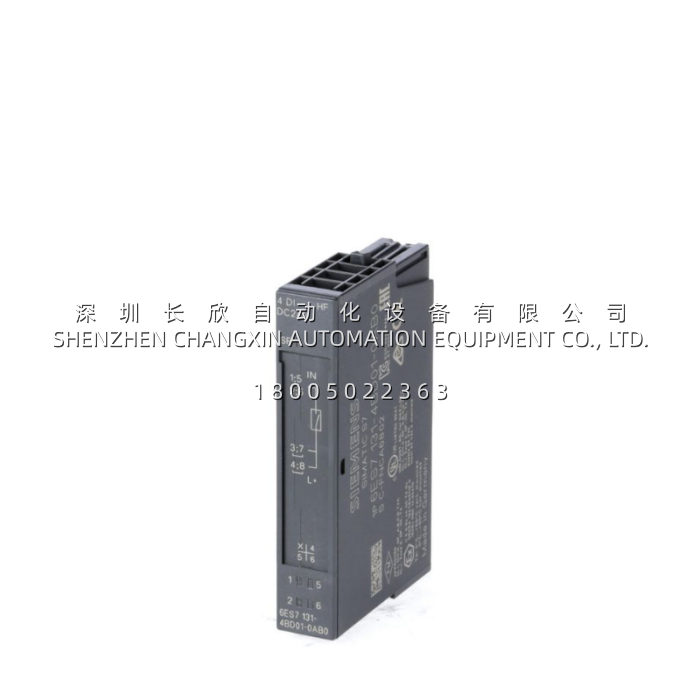
| Product Model | 6ES7 131-4BD01-0AA0 (also listed as 6ES7131-4BD01-0AA0) |
| Manufacturer | Siemens AG |
| Product Category | Digital Electronic Module, ET 200S distributed I/O (DP 5) |
| Digital Inputs | 4 × DC 24 V, IEC 61131 Type 1 |
| Input Voltage Range | 20.4 – 28.8 V DC (rated 24 V DC) |
| Input Current @ “1” | Typ. 7 mA per channel @ 24 V |
| Input Delay | 2 – 4.5 ms (“0″→”1” and “1”→”0″), non-parameterizable |
| Cable Length | Max. 1000 m shielded / 600 m unshielded |
| Isolation | 500 V DC, channel ↔ backplane bus (channel-to-channel: none) |
| Power Loss | Typ. 0.7 W |
| Mechanical | 15 mm W × 81 mm H × 52 mm D, approx. 35 g |
| Terminal Module | TM-E15C26 / TM-E15C24 / TM-E15S23 etc. (sold separately) |
| Operating Temp | 0 °C to +55 °C (vertical mounting) |
h2 Technical Principles and Innovative Values
Innovation Point 1: Split Electronic-Module / Terminal-Module Architecture. Unlike S7-300 SM321 cards where the terminals are integral, the 6ES7 131-4BD01-0AA0 snaps onto a detachable TM-E15xx carrier. During cabinet wiring, the TMs are screwed in and landed first; the 6ES7 131-4BD01-0AA0 is clicked on during commissioning. If a DI channel fails years later, the TM stays—wires untouched—and only the 35 g electronic slice moves. For retrofit projects where “don’t touch the field wires” is a hard rule, this is the differentiator.
Innovation Point 2: 15 mm Width for High-Density Remote I/O. The 6ES7 131-4BD01-0AA0 is one of the thinnest 4-channel DI slices Siemens ever made for ET 200S—half the width of an S7-300 SM321 8DI card. On PROFIBUS strings that daisy-chain through 10–12 stations (conveyor zones, press lines, batching skids), the cabinet footprint saving compounds fast. Three 6ES7 131-4BD01-0AA0 + one 6ES7132-4BD01 DO + PM-E fit in 120 mm of DIN rail.
Innovation Point 3: Standard (ST) vs High-Feature (HF) Clarity. The “-4BD01-” code means this is the ST variant—no channel-level diagnostics, no wire-break detection, no diagnostic interrupt. The HF sibling is 6ES7 131-4BF01-0AA0, which adds value-status bits and wire-break. The swap is electronic-module-only; the TM, GSD slot, and wiring don’t change. For cost-sensitive lines where a dead sensor just means a nuisance alarm anyway, the 6ES7 131-4BD01-0AA0 saves ~30 % per slice over HF with zero panel rework.
Innovation Point 4: 2-Wire and 3-Wire Sensor Native. The 6ES7 131-4BD01-0AA0 accepts both 2-wire (loop-powered proximity) and 3-wire (PNP/NPN BERO) field devices on the same 4 channels—no jumpering, just land AUX+ (L+) and AUX– (M) on the TM and the sensor return goes to the DI pin. Maximum permissible closed-circuit current for 2-wire sensors is 1.5 mA, so it plays nicely with long cable runs and leaky old float switches.
h2 Application Cases and Industry Value
A bottled-water line in Southern Europe originally ran all conveyor zone sensors (photoeyes, jam-detect plungers, guard-door limit switches) back to a central S7-300 rack through 600 m of multicore tray cable. After a forklift crushed a tray section and took down three zones for a shift, the plant engineer re-architected to distributed I/O: one IM 151-1 + PM-E + two Siemens 6ES7 131-4BD01-0AA0 per conveyor zone, PROFIBUS DP daisy-chained along the line backbone. Each zone’s 6ES7 131-4BD01-0AA0 picked up 8 DI’s worth of sensors (four per slice, two slices stacked), and the TM-E15C26 spring terminals let the panel shop pre-wire the zone boxes on the bench before delivery. Post-cutover, the plant reported two gains: first, fault-isolation—when a photoeye shorted, only that zone’s 6ES7 131-4BD01-0AA0 logged a channel fault instead of the whole rack dropping; second, spare inventory simplification—the same 6ES7 131-4BD01-0AA0 fits every zone on the line, whereas the old SM321 16DI and SM323 8DI/8DO mix meant three different spare SKUs. The line lead put it plainly: “the 6ES7 131-4BD01-0AA0 is boring hardware, which is exactly why it never calls me at 2 a.m.”