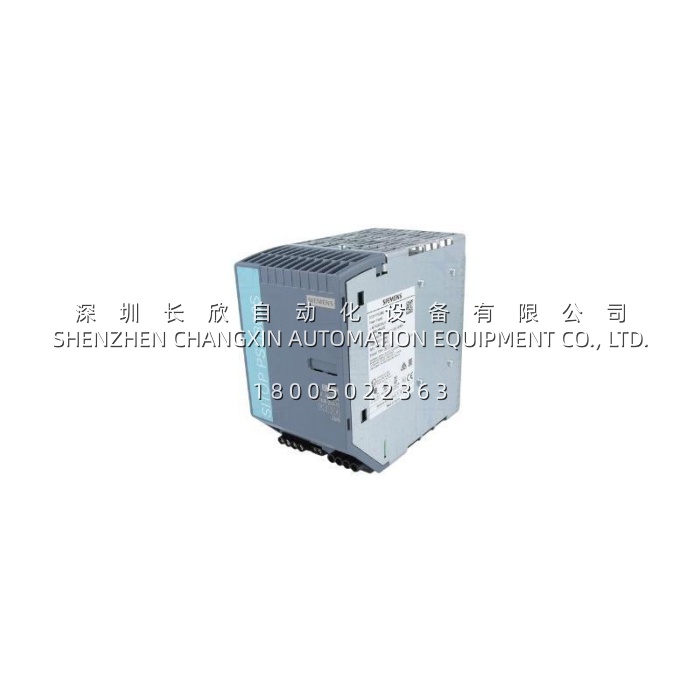
Technical Specifications
| Parameter Name | Parameter Value |
|---|---|
| Product Model | 6EP1437-2BA20 |
| Manufacturer | Siemens |
| Product Type | Stabilized Switch-Mode Power Supply (3-Phase Input) |
| Series / Platform | Siemens SITOP PSU400S |
| Input Voltage | 3AC 400 – 500 V (operating range approx. 320 – 576 V AC, 45 – 65 Hz) |
| Rated Output Voltage | 24 V DC |
| Output Adjustment Range | 22 – 28 V DC (via front potentiometer) |
| Rated Output Current | 37 A (at +45 °C, constant 125% Power Boost class) |
| Extra-Power Capability | 40 A (150% for 5 s/min at < +45 °C) |
| Rated Output Power | 890 W |
| Peak / Short-Term Overload | 125 % continuous (Power Boost, to +45 °C), 150 % (Extra Power, 5 s/min, < +45 °C) |
| Mains Buffering | approx. 20 – 50 ms (typ. at rated load & nominal input; varies with load & input voltage) |
| Efficiency | > 91 % (typical at rated conditions) |
| Protection | Short-circuit (constant-current limiting), overload, no-load safe, over-temperature |
| Diagnostic Indicator | LED “DC OK” or “24 V OK” (green; fault/red per batch behavior) |
| Operating Temperature | –25 °C to +70 °C (derating above +45 °C) |
| Storage Temperature | –40 °C to +85 °C |
| Relative Humidity | 10 % – 95 % (non-condensing) |
| Mounting | 35 mm standard DIN rail |
| Dimensions (W × H × D) | approx. 70 × 125 × 125 mm (PSU400S 37A/40A class, 70 mm narrow body) |
| Weight | approx. 0.9 – 1.1 kg |
| Terminals | Screw terminals (PSU400S class, accept appropriate ferrules) |
| Degree of Protection | IP20 (EN 60529, cabinet-only installation) |
| Certifications | CE, cULus, CB (typical SITOP PSU400S portfolio); refer to nameplate for exact listing |
Main Features and Advantages
The Siemens 6EP1437-2BA20 is built for the moment when a single-phase supply hits the wall—and for the panels where “wall” arrives fast. The headline spec is the 37 A / 890 W rating with 40 A (150 %) Extra Power burst, but the real story is how Siemens packages that current into a 70 mm-wide convection-cooled body without a fan. No fan means no bearing to fail at year 8 in a dusty cabinet, and the PSU400S thermal design keeps the Siemens 6EP1437-2BA20 stable at +70 °C ambient (derated) where cheaper supplies would thermal-trip. The 3AC 400–500 V input with 320–576 V operating envelope also means the module shrugs off phase imbalance and mild sags that would reset a single-phase unit—valuable on large-machine feeders where the same 400 V 3PH that runs the motors is tapped for the control supply.
Power Boost and Extra Power deserve separate mention because they solve two different field problems. The Siemens 6EP1437-2BA20 delivers 125 % continuous (Power Boost) up to +45 °C—this covers the steady-state overload case, e.g., a cabinet where summer ambient + full I/O + a few extra solenoids pushed online pushes the draw to ~46 A. Above +45 °C the boost derates, but the spec is honest about it. Then there’s Extra Power at 150 % for 5 s/min—this is the start-up case: big contactor coil banks, pneumatic valve manifolds all firing on power-up, DC-link pre-charge on downstream drives fed from the same 24 V rail. The Siemens 6EP1437-2BA20 absorbs that 5-second surge without tripping, then settles back to 37 A. A single-phase 10 A unit would fold instantly in the same scenario.
System integration is the third pillar. The Siemens 6EP1437-2BA20 is designed to pair with SITOP RED redundancy modules (for 1+1 redundant 24 V rails—common in S7-400 H-systems and S7-1500 R/H fault-tolerant builds) and SITOP SELECT modules (selective fuse breakout that lets you trip-branch A without killing branch B—game-changing on conveyor lines where one shorted sensor shouldn’t drop the whole 24 V bus). The 22–28 V front pot lets panel builders compensate for voltage drop on long 24 V feeders; the Siemens 6EP1437-2BA20 can be dialed to 27–28 V at the PSU so the far-end ET 200SP or IP67 block sees ≥24 V. And because the output is potential-isolated with no-load protection, a dead short on a branch just makes the PSU current-limit and recover when the fault clears—no blown PSU, no hunting for a rare 37 A fuse (there isn’t one; the PSU self-protects).
Application Field
The Siemens 6EP1437-2BA20 belongs in panels where the 24 V draw is measured in hundreds of watts, not tens. S7-400 racks are the classic home: a single S7-400 CPU 414/416/417 with several dozen SM modules, CP communication processors, and possibly an FM function module or two can pull 15–25 A by itself; add the cabinet’s PROFIBUS/PROFINET remote I/O drops, valve terminals on a process skid, and solenoid banks, and a 10 A single-phase supply is nowhere near enough. The Siemens 6EP1437-2BA20 becomes the obvious choice—often specified as a pair in redundancy with a SITOP RED module for S7-400 H fault-tolerant systems where a 24 V rail loss = process trip.
S7-1500 high-density panels form the second big bucket. A modern S7-1515R/1517H or even a straight S7-1516 with 8–12 ET 200SP IM155-6 PN ST/HS drops, TM pulse-count modules, and a rack of G120 / SINAMICS drives drawing 24 V aux from the same bus can easily hit 30 A steady-state. The Siemens 6EP1437-2BA20 gives headroom for future expansion without a mid-life PSU swap, and the 3AC 400 V input taps the same feeder the drive infeed uses, keeping the panel’s upstream distribution clean—one 3-phase branch, not a 3-phase for motors + a separate single-phase tap for controls.
Automotive body-shop conveyors, paint-shop skids, and general assembly lines are the third pattern. These lines run long stretches of IP67 block I/O (ET 200eco/ET 200pro) and pneumatic valve terminals every 3–5 m along the conveyor, all 24 V-fed. A 40 A Extra Power burst at start-up handles the “everyone powers up together” case, and the Siemens 6EP1437-2BA20 narrow 70 mm body leaves DIN rail for a SITOP SELECT 4-channel or 8-channel fuse breakout—so when a weld-cell sensor shorts, only that 4 A branch fuse pops, not the whole conveyor’s 24 V. Process industries—chemical batch, water/wastewater pump houses, cement finish-mill local panels—round out the list, especially where the plant standard is 400 V 3PH throughout and the engineering team wants one PSU BOM line for the whole site.