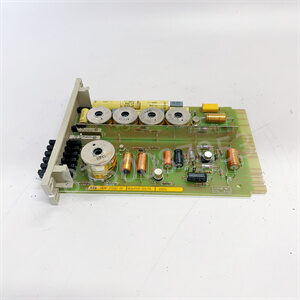
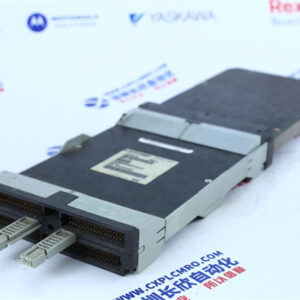
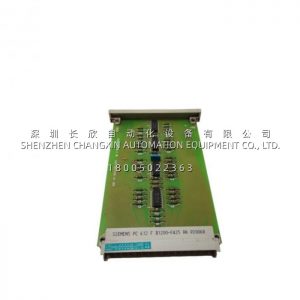
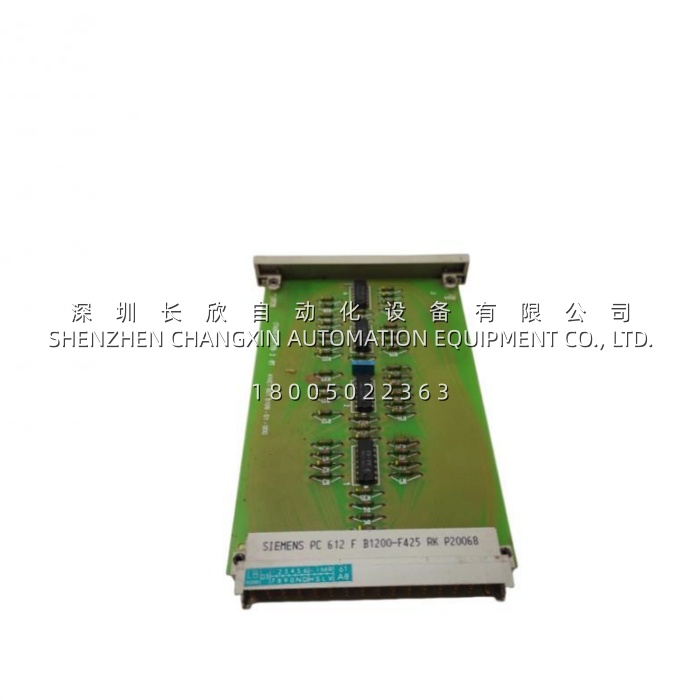
Technical Specifications
| Parameter | Value |
|---|---|
| Product Model | 6EC1001-0A |
| Manufacturer | Siemens |
| Product Type | SIMATIC C1 Logic Module (Boolean Gate / SPS Slice) |
| Logic Resources | 1 × SPS + 11 × 3-input AND gates |
| Rated Voltage | 24 V DC |
| Rated Current | 0.5 A (typical module draw) |
| Operating Temperature | –25 °C to +60 °C |
| Storage Temperature | –40 °C to +85 °C |
| Protection Rating | IP20 (cabinet installation) |
| Mounting | SIMATIC C1 rack / proprietary C1 carrier, plug-in |
| Termination | Dedicated C1 plug-in connector (system-side) |
| Weight | ≈ 0.5 kg |
| Compatible System | Siemens SIMATIC C1 family racks |
| Function Class | Combinational boolean logic expansion, interlock support |
Main Features and Advantages
Legacy-rack drop-in compatibility: The defining strength of the Siemens 6EC1001-0A is that it speaks the C1 backplane natively. In a plant where a 40-year-old transfer line still runs on SIMATIC C1 and the original logic module has failed, there is often no business case to re-panel the entire machine. The Siemens 6EC1001-0A slots straight into the original carrier, reuses the existing C1 inter-module wiring, and restores gate-level logic without touching higher-level controls. This is why spare stocks of the Siemens 6EC1001-0A command premium pricing among European textile- and stamping-press maintainers.
Eleven three-input AND gates plus one SPS: The gate count on the Siemens 6EC1001-0A is deliberately generous for a single C1 slice. Eleven 3-input ANDs can be wired to synthesize larger AND/OR structures, enable veto chains (e.g., “guard closed AND reset pressed AND estop cleared → permit cycle”), and decompose multi-sensor voting logic without consuming the rack’s SPS capacity elsewhere. The single onboard SPS element adds a minimal sequential/stored-program dimension—enough for simple latching or one-shot behaviors—while the AND array handles the combinational heavy lifting. For many C1 machines, one Siemens 6EC1001-0A replaces what would have been two full relay panels in the pre-solid-state era.
Zero-scan-latency response: Because the Siemens 6EC1001-0A is fundamentally gate-based rather than scan-based, propagation delays are gate-level (sub-microsecond to low-microsecond range typical of that silicon generation), not millisecond scan-cycle. In emergency-stop veto chains, guard-door interlocks, and press-clutch release logic, this matters: the Siemens 6EC1001-0A can kill a outputs path in hardware time, independent of whatever the C1 master scanner is doing. This architectural property is one reason why C1 logic modules survive in safety-adjacent loops even as the rest of the cell migrates to S7.
Electrical simplicity and resilience: 24 V DC at 0.5 A is the classic control-voltage domain—no AC mains near the logic, no SMPS noise to speak of by modern standards, and a 0.5 kg injection-molded housing that shrugs off the kind of low-frequency vibration found on mechanical presses and looms. The IP20 rating assumes cabinet residence, which matches the C1’s original deployment model (all C1 modules lived behind a locked machine-control cubicle door). The Siemens 6EC1001-0A therefore ages predictably: the failure modes are typically connector fretting, internal bond-wire fatigue on thermal cycles, or the SPS EPROM/EEPROM retention—not EMI susceptibility.
Obsolescence-aware sourcing: From a procurement standpoint, the Siemens 6EC1001-0A is no longer in active Siemens production. Its market exists entirely in verified-surplus, tested-pull, and NOS (new-old-stock) channels. This makes functional testing before dispatch non-negotiable—every Siemens 6EC1001-0A should be backplane-tested for SPS retention and AND-gate truth-table integrity, because a “dead gate” on one channel can silently break an interlock chain that only activates during fault conditions.
Application Field
The Siemens 6EC1001-0A is almost exclusively deployed in legacy contexts—there is no greenfield rationale for specifying a C1-logic module in 2025. Its natural habitat is the SIMATIC C1 rack of a 1980s–1990s European production machine that is still mechanically sound and economically unjustified to rewire. In textile mills, the Siemens 6EC1001-0A appears on loom sequencing panels and bobbin-handling interlocks, where the 11 AND gates decompose multi-photocell voting (“warp present AND bobbin seated AND operator-two-hand → advance”). On mechanical stamping and punching presses, the Siemens 6EC1001-0A typically sits in the guard-door / light-curtain veto tree—its gate-level speed means the clutch-kill path is not dependent on a PLC scan, which some legacy safety assessments still grandfather accept.
Conveyor interlock strings in old parcel-sort and baggage-handling rooms also consume Siemens 6EC1001-0A modules: zone-full detection, photo-eye triplet voting, and slug-release enable can all be expressed in the eleven 3-input ANDs with the SPS providing a latch (“slug-released” memory bit until downstream clear). In process skids (brewery, dairy, legacy batch) where C1 was used for auxiliary interlocks separate from the main S5/S7 process controller, the Siemens 6EC1001-0A acts as the “local veto officer” that can kill a pump or valve string even if the master controller is in manual or faulted.
Beyond production, the Siemens 6EC1001-0A has a second life in teaching collections and industrial-heritage exhibits. Automation-engineering programs that trace the relay→C1→S5→S7→TIA lineage use the Siemens 6EC1001-0A to demonstrate what “pre-ladder” boolean modular logic looked like—a rack of gate-slices rather than a scanned program. For museums of technology and for OEMs maintaining “heritage” production assets (e.g., specialty paper machines, historic rolling-mill auxiliaries), the Siemens 6EC1001-0A is less a component than a continuity guarantee: without it, the C1 rack is incomplete and the machine stays down.