Technical Specifications
| Parameter Name | Parameter Value |
|---|---|
| Product Model | 6DS1412-8RR |
| Manufacturer | Siemens |
| Product Type | K-Loop Controller Module (Continuous Controller) |
| Series / Platform | Siemens Teleperm ME |
| Rated Voltage | 24 V DC (allowable range 19.2 – 28.8 V DC) |
| Power Consumption | approx. 12 – 16 W |
| Control Algorithms | PID, PI, P, Feedforward, Ratio, Selector, Cascade |
| Configurable Cycle Time | 100 ms – 1 s (typical, user-definable) |
| Supported Loops | Multiple independent or cascaded control loops per module |
| Input Signal Compatibility | Via Teleperm ME analog input modules: 0/4–20 mA, 0–10 V, RTD, TC (backplane-routed) |
| Output Signal Compatibility | Via Teleperm ME analog output modules: ±10 V, ±250 µA ranges supported through onboard jumper-configured A/S channels |
| Communication / Programming | TML (TELEPERM M Language) + STEP M; rack backplane bus to I/O and communication processors |
| Diagnostic Features | LED status indicators, algorithm-block self-check, firmware variant reporting |
| Operating Temperature | 0 °C to +60 °C |
| Storage Temperature | –25 °C to +70 °C |
| Relative Humidity | 10 % to 95 % (non-condensing) |
| Mounting | Teleperm ME dedicated rack slot, Eurocard format (3HE) |
| Dimensions (approx.) | 254 mm × 76 mm × 204 mm (25.4 × 7.6 × 20.4 cm) |
| Weight | approx. 0.4 kg |
Main Features and Advantages
The Siemens 6DS1412-8RR distinguishes itself through a combination of algorithmic depth, Teleperm ME heritage reliability, and careful lifecycle design that respects legacy installations while offering modest extensibility. Its on-board algorithm library goes well beyond elementary single-loop PID: engineers can configure cascade control, feedforward compensation, ratio control, selector (high/low pick) logic, and bumpless auto/manual transfer entirely through TML function-block group calls, avoiding custom code for the majority of process loops. This makes the Siemens 6DS1412-8RR especially valuable when migrating or maintaining older plants where the original control narrative was built around Teleperm ME function charts—replication fidelity is near-exact.
Processing precision is another strength. The module employs a dedicated digital-signal architecture for loop arithmetic, with floating-point handling that suppresses quantization error across the analog chain. When paired with the correct Teleperm ME analog input and output modules, the Siemens 6DS1412-8RR yields smooth control trajectories even on sluggish, integrating processes such as boiler drum level or large-compartment furnace pressure, where overshoot and oscillation are costly.
Redundancy support is implemented at the module-pair level: two Siemens 6DS1412-8RR units (or two identical -8CC / -8DD / -8DE pairs, but not mixed variants) can run redundantly, with firmware versions required to match within the pair. The replacement path is also well-defined—online upgrade from -8DD or -8DE to -8RR is supported by Siemens, allowing plants to standardize on the -8RR as the preferred long-term spare without a cold-cutover.
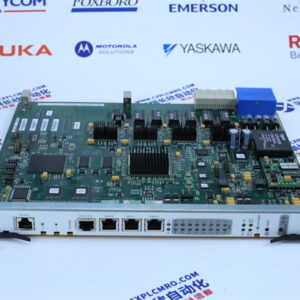
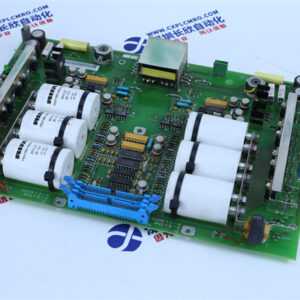
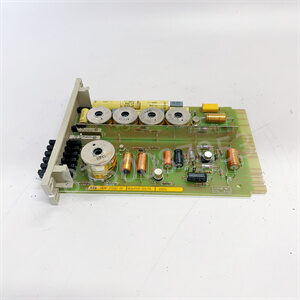
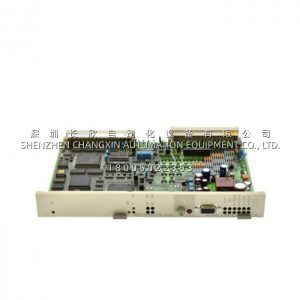
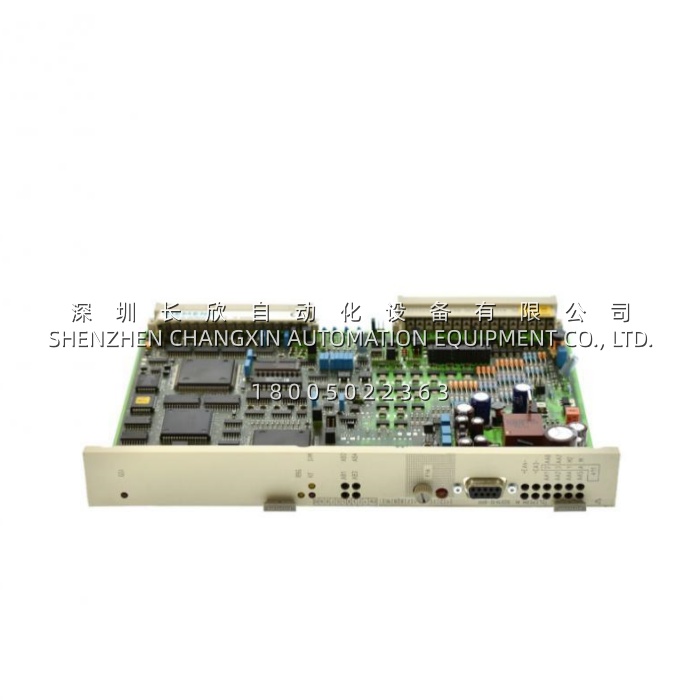
Physically, the Siemens 6DS1412-8RR exposes a row of user-accessible jumper blocks (X8, X22, X25, X28/X29, X73, X78, X80, X81, etc.) that select analog input ranges (0–20 mA vs. ±10 V on the A/S channels), output ranges (–250…+250 µA vs. –10…+10 V), and single-wired vs. cross-wired redundancy wiring on X2. A small subset—X41 and X43—ship in a fixed delivery state and, along with the processor-module jumpers carried over from the -8AA/-8CC/-8DD/-8DE lineage, are explicitly flagged by Siemens as works-internal test points that must not be altered by the user. Firmware variant selection is handled through X22/7-8 and X22/9-10: plugged/open combinations report E, D, or the default R. Keeping this jumper discipline is essential; arbitrary changes can make a replacement Siemens 6DS1412-8RR report the wrong firmware ID to the Teleperm ME central station and block download.
Application Field
The Siemens 6DS1412-8RR is squarely aimed at process industries where Teleperm ME DCS racks still form the automation backbone. In fossil power plants, the module routinely handles boiler master pressure control, mill outlet temperature loops, forced/outlined draft fan damper positions, and—most classically—three-element drum-level feedwater control where a cascade primary (level PID) drives a secondary (feedwater flow PID) with steam-flow feedforward. The bumpless transfer and feedforward capabilities of the Siemens 6DS1412-8RR make it a natural fit here, since load swings from peaking units demand smooth hand-off between auto and manual without operator-induced transients.
In petrochemical and refining contexts, the Siemens 6DS1412-8RR often appears on distillation-column pressure-compensated temperature control, reactor jacket temperature cascade loops, and fuel-gas/combustion-air ratio stations where a ratio block keeps excess O₂ in check during load changes. The module’s tolerance for 0…+60 °C ambient and 10–95 % non-condensing humidity, together with the Eurocard’s conformal-coated Teleperm ME pedigree, means it survives control-room and local-enclosure environments that would stress consumer-grade controllers.
Another major application segment is retrofit and lifecycle extension: many Teleperm ME installs dating from the 1990s–2000s are now in “run-to-failure with spares” mode. The Siemens 6DS1412-8RR, being pin- and function-compatible with -8AA/-8CC/-8DD/-8DE, lets maintenance teams consolidate spare inventory on a single modernized variant while retaining the ability to hot-swap into legacy racks. For EPC and service contractors supporting Middle East refineries, Asian IPPs, and European chemical sites, the Siemens 6DS1412-8RR is typically specified whenever the bill of materials still calls out any of the older 6DS1412-8xx codes.