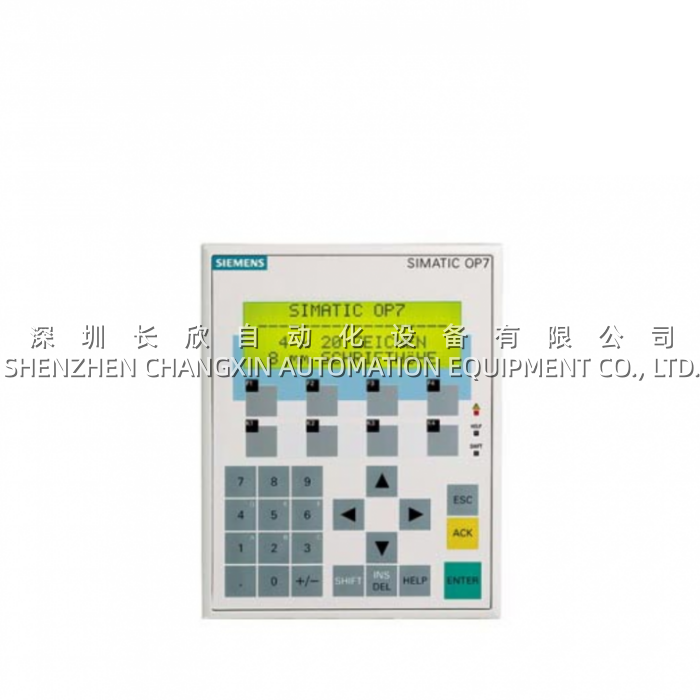
Technical Specifications
| Parameter Name | Parameter Value |
|---|---|
| Product Model | 6AV3617-1JC20-0AX1 |
| Manufacturer | Siemens |
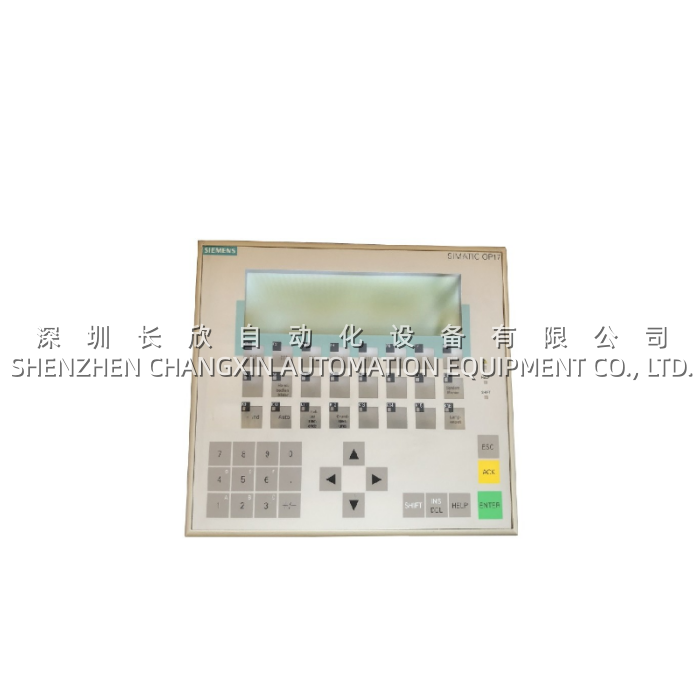
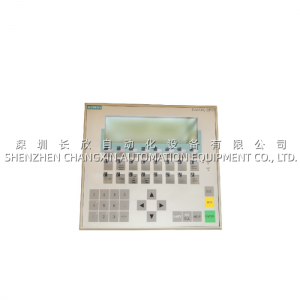
| Product Type | SIMATIC OP17/C Operator Panel (Character-based, DP version) |
| Display | LC, LED backlit, 4 × 20 chars / 8 × 40 chars switchable, monochrome |
| Function Keys | 24 keys total: 16 programmable F-keys (with LEDs) + 22 system keys + numeric/hex keypad |
| Memory | 256 KB Flash / RAM |
| Supply Voltage | 24 V DC (19.2–28.8 V range, ±20%) |
| Current / Power | 0.34 A typ. / ≈10 W |
| Communication | MPI / PROFIBUS DP slave, up to 1.5 Mbps |
| Serial Interfaces | 2 × RS232, 1 × RS422, 1 × RS485 |
| RTC / Backup | Hardware RTC, optional 3.6 V lithium backup battery |
| Protection | IP65 front / IP20 rear (UL/CSA/FM Class I Div 2, EX Zone 2/22) |
| Operating Temp | 0 … +55 °C |
| Dimensions (W × H × D) | 240 × 204 × 50 mm (flush mount) |
| Config Software | ProTool / ProTool Lite V2.51+, RS232 download (no USB, no Ethernet) |
Main Features and Advantages
DP slave capability saves MPI headroom. The core differentiator of the 6AV3617-1JC20-0AX1 versus the cheaper OP17/A and OP17/B is the “C” hardware revision’s PROFIBUS DP slave port. On a typical S7-400 cell with a CPU 414-2 DP, the MPI side often already carries a PG, maybe an older OP27, and the CPU’s own PG port — leaving zero MPI connections for a second panel. By putting the 6AV3617-1JC20-0AX1 on the DP master port as a DP slave (1.5 Mbps), the MPI bus stays free and the HMI still reads/writes DB, M, I/Q, timers, and counters identically. For retrofit engineers inheriting a saturated MPI backplane, this is why the “C” suffix commands a premium over the “A” on the surplus market.
Physical-key durability for glove/shop-floor duty. The 6AV3617-1JC20-0AX1 is resolutely non-touch — 24 membrane keys with the Siemens OP17 tactile feel, F-key LED annunciation, cursor cluster, ACK/Escape, and a 0–9/A–F hex pad. Membrane life is rated ≥1 million actuations, and the front foil is IP65-rated against oil mist and spray — important in packaging, metalworking, and batching skids where a resistive touch would be blinded by coolant or flour dust within a season. Operators who have run the machine for 15 years know which F3 vs F7 does what without looking; migrating them to a KTP touch panel often slows them down, which is why plants keep buying the 6AV3617-1JC20-0AX1 as long as supply holds.
ProTool project continuity. Because the 6AV3617-1JC20-0AX1 configures only in ProTool/Lite (V2.51+), plants with archived .pdb files can clone a failed unit by RS232 download in under 20 minutes — no TIA license, no WinCC Flexible migration headache, no tag-count anxiety. The 256 KB user memory sounds tiny by 2025 standards but was sized for OP17’s screen count (typically 50–100 screens, alarm buffers, recipe text blocks), and for legacy lines that scope is unchanged after two decades. The 6AV3617-1JC20-0AX1 also supports basic trending (f[t] curve vectors), alarm ACK, and printer output via the auxiliary serial ports — enough for a stand-alone filler, capper, or test stand that has no business case for a Comfort panel.
Certifications for hazardous-adjacent zones. The 6AV3617-1JC20-0AX1 carries CE, UL/CSA, FM Class I Div 2, and EX Zone 2/22 — meaning it can be specified in cabinets adjacent to classified areas (oil & gas skids, pharma solvent zones, grain handling) without extra enclosure uprating, something the later Basic panels dropped in some regional SKUs.
Mechanical commonality across OP17 family. The 6AV3617-1JC20-0AX1 shares the same 240 × 204 mm faceplate and cutout as the /A (6AV3617-1JA20) and /B (6AV3617-1JB20), so a DP retrofit of an MPI-only /A is a like-for-like panel swap — gasket, clamp screws, and cutout all transfer. Only the back-shell DB9 + DP connector orientation changes, which the cabinet installer handles in five minutes.
Application Field
The 6AV3617-1JC20-0AX1 lives almost entirely in legacy sustainment scenarios rather than new designs, but those scenarios are numerous: S7-300/400 lines installed 1998–2010 that were never migrated to S7-1500 + TIA, and where the HMI scope (alarm text, setpoint entry, jog, recipe select) hasn’t changed in a decade. Typical deployments include packaging OEMs (horizontal wrappers, rotary fillers, cartoners) where the has been the faceplate since the machine shipped and the operator workforce knows the F-key map by muscle memory; food & beverage skids (CIP loops, depot vessels, batch weigh platforms) where the IP65 foil survives daily washdown adjacency and the RS422/485 ports still talk to an old weigh scale or barcode gun; and utility-area machines — hydraulic test stands, leak-test fixtures, winding machines — where a 4×20 text screen plus 16 F-keys is genuinely sufficient and a €1 500 KTP upgrade cannot be justified to the plant manager.
Retrofit is the dominant purchase reason: a 6AV3617-1JC20-0AX1 fails (typically membrane delamination after 12–15 years, or backlight dimming, or the DB9 DP port gets wiggled once too often), the plant finds the 0AX1 is EOL, and they buy a tested-refurb 0AX1 or the 0AX2 revision to drop in with the same ProTool runtime. Some integrators proactively keep two cold spares per cell because Siemens’ SIMATIC family has been out of production for years and lead times on “new old stock” are unpredictable. In mixed-vendor cells, the 6AV3617-1JC20-0AX1 sometimes appears paired with non-Siemens PLCs via the RS422/485 ports running generic ASCII or Modbus RTU, though MPI/DP to S7 is the native sweet spot. Export machinery originally sold to Asia or Eastern Europe with ProTool projects also cycles back to the 6AV3617-1JC20-0AX1 when a spare is needed, because rewriting the HMI into a current-generation panel would cost more than the machine is worth.