Technical Specifications
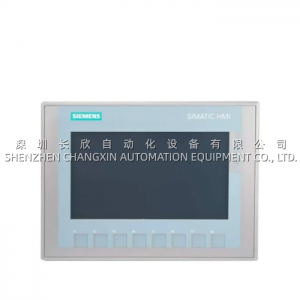
| Parameter Name | Parameter Value |
|---|---|
| Product Model | 6AV2123-2GB03-0AX0 |
| Manufacturer | Siemens |
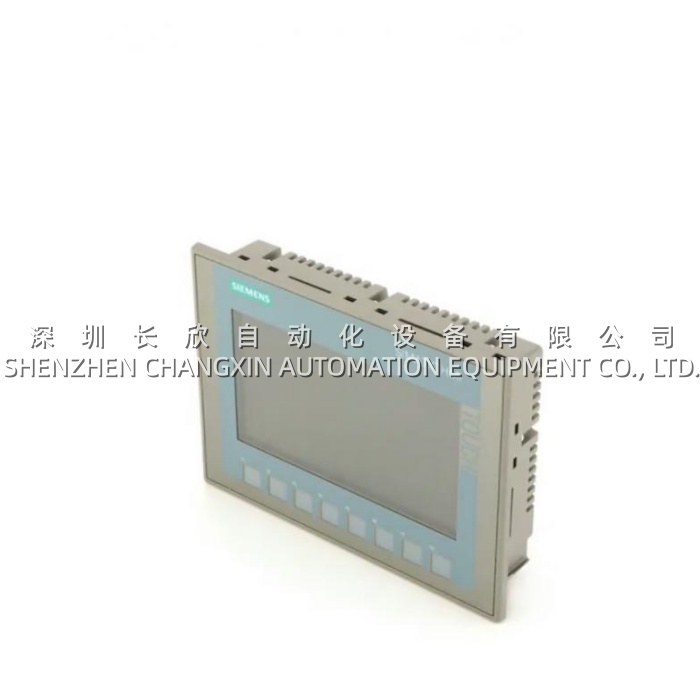
| Product Type | SIMATIC HMI KTP700 Basic (2nd Gen), Key/Touch Panel |
| Display | 7″ TFT widescreen, LED backlight, 65 536 colors |
| Resolution | 800 × 480 pixels |
| Touch / Keys | Resistive touch + 8 configurable function keys (no LEDs) |
| Processor | ARM |
| User Memory | 10 MB |
| Interface | 1 × RJ45 PROFINET (also Modbus TCP / EtherNet/IP) |
| USB | 1 × USB host (≤ 16 GB) |
| Supply Voltage | 24 V DC (19.2–28.8 V range) |
| Current / Power | 230 mA typ., 5.5 W active |
| Protection | IP65 front / IP20 rear (NEMA 4x front when mounted) |
| Operating Temp | 0 … +50 °C |
| Front / Cutout / Depth | 214 × 158 mm / 197 × 141 mm / ~46 mm |
| Config Software | WinCC Basic V13+ / TIA Portal (STEP 7 Basic V13+) |
Main Features and Advantages
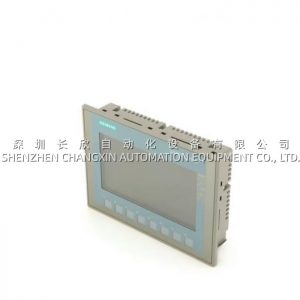
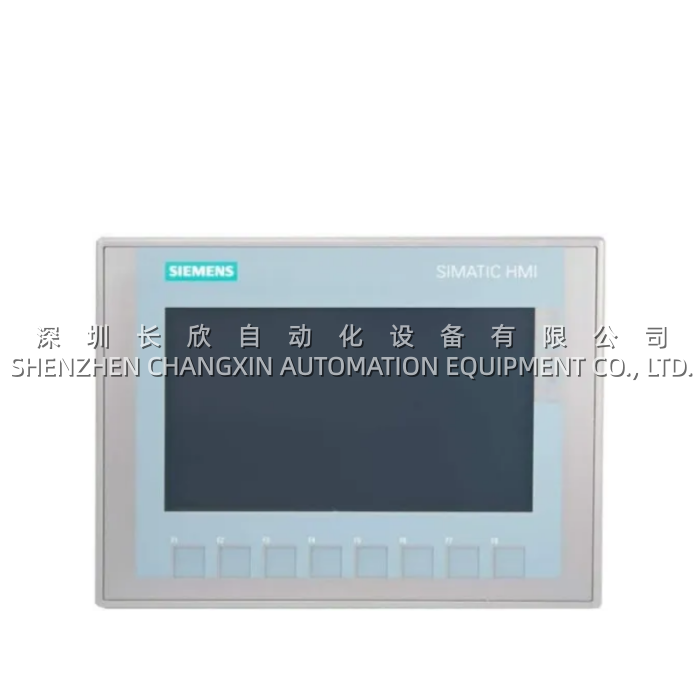
Key + Touch hybrid for real-shop usability. The defining trait of the 6AV2123-2GB03-0AX0 is the KTP form factor—resistive touch for screen navigation, recipe browsing, and alarm ack, plus eight physical function keys for the operations operators hit dozens of times per shift: Start, Stop, Reset, Mode Select, Jog, Home. In food packaging or metalworking shops where gloves, oil, and vibration are routine, a resistive touch alone can drift; the physical keys give deterministic actuation that a pure TP (touch-only) panel cannot match. The keys are not illuminated (no LED), which keeps the BOM and power draw low—acceptable because the main screen already carries status graphics.
Single-cable multi-protocol Ethernet. The RJ45 port on the 6AV2123-2GB03-0AX0 is labeled PROFINET but the stack also speaks Modbus TCP and EtherNet/IP on the same interface. For machine builders exporting to North America where EtherNet/IP is specified by the end customer, or to Asia where Modbus TCP is the default, the same HMI hardware covers all three without a gateway or dual-port swap. PROFINET IO controller role lets the panel talk natively to S7-1200/1500 IO, while the Ethernet protocols handle third-party drives, weigh scales, or barcode scanners on the same switch.
TIA Portal / WinCC Basic integration with predictable quotas. The 6AV2123-2GB03-0AX0 is licensed under the Basic tier—100 screens, 32 message classes, 1000 alarms, 800 tags, 50 recipes, trending (f(t) curves), bar/vector graphics, and archival. For a standalone machine this is usually more than enough; the quota acts as a guardrail preventing a machine builder from overloading the ARM processor with a Comfort-sized project. Knowing the quotas upfront avoids the classic mistake of specifying a KTP700 Basic for a 2000-tag cell and hitting the wall six months later—use case discipline is part of the selling point.
Low power, slim depth, cabinet-friendly. At 5.5 W from 24 V DC, the 6AV2123-2GB03-0AX0 rarely needs a dedicated PSU branch—it rides the same SITOP that powers the S7-1214C or 1511C. Depth is ~46 mm behind the gasket, so shallow door pockets that reject a 60 mm+ Comfort panel still close. Cutout 197 × 141 mm matches the 7-inch Basic family, so cabinet punch templates are reusable across KTP700 orders.
Software & lifecycle maturity. Second-gen Basic (2GB03) supersedes the 2GA03 first-gen, with improved backlight longevity and TIA Portal V13+ baseline. The 6AV2123-2GB03-0AX0 shares the same faceplate dimensions and mounting as the DP-variant (2MB03) and the Comfort TP700, giving panel-shop designers a migration path upward if the tag count eventually bursts past 800. Open-source software components (PDF viewer, web-free diag elements) are included on the companion CD per Siemens’ Basic Panel bundle convention.
Application Field
The 6AV2123-2GB03-0AX0 is the default HMI choice for S7-1200 and compact S7-1500 CPU-based machines where visualization needs sit between “text display” and “full SCADA”. In packaging lines—entry-level horizontal wrappers, intermittent-motion cartoners, rotary fillers—the KTP700 Basic hosts the recipe page (50 slots), the alarm buffer (1000 entries with ACK), and the jog/manual screens reachable via the 8 function keys while the operator’s other hand is on the part. In material handling, small conveyor zones with 2–4 drives and a barcode scanner hang off the RJ45: PROFINET to the S7-1215, Modbus TCP to the scanner, single cable, no gateway. In lab-scale process skids (pharma water, CIP pilot units, bioreactor jacket control), the 800-tag ceiling comfortably covers analog loops, valve matrices, and batch-phase states, while the IP65 front face wipes clean in washdown-adjacent zones (though not full hygienic—Combo or Pro panels sit above this).
Food & beverage OEMs use the 6AV2123-2GB03-0AX0 on depositors, deposit-and-cut tables, and bottle rinsers where the operator stands at the machine 8 hours a day—physical F-keys beat dive-through touch menus for Start/Stop/E-Stop-override acknowledgment. Automotive job-shop test benches (hydraulic press controls, leak-test fixtures) spec the same panel because the ARM processor is adequate for trending four pressure curves simultaneously (f(t) vector graphics) without the cost of a TP700 Comfort. Retrofit is another lane: replacing an obsolete OP7/OP17 text panel on an S7-300 legacy line, the 6AV2123-2GB03-0AX0 drops into a closely matched cutout with a trimming gasket, and WinCC Basic imports the old ProTool tags with less rework than jumping to Comfort. For export machinery, the EtherNet/IP enablement on the same RJ45 means one BOM covers EU (PROFINET) and NA (EtherNet/IP) shipments—just flip the TIA Portal device profile.