Application Scenarios:
A municipal water treatment plant commissioned in the late 1990s runs twelve Modicon Quantum PLCs on a single MB+ trunk, with the SCADA node, the historian and the engineering laptop all hanging off the same cable. The plant wants to add a second HMI for the new sludge line, but nobody wants to touch the running network — one wrong node address or one missing terminator and twelve PLCs go dark.
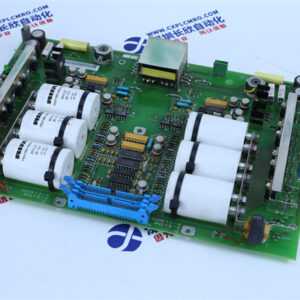
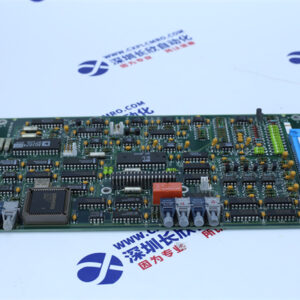
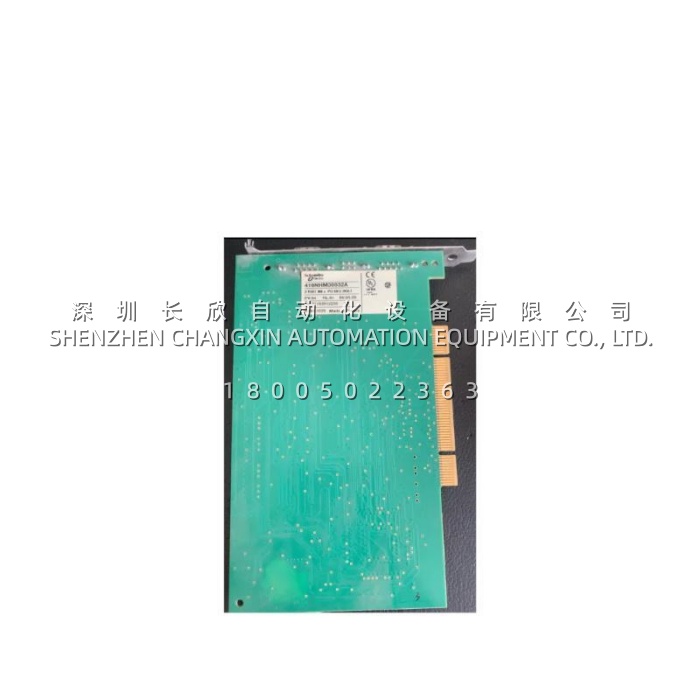
This is the environment the 416NHM30032A was built for. Installed in a spare PCI slot of the existing operator station, its second port connects the new HMI segment while the first port stays on the legacy trunk, so the two networks share a workstation but not bandwidth or failure modes. The token-passing protocol means the new node does not steal airtime from the old ones; it waits for the token like everyone else.
A second, more awkward case: a pharmaceutical batch suite where the validated engineering workstation is a 2008-vintage industrial PC running Windows XP, and the qualification documentation forbids touching the OS image. When that PC’s original adapter dies, the 416NHM30032A is one of very few cards that can drop into the same PCI slot, use the same driver stack, and leave the validated configuration untouched. Re-qualification is a hardware swap, not a software project — which, in a GMP environment, is worth far more than the price of the card.
Parameter:
| Main Parameters | Value / Description |
|---|---|
| Product Model | 416NHM30032A (also listed as 416NHM30032) |
| Manufacturer | Schneider Electric (formerly Modicon) |
| Product Category | Modbus Plus PCI communication adapter / network interface card |
| Series | Modicon communication interfaces, ConneXium family |
| Host Bus | 32-bit PCI, 33 MHz, standard PCI form factor |
| Bus Voltage | Universal keyed, 5 V and 3.3 V PCI slots |
| Port Count | 2 independent MB+ channels (Channel A / Channel B) |
| Port Connector | DB9 female on most units; some batches use RJ45 — confirm against the physical card |
| Protocol | Modbus Plus (MB+), token-passing peer-to-peer LAN |
| Data Rate | 1 Mbps, fixed, not user-adjustable |
| Max Nodes | 64 per network segment (32 nodes commonly quoted for planning margin) |
| Max Segment Length | ≈ 450–457 m (1,500 ft) of shielded twisted pair; extendable with repeaters |
| Cable Type | Belden 9182 / 9842 or equivalent shielded twisted pair |
| Node Addressing | Set by DIP switch / software, range 1–64 |
| Isolation | Ports isolated from the PCI bus, ~500 V RMS |
| Termination | 120 Ω at each end of the trunk, required |
| Driver Support | Windows 95/98/ME, NT 4.0, 2000, XP and 32-bit Windows 7 |
| Engineering Software | Unity Pro, Concept, Modsoft, PL7 Pro; MB+ OPC and NetBIOS applications |
| Power | PCI slot powered, no external supply, typically under 5 W |
| Indicators | Per-port activity / status LEDs (ACT / ERR or equivalent, varies by revision) |
| Environment | 0 … +60 °C operating, −40 … +85 °C storage, 5–95 % RH non-condensing |
| Form Factor / Weight | ≈ 120 × 100 mm standard PCI card, ≈ 0.12–0.15 kg |
| Approvals | CE, UL, CSA C22.2 No. 142; EN/IEC 61131-2 Type 2 |
| Lifecycle Status | Discontinued by Schneider Electric; end of service 31 Dec 2022 |
Technical Principles and Innovative Values:
Innovation Point 1: Token rotation instead of collision. Modbus Plus is not polled Modbus and it is not Ethernet. The 416NHM30032A implements the token-passing data link layer in hardware on the card, so the host CPU never has to manage arbitration. Every node gets a bounded, predictable opportunity to transmit; there are no collisions and no retransmission storm. On a 1 Mbps trunk with 30 nodes, worst-case token rotation time is deterministic and calculable — which is why plants that commissioned MB+ in 1995 still trust it for interlocking today.
Innovation Point 2: Two channels, two independent processors. Each port on the 416NHM30032A carries its own communication processor, so the channels run in parallel rather than time-sharing the card. That means a workstation can poll a Quantum rack on channel A while a Concept session downloads logic on channel B, with neither path starving the other. It also opens a clean redundancy pattern: one port on the primary trunk, one on a physically separate backup trunk, with the SCADA application failing over at the software layer.
Innovation Point 3: Galvanic isolation at the port boundary. Each MB+ port is isolated from the PCI bus by roughly 500 V RMS. On a plant floor where the MB+ cable runs 400 m through cable trays shared with 480 V motor feeders, that isolation barrier is what keeps a ground potential difference between the PLC cabinet and the control room from cooking the motherboard of the operator station. Cheap serial converters omit it; this card does not.
Innovation Point 4: A bus interface that outlived its slot. The universal 5 V / 3.3 V keying means the 416NHM30032A fits both the older 5 V-only PCI slots and the 3.3 V slots found on later industrial motherboards. In a fleet of mixed-vintage IPCs, that single detail eliminates the “wrong card for that machine” problem that plagues single-voltage adapters.
Innovation Point 5: Configuration stored on the card. I/O base address, IRQ and hardware parameters live in on-board EEPROM, so the card comes up with the same identity after a reboot or a move to a different slot. For a validated station where the driver configuration is part of the qualification package, that repeatability matters.
Honest constraints, stated up front. Two things to know before you buy. First, there is no official 64-bit driver for Windows 10 or Windows 11 — plan on a 32-bit OS, a dedicated legacy IPC, or a virtual machine with PCI passthrough, and verify your specific scenario before committing. Second, Schneider discontinued this reference and closed service at the end of 2022 with no drop-in replacement offered; supply is new-surplus and refurbished stock, so matching the connector type (DB9 versus RJ45) to your existing cabling is your responsibility.