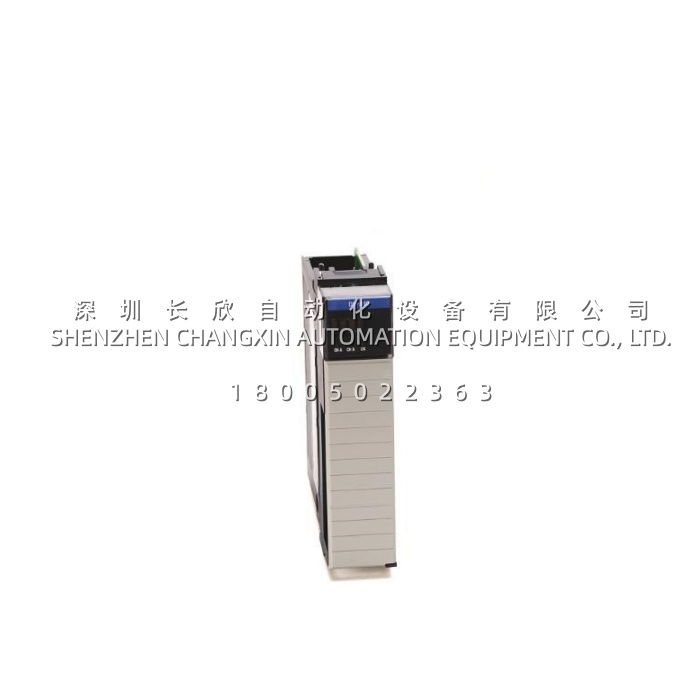
Application Scenarios
Consider a regional water utility operating a network of 14 remote pump stations across a city. Each station has a 1747-ACN15 ControlNet adapter feeding I/O back to a central control room, but the master processor is struggling: the program has grown beyond 1 MB with alarm handling, pump alternation logic, pressure PID loops, and SCADA messaging all competing for scan time. The utility needs more memory and more tasks, but it cannot justify a full DCS replacement—the field wiring, the I/O racks, and the validated logic are all tied to the existing ControlLogix installation.
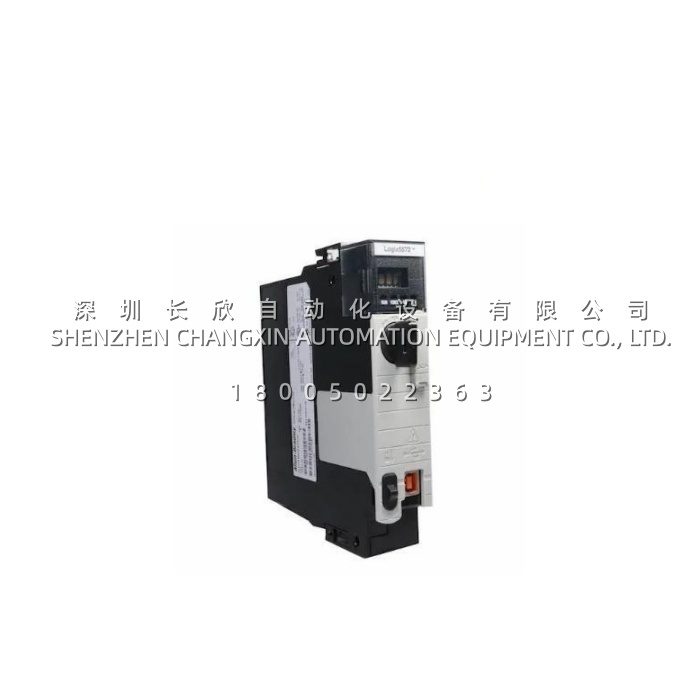
The 1756-L71 is the answer. It drops into the same chassis slot as the older L55 or L61 processor, accepts the converted project file, and immediately provides 2 MB of user memory—roughly four times the capacity of the 1756-L61. The 32-task architecture lets the utility separate the time-critical pump control into its own periodic task with a short interval, while alarm processing and SCADA messaging run at lower priority. The result is a control system that feels new without being replaced: same chassis, same I/O, same wiring, same validation documentation, but with headroom for the next decade of expansion. For the utility, this is the difference between a 2 million DCS project and a 15,000 processor upgrade.
Parameter
| Parameter | Value / Description |
|---|---|
| Product Model | Allen-Bradley 1756-L71 (Logix5571) |
| Manufacturer | Rockwell Automation / Allen-Bradley (USA) |
| Product Category | ControlLogix 5570 PAC Processor / Controller |
| User Memory | 2 MB (2,097,152 bytes) |
| I/O Memory | 0.98 MB (approximately 1,003,796 bytes) |
| Non-Volatile Storage | 1 GB SD card (1784-SD1), upgradeable to 2 GB (1784-SD2) |
| Energy Storage | 1756-ESMCAP supercapacitor module (no battery required) |
| Maximum Digital I/O | 128,000 points |
| Maximum Analog I/O | 4,000 points |
| Motion Axes | Up to 100 (SERCOS II or EtherNet/IP CIP Motion) |
| Tasks | 32 (1 continuous + 31 periodic/event) |
| Programs per Task | Up to 100 |
| Local I/O (Backplane) | Up to 128 modules in local chassis (limited by power budget and slot count) |
| Front Ports | 1 × USB 2.0 (full-speed, local programming and diagnostics) |
| Embedded Ethernet Port | No — requires 1756-EN2T / 1756-EN3TR or similar communication module |
| Display | Front-panel 4-character alphanumeric LCD (status, fault codes, IP octets) |
| Backplane Current Draw | 5 mA @ 1.2 V DC, 800 mA @ 5.1 V DC |
| Power Dissipation | 2.5 W (8.5 BTU/hr thermal dissipation) |
| Isolation Voltage | 30 V continuous (500 V AC / 60 s test) |
| Operating Temperature | 0 °C to +60 °C (32 °F to 140 °F) |
| Storage Temperature | −40 °C to +85 °C |
| Relative Humidity | 5 % to 95 % non-condensing |
| Vibration / Shock | 2 g @ 10–500 Hz; 30 g operational |
| Enclosure / Protection | Open-style, IP20 when installed in cabinet |
| Certifications | UL Listed, CE, RCM, KC, ATEX / IECEx (Zone 2 with appropriate enclosure) |
| Programming Software | Studio 5000 Logix Designer (RSLogix 5000 legacy) |
| IEC Compliance | IEC 61131-3 (LD, FBD, ST, SFC, IL) |
| Lifecycle Status | Active Mature (replacement available, repairable) |
| Standard Warranty | 1 year |
Technical Principles and Innovative Values
Innovation Point 1 – Unified Tag-Based Database Across Disciplines: The 1756-L71 executes one project file that contains discrete logic, process control (PID, sequencing), motion, and safety. All share a common tag database, so a pump speed setpoint defined in a PID loop is directly consumable by a motion axis profile and visible on an HMI without mapping tables or data copying. This is the architectural principle that lets a single controller replace what previously required a PLC, a separate motion controller, and a safety relay bank.
Innovation Point 2 – Battery-Less Program Retention: The 1756-L71 uses the 1756-ESMCAP supercapacitor energy module instead of a lithium battery to retain RAM contents during a power outage. There is no battery to expire, no battery to leak, and no annual preventive maintenance item on the controller. For a plant with 40 controllers across multiple buildings, this eliminates a recurring maintenance task that is easy to forget and expensive when it fails.
Innovation Point 3 – 32-Task Architecture With Event-Driven Execution: The controller supports 32 tasks—one continuous task plus 31 periodic or event tasks—with up to 100 programs per task. A high-speed safety-critical routine can be placed in a periodic task with a 2 ms interval, while a recipe download or report generation runs in an event task that triggers only when needed. This is materially more disciplined than a single scan cycle and is the reason the 1756-L71 can handle both fast control loops and large data-handling routines in the same project.
Innovation Point 4 – 100-Axis Integrated Motion Without a Dedicated Controller: The 1756-L71 coordinates up to 100 axes of SERCOS II or EtherNet/IP CIP Motion. Electronic gearing, electronic camming, flying shear, and synchronous cut-to-length applications can be implemented without a separate motion controller, reducing panel footprint, wiring, and the number of failure points. The motion and discrete logic share a common time base, so synchronization between a conveyor and a servo-driven cutter is exact.
Innovation Point 5 – Full Redundancy Capability: When paired with the 1756-RM redundancy module, synchronized fiber optics, and a second chassis, the 1756-L71 supports dual-chassis redundancy with automatic primary-to-secondary failover. In a water treatment or oil and gas application where an unplanned controller outage means an environmental or safety event, this is not a luxury—it is the defining requirement.