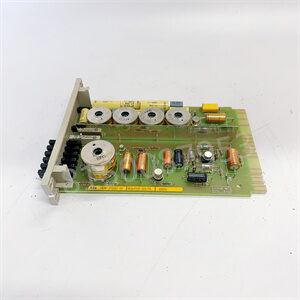
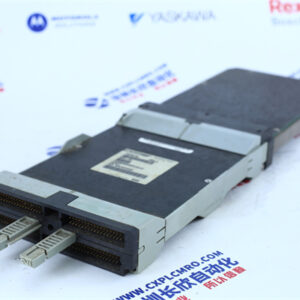
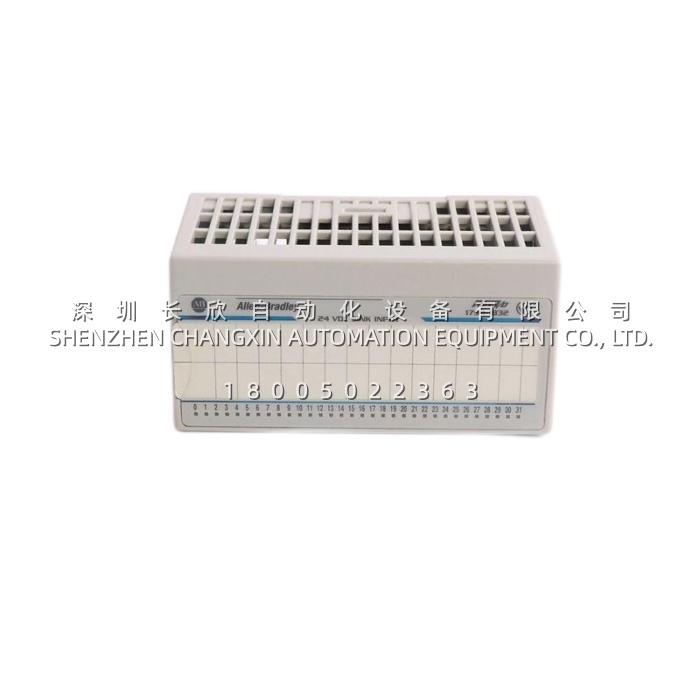
Technical Specifications
| Parameter Name | Parameter Value |
|---|---|
| Product Model | 1747-DCM |
| Manufacturer | Allen-Bradley (Rockwell Automation) |
| Product Type | Direct Communication Module (Remote I/O Scanner) |
| Platform | SLC 500 (1747/1746 I/O) |
| Network Protocol | Allen-Bradley Remote I/O (RIO) |
| Communication Rate | 57.6 kbps |
| Maximum Devices per Network | 32 Remote I/O devices |
| Maximum Cable Length | 10,000 ft (3,048 m) with repeaters |
| Input Data Capacity | 128 words per device |
| Output Data Capacity | 128 words per device |
| Network Media | Shielded twisted-pair (Belden 9463 or equivalent) |
| Connector Type | 3-pin screw terminal (RIO trunk connection) |
| Backplane Current Draw | 1.0 A @ 5V DC |
| Power Dissipation, Max | 5.0 W |
| Isolation (network to backplane) | 500V AC continuous |
| Operating Temperature | 0°C to 60°C (32°F to 140°F) |
| Storage Temperature | -40°C to 85°C (-40°F to 185°F) |
| Certifications | CE, UL, cULus, CSA, ATEX, IECEx, RoHS |
| Dimensions (W x H x D) | 5.7 x 6.6 x 5.8 in (145 x 168 x 147 mm) |
Main Features and Advantages
The 1747-DCM provides a straightforward and cost-effective way to connect an SLC 500 controller to Allen-Bradley’s proven Remote I/O network, enabling communication with a wide range of intelligent field devices without the need for a dedicated communication processor. One of the module’s most compelling advantages is its transparent operation: once the network and data mapping are configured in RSLogix 500, all Remote I/O communication occurs automatically in the background, requiring no communication instructions in the user program and imposing no scan-time overhead on the controller. This allows engineers to focus on the control logic itself while the 1747-DCM handles all low-level network management, error recovery, and data transfer tasks independently.
With support for up to 32 Remote I/O devices on a single network and 128 words of input and output data per device, the 1747-DCM provides generous capacity for medium-sized distributed control systems. A single module can, for example, communicate with multiple PowerFlex drives, PanelView operator terminals, remote I/O racks, barcode scanners, and weight controllers simultaneously, all over a single shielded twisted-pair cable. This concentration of connectivity in one module significantly reduces wiring cost and complexity compared to hardwired discrete I/O, particularly in applications where field devices are distributed across a large facility or where devices must be located hundreds or thousands of feet from the main control panel.
The 1747-DCM also provides robust error handling and diagnostic capabilities that simplify troubleshooting and improve system reliability. The module continuously monitors the health of the Remote I/O network and each connected device, setting status bits in the SLC 500 data table that the control program can use to detect communication faults, identify failed devices, and take appropriate action such as alerting operators or safely shutting down affected equipment. This built-in diagnostics capability, combined with the deterministic nature of the RIO protocol, ensures that communication problems are detected and handled quickly, minimizing the risk of process upsets or unsafe conditions.
Configuration and network management are performed using Rockwell Automation’s RSLogix 500 software, which provides an intuitive graphical interface for defining the Remote I/O network, assigning device addresses, mapping input and output data, and setting communication timeouts. All configuration data is stored in non-volatile memory on the 1747-DCM, meaning that network settings are retained even if power is lost and the module can resume communication immediately upon power-up without requiring a PC connection or manual reconfiguration.
Application Field
The 1747-DCM is deployed in industrial automation applications where reliable communication between an SLC 500 controller and multiple remote intelligent devices is essential to system operation. In manufacturing and discrete automation, the module is commonly used to connect the controller to PowerFlex adjustable frequency drives for motor speed control, PanelView operator terminals for local HMI functionality, and remote 1746/1747 I/O racks for distributed digital and analog I/O. Its support for up to 32 devices and 10,000 feet of cable makes it particularly well-suited to large facilities such as automotive assembly plants, bottling lines, and material handling systems where equipment is spread across a wide area.
In process industries including water treatment, food and beverage, and chemical processing, the 1747-DCM is frequently used to interface the SLC 500 controller with intelligent field instruments such as flow meters, weigh scales, barcode readers, and analytical instruments. These devices often provide critical process data that must be communicated to the controller for monitoring, control, and reporting purposes. The Remote I/O protocol’s deterministic timing and robust error handling make it well-suited to these applications, where data must be exchanged reliably even in electrically noisy industrial environments.
Beyond new installations, the 1747-DCM plays a significant role in system modernization and legacy equipment integration. Many facilities continue to operate SLC 500 controllers and Remote I/O-based devices that have provided reliable service for decades, and the 1747-DCM provides a straightforward way to maintain and extend these systems without requiring a complete control system replacement. Its compatibility with the full range of Allen-Bradley Remote I/O devices also makes it an invaluable tool for phased migrations, allowing facilities to preserve proven field devices and wiring while gradually upgrading the controller and network infrastructure. Whether connecting a handful of drives or building a comprehensive distributed I/O architecture, the 1747-DCM delivers the reliable, deterministic communication that industrial automation systems demand.